Chapter 12 Summary

भक्तियोगः

bhaktiyogaḥ

Chapter 12 in the Middle Section of the Bhagavad Gītā

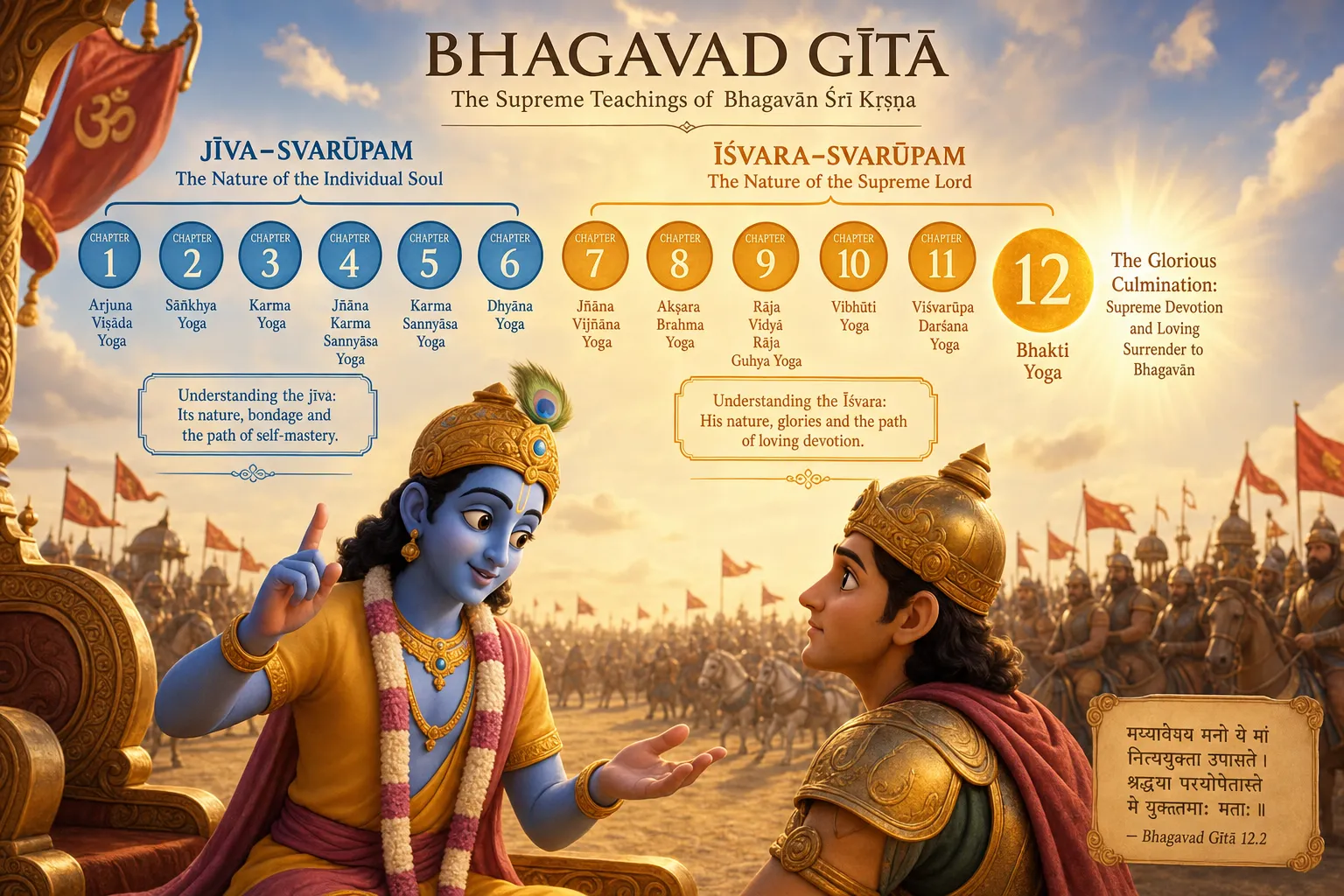
Chapter 12 is the concluding chapter of the madhyama-ṣaṭkam, the middle group of six chapters in the Bhagavad Gītā. The first six chapters, the prathama-ṣaṭkam, primarily deal with jīva-svarūpam, the nature of the individual. Chapters 7 to 12, the madhyama-ṣaṭkam, deal with īśvara-svarūpam, the nature of Bhagavān. Since the nature of Bhagavān has been unfolded from Chapter 7 through Chapter 11, Chapter 12 naturally culminates in bhakti toward that Bhagavān.

This chapter is small, containing only twenty verses, but it is highly significant because it gives a comprehensive picture of the entire Vedic teaching. It is presented as Veda-sāra, the essence of the Vedas. Its importance lies in the fact that it removes many common confusions about bhakti-yoga.

The chapter has two broad divisions. The first part, up to verse 12, deals with bhakti-yoga as a means to mokṣa. The second part, from verses 13 to 20, deals with bhakti-yoga-phalam, the result of bhakti-yoga, namely mokṣa. Thus the chapter first teaches the sādhana and then describes the one who has gained the result.

The Central Clarification: What Bhakti-Yoga Really Means

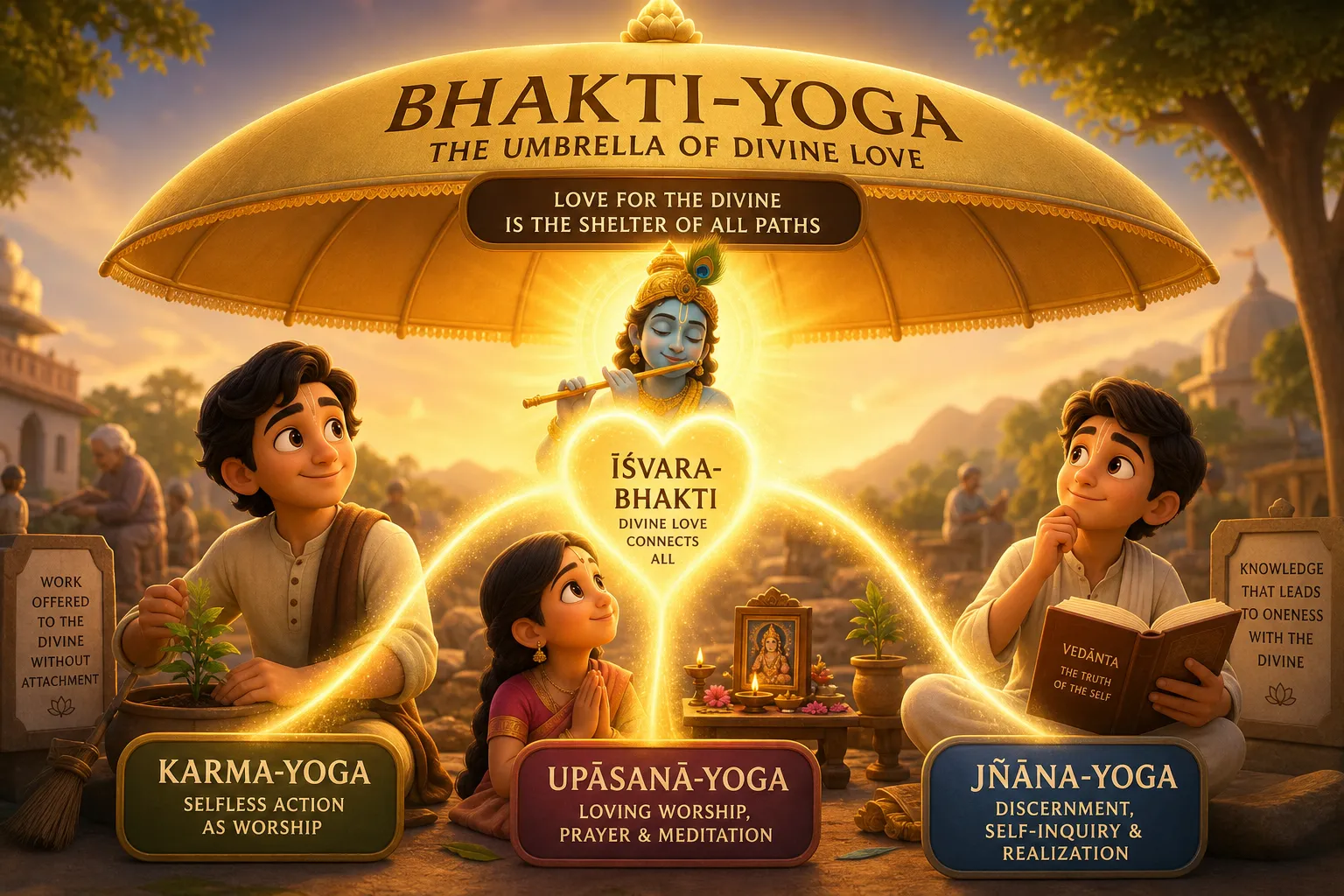
The first major teaching is that bhakti-yoga is not one separate sādhana. It is not merely singing, pūjā, emotional devotion, temple worship, or meditation on a form. Bhakti-yoga is the name for the entire range of spiritual disciplines that culminate in mokṣa.

The Vedas speak of three major spiritual disciplines: karma-yoga, upāsanā-yoga, and jñāna-yoga. The Bhagavad Gītā, being the essence of the Vedas, presents these same three disciplines. In this chapter, these three are collectively called bhakti-yoga.

They are called bhakti-yoga because all three must be practiced in an atmosphere of īśvara-bhakti. Karma, upāsanā, and jñāna become yoga only when they are connected to Bhagavān. Without īśvara-bhakti, these disciplines lose their sacred orientation. Therefore karma-yoga is bhakti-yoga at one level, upāsanā-yoga is bhakti-yoga at another level, and jñāna-yoga is bhakti-yoga at the final level.

Why Three Disciplines Become Five Levels

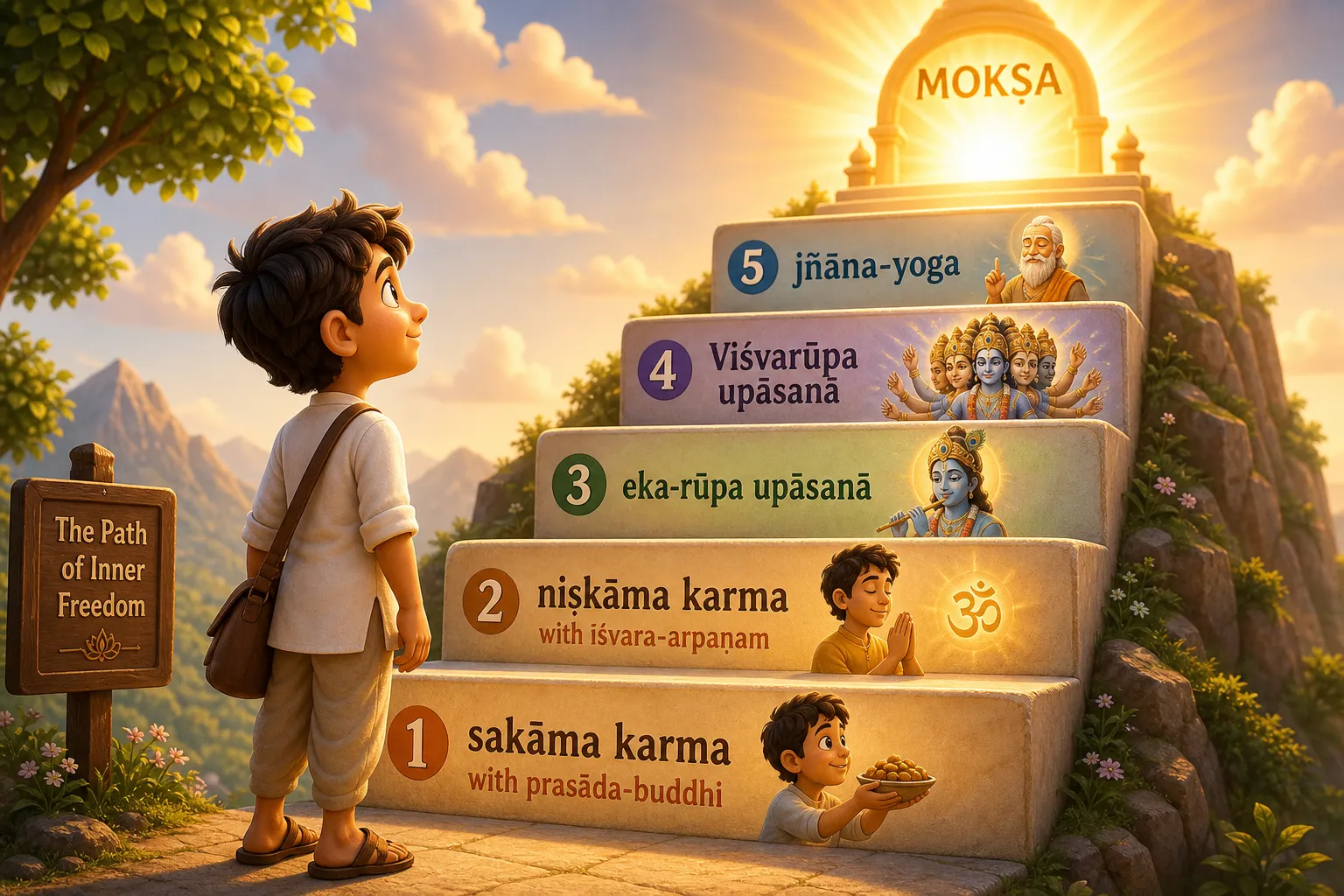
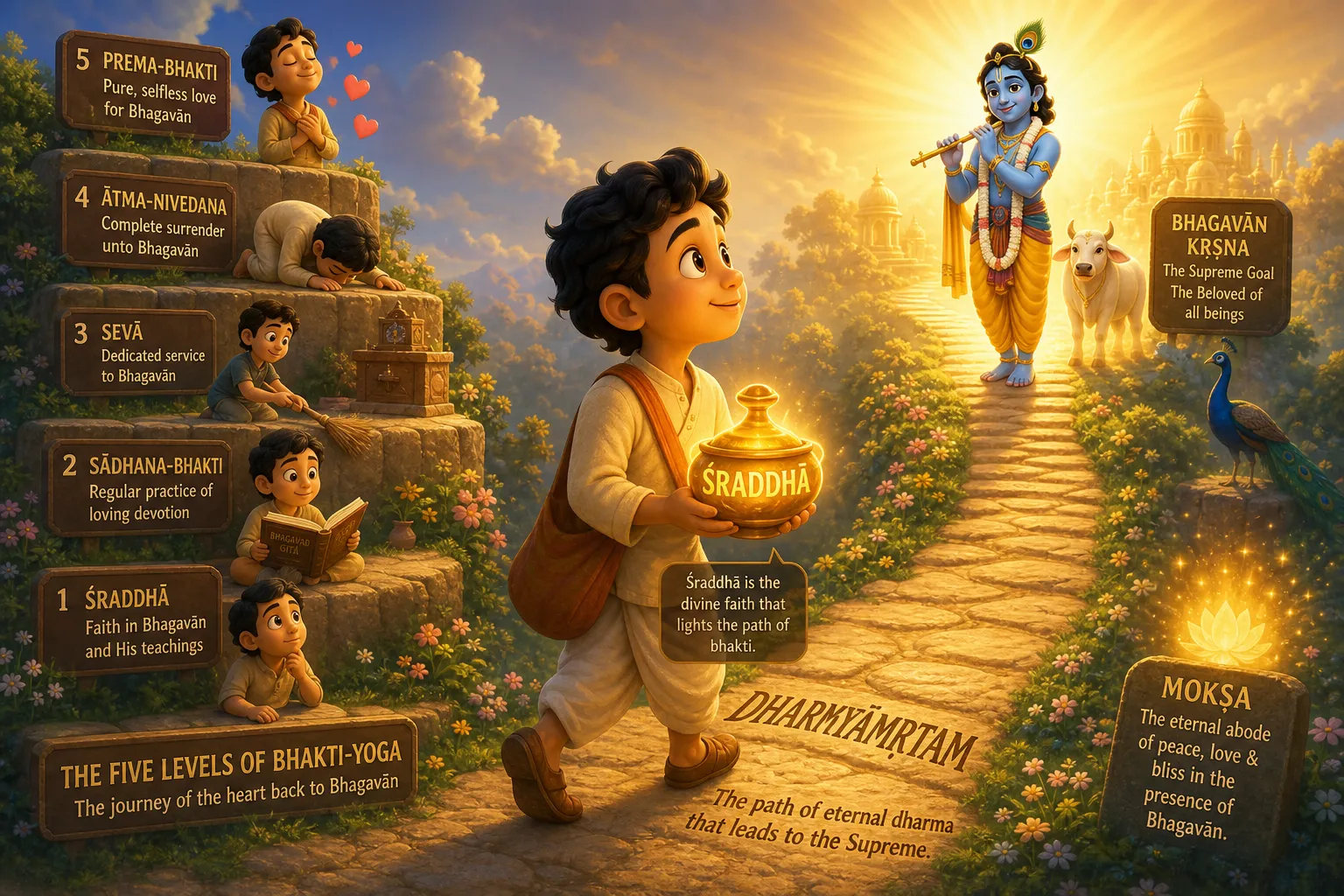
For the benefit of seekers at different levels of maturity, the three disciplines are divided into five levels. Karma-yoga is divided into two levels. Upāsanā-yoga is divided into two levels. Jñāna-yoga remains the fifth and final level. Thus the total path becomes: two levels of karma-yoga, two levels of upāsanā-yoga, and one level of jñāna-yoga.

This division makes the staircase less steep. Not every seeker can begin with subtle inquiry into nirguṇa brahman. Some are still strongly interested in worldly goals. Some are ready for service. Some are ready for meditation. Some are ready for Vedānta. Therefore Bhagavān gives a graded path, so that every seeker can begin from where they are and grow step by step.

Level 1: Sakāma Karma with Prasāda-Buddhi

The first level of karma-yoga accommodates even the materially oriented person. Such a person may not yet be interested in mokṣa, Bhagavān, or service to society. The person may be interested in artha and kāma — money, security, pleasure, comfort, family, house, and enjoyment. The teaching does not begin by demanding immediate renunciation of these desires.

Suppression of desires is considered dangerous. When desires are suppressed without maturity, the mind continues to fantasize about them. They may gather force like a volcano and later disturb the seeker. Therefore the teaching accommodates legitimate desires, but places them within a dhārmic framework.

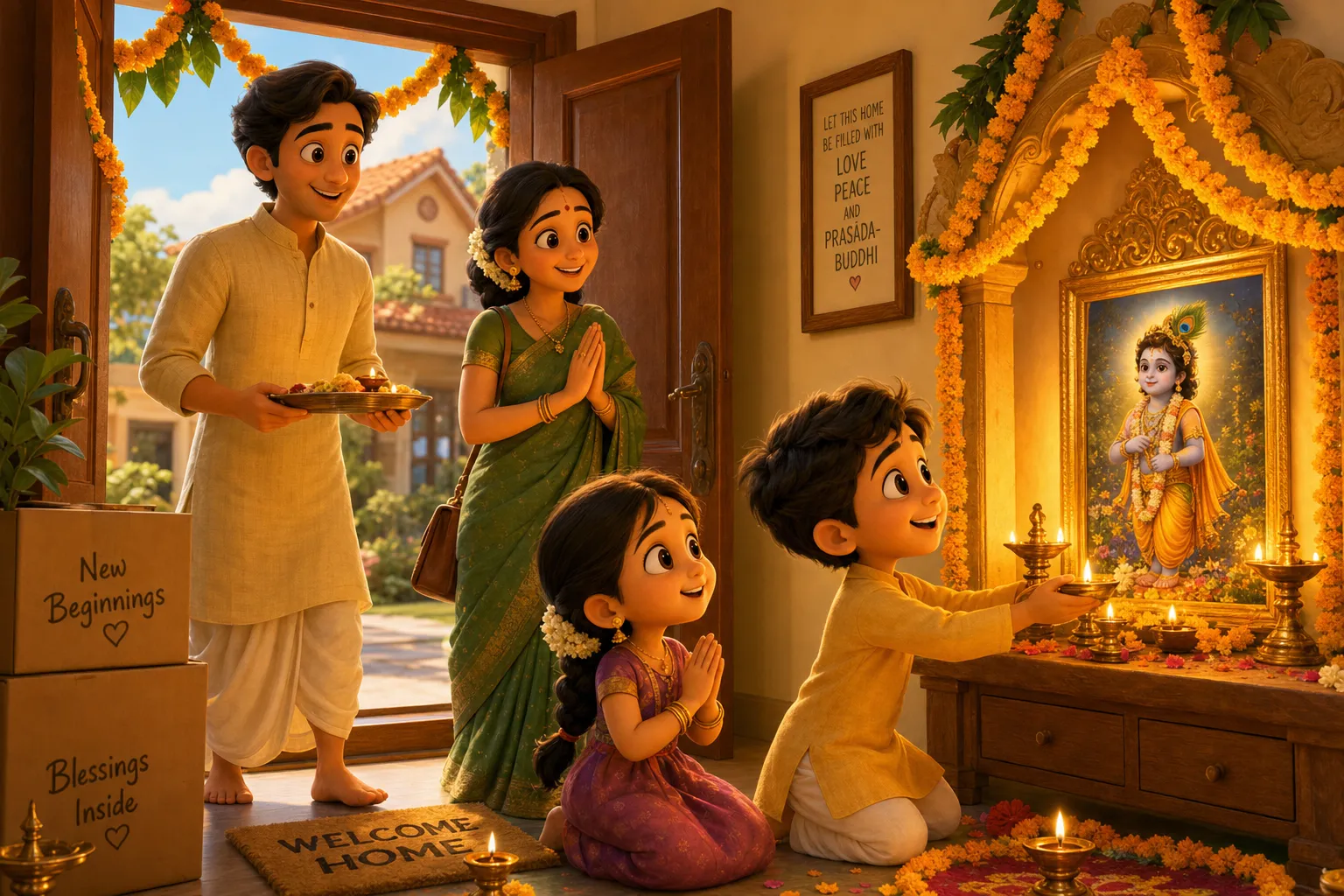
The first condition is: fulfill desires only through legitimate means. Do not follow adharma. The second and more important condition is: when the desired result comes, do not claim it merely as personal accomplishment. Receive it as īśvara-prasāda, Bhagavān’s gift.

A house, car, dress, food, success, or even children should be looked upon as Bhagavān’s prasāda. A new house may be personally desired, personally built, and personally used; still, before enjoying it, dedicate it to Bhagavān. Then the house becomes not merely a residence but an ālaya, a sacred place. Even a kāmya karma gains the capacity to purify the mind when its result is received as Bhagavān’s gift.

This first level may be called prasāda-buddhyā sakāma-karma-anuṣṭhānam. The action may still be for oneself, but the result is received with prasāda-buddhi. This attitude slowly purifies the mind. The person who began with personal desire gradually begins to ask: “Can I spend my whole life only for myself? Should I not contribute something to the world?”

Level 2: Niṣkāma Karma with Īśvara-Arpaṇa-Bhāvanā

When the mind becomes purer, the movement from taking to giving begins. In sakāma karma, the primary desire is to take. In niṣkāma karma, the desire to give also develops. Earlier success was measured by how much one acquired. Now success is measured by how much one has shared.

This is the shift from the materialistic approach to the spiritual approach. In the materialistic approach, success is proportional to acquisition. In the spiritual approach, success is proportional to sharing, contribution, and tyāga.

In this second level, selfish activity gradually decreases, and awareness of others increases. One begins to make time for paropakāra, niṣkāma karma, and pañca-mahā-yajña-rūpa karmāṇi. Giving does not mean only giving money. It includes giving time, giving consoling words, giving knowledge, giving attention, and offering support.

This giving is not done with arrogance. It is done as īśvara-arpaṇam. Therefore the second level of karma-yoga is īśvara-arpaṇa-bhāvanayā niṣkāma-karma-anuṣṭhānam. The first level purifies the mind slowly; the second level purifies the mind faster because selfishness is reduced more directly.

Why Karma-Yoga Alone Is Not Enough

Karma-yoga is essential for purity of mind. Without karma-yoga, spiritual elevation is not possible. Yet karma-yoga has a limitation: it keeps the person active and extroverted. In the first level, one is busy serving oneself. In the second level, one is busy serving society. Both are useful, but both keep the mind moving outward.

Jñāna-yoga requires a mind that can turn inward. Self-inquiry, pañca-kośa-viveka, and Vedāntic contemplation require an inward-looking mind. An extroverted mind misses self-knowledge. Therefore upāsanā-yoga becomes necessary after karma-yoga.

Level 3: Eka-Rūpa Īśvara-Dhyānam

The third level is upāsanā-yoga, meditation upon Bhagavān. The first form of upāsanā is eka-rūpa īśvara-dhyānam. Here the seeker meditates on one chosen form of Bhagavān — Rāma, Kṛṣṇa, Śiva, Devī, Gaṇeśa, or any iṣṭa-devatā. This is also called abhyāsa-yoga.

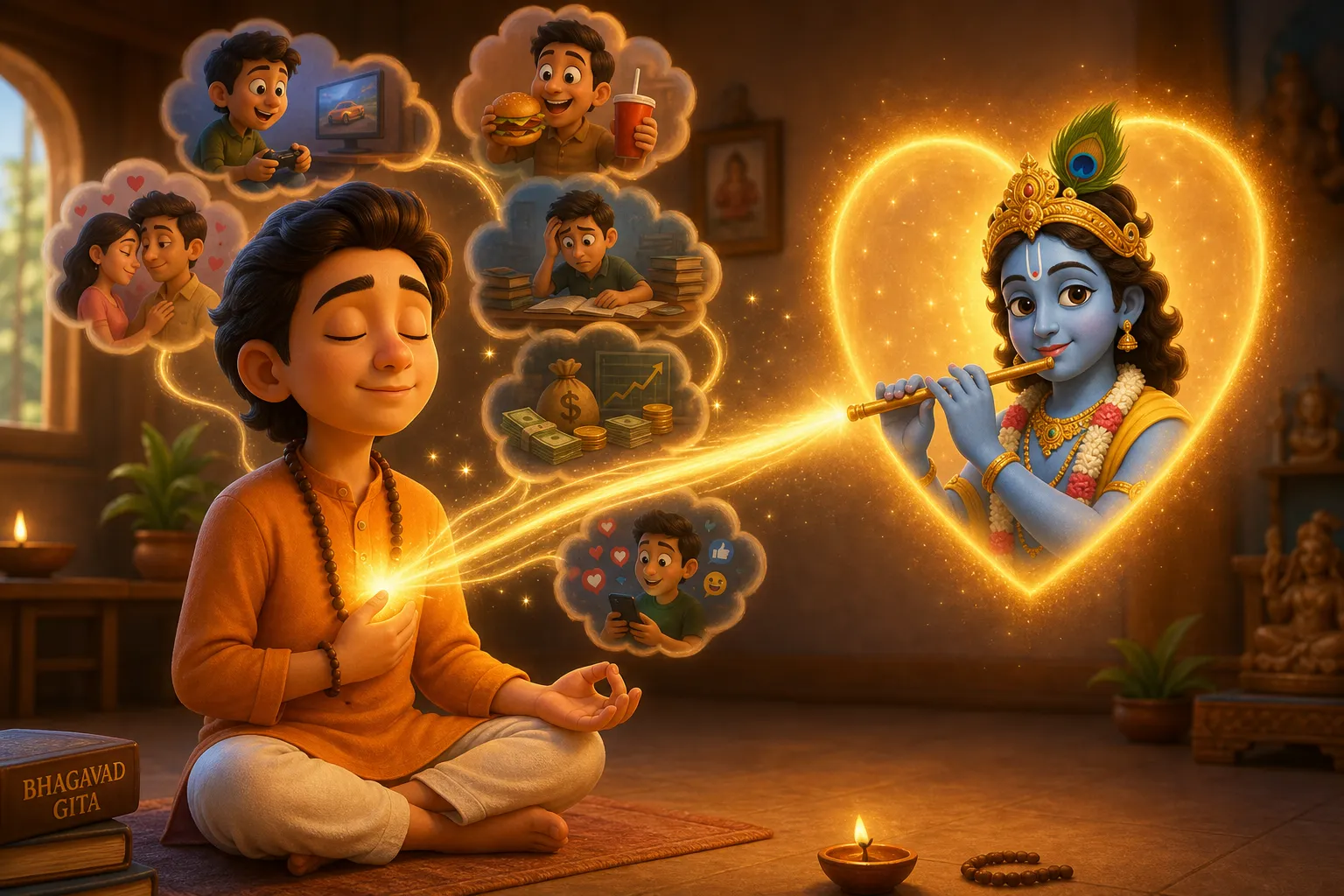
This level trains the mind to become inward. The devotee invokes Bhagavān in the heart and turns attention away from constant external activity. The purpose is not merely emotional devotion; it is mental training. The mind learns steadiness, focus, and inwardness.

Level 4: Aneka-Rūpa or Viśvarūpa Īśvara-Dhyānam

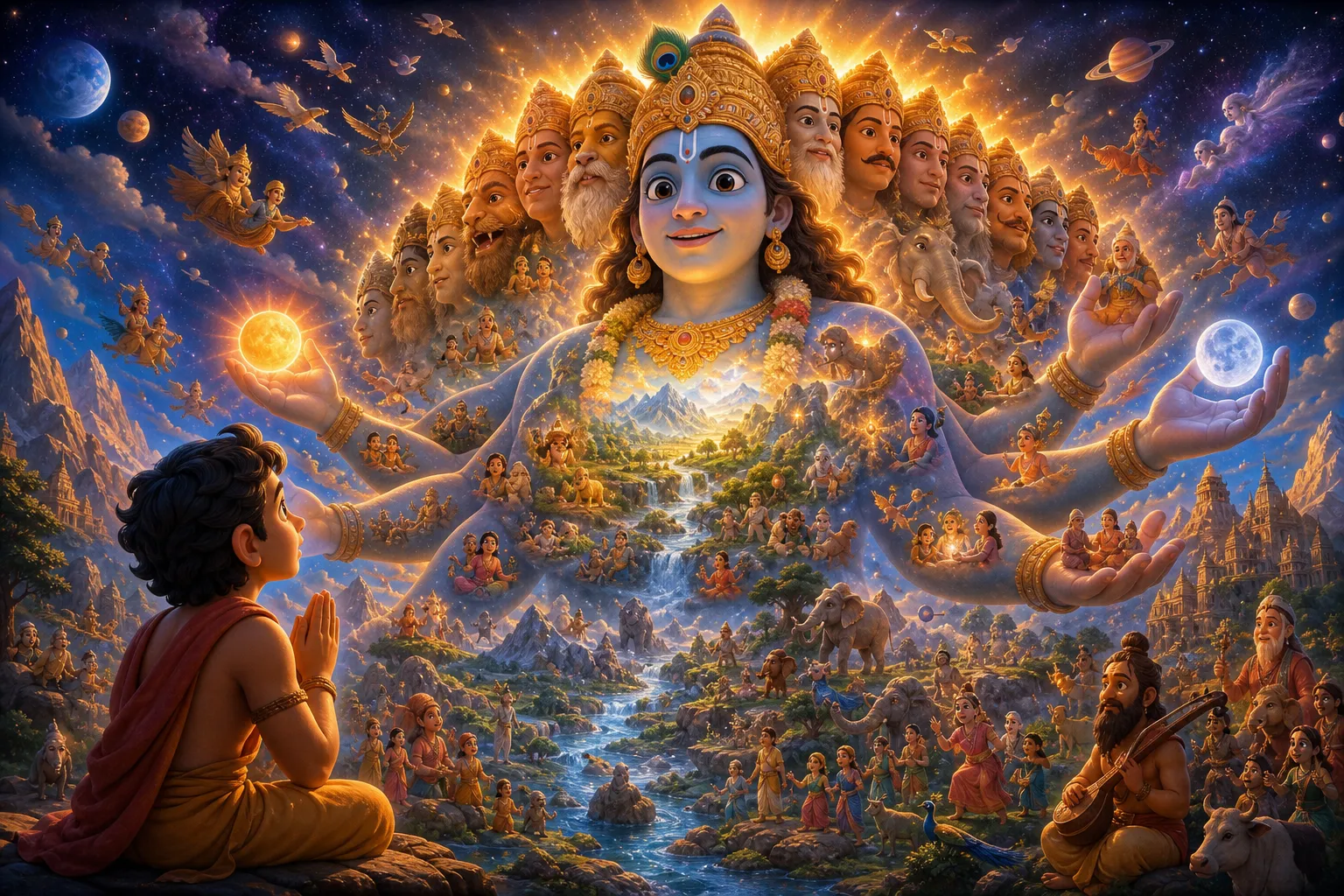
Once the mind has practiced meditation on one form, it must expand. Bhagavān should not be confined to one place, one image, or one limited form. Therefore the next level is aneka-rūpa īśvara-dhyānam, also called Viśvarūpa īśvara-dhyānam.

In this meditation, Bhagavān is appreciated as the entire cosmos. Mountains, rivers, stars, animals, people, elements, laws, events, and all forms become expressions of Bhagavān. The first upāsanā helps in focusing the mind; the second upāsanā helps in expanding the mind. Both are forms of saguṇa īśvara-dhyānam because Bhagavān is still meditated upon with attributes.

Level 5: Jñāna-Yoga

After the two levels of karma-yoga and the two levels of upāsanā-yoga, the seeker gains jñāna-yogyatā, fitness for knowledge. Then the seeker enters the fifth and final level: jñāna-yoga. This is inquiry into nirguṇa īśvara, also called brahman.

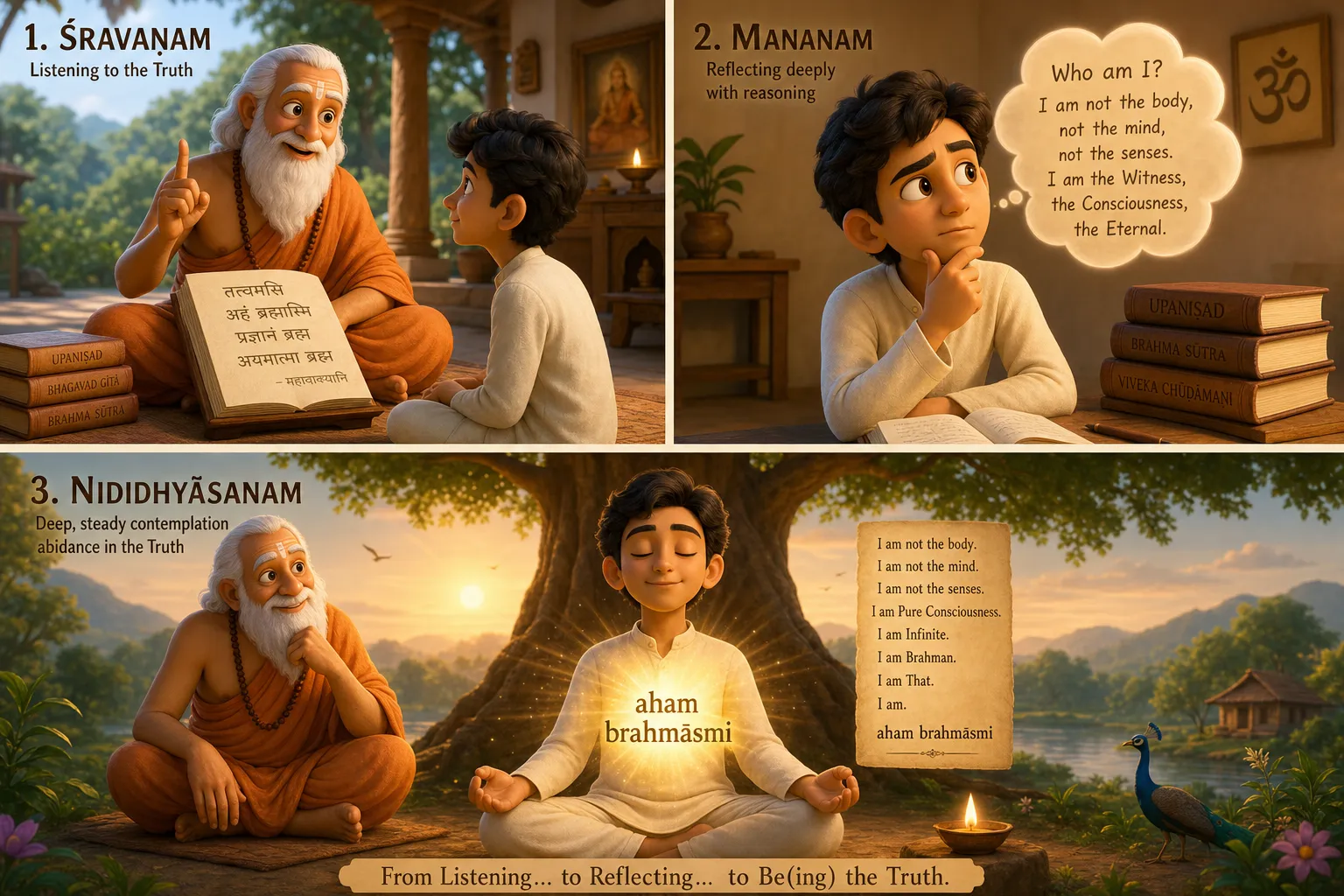
Jñāna-yoga consists of śravaṇam, mananam, and nididhyāsanam. Śravaṇam is consistent and systematic study of the Upaniṣadic teaching. Mananam removes intellectual doubts. Nididhyāsanam removes emotional obstacles and psychological hang-ups that prevent the enjoyment of knowledge.

The culmination of this inquiry is the recognition that nirguṇa īśvara is not different from one’s own higher nature: aham brahmāsmi. At the saguṇa level, the difference between jīva and īśvara is maintained. At the nirguṇa level, the difference disappears.

Nirguṇa īśvara has no form, color, sound, smell, taste, or touch. Therefore, at this level, even the language of “His” or “Her” becomes inadequate. This final level is not meditation on Bhagavān as an object; it is the recognition of brahman as the very Self.

Bhakti-Yoga and Jñāna-Yoga Are Not Separate Paths

A major confusion removed in this chapter is the idea that bhakti-yoga and jñāna-yoga are two separate options. They are not alternatives. Jñāna-yoga is the final level of bhakti-yoga. Upāsanā-yoga is also a level of bhakti-yoga. Karma-yoga is also a level of bhakti-yoga.

Therefore, the question should not be, “Do you follow bhakti-yoga or jñāna-yoga?” Everyone must pass through the appropriate levels. Some rare spiritual prodigies may begin from the fourth or fifth level because they have completed the earlier preparation in a previous birth. Otherwise, the normal journey is step by step: 1, 2, 3, 4, and 5.

Arjuna’s Question: Saguṇa or Nirguṇa?

Chapter 12 begins with Arjuna’s question: Who is superior — the saguṇa upāsaka or the nirguṇa upāsaka? This question arises from the previous teaching, especially the Viśvarūpa teaching of Chapter 11. Arjuna asks whether those who meditate on Bhagavān with form and attributes are superior, or those who meditate on the imperishable unmanifest brahman are superior.

The deeper answer is that the comparison itself is not valid. Comparison makes sense only when there is a choice between two similar alternatives. There can be a choice between coffee and tea, or between two roads, or between two destinations. But there cannot be a choice between road and destination. Saguṇa bhakti and nirguṇa bhakti are like that: one is the means, the other is the culmination.

Saguṇa bhakti is the stepping stone. Nirguṇa bhakti is the final discovery. Without saguṇa bhakti, nirguṇa bhakti is impossible. Without nirguṇa bhakti, saguṇa bhakti is incomplete. Therefore everyone must begin with saguṇa and ultimately discover nirguṇa.

Bhagavān answers Arjuna skillfully. He praises the saguṇa bhakta so that everyone will take to saguṇa bhakti in the beginning. He also says that the nirguṇa bhakta attains Him. The real teaching is that there is no question of choosing one and rejecting the other. The seeker must grow from saguṇa bhakti into nirguṇa jñānam.

The Difficulty of Nirguṇa Contemplation

Nirguṇa brahman is not available to the senses. It cannot be seen, heard, touched, tasted, or smelled. It is also not an object of the mind. It is not merely an idea or concept. Since it cannot be objectified, it can be meditated upon only as the very subject, the meditator. Therefore nirguṇa brahma upāsanā is really ātma-dhyānam.

This is why nirguṇa contemplation is difficult for those with strong body-identification. The more one is attached to the body, the more one is attached to physical security, relatives, possessions, health, comfort, and survival. Such a mind becomes localized and finds it difficult to appreciate the unlocalized, formless reality.

Verses 13–20: The Parā-Bhakta

From verse 13 onward, Bhagavān describes the highest bhakta. This person has gone through all five levels of bhakti-yoga. Since the final level is jñāna-yoga, the highest bhakta is necessarily a jñānī. This person was called sthita-prajña in Chapter 2 and is called parā-bhakta here.

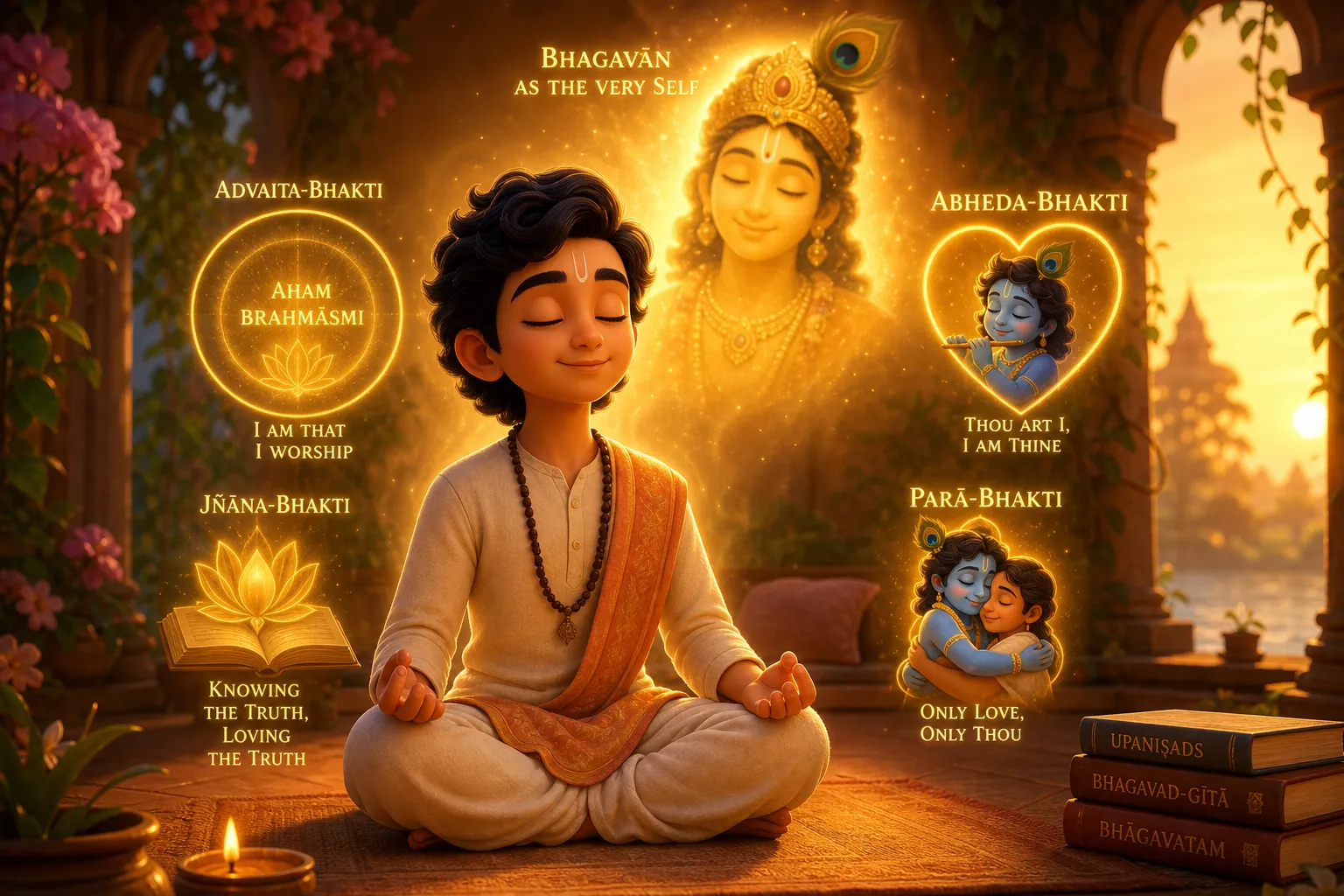
Such a person is also called advaita-bhakta, abheda-bhakta, or jñānī-bhakta. The parā-bhakta has discovered aham brahmāsmi. Bhagavān, in His original nature, is not away from oneself and not different from oneself. Therefore there is no distance between Bhagavān and the jñānī.

The Character of the Parā-Bhakta

The parā-bhakta is free from hatred toward all beings. There is no private list of people one is allowed to hate. Friendliness and compassion naturally arise because the mind is no longer governed by narrow ego. The parā-bhakta is free from possessiveness and ego, balanced in sorrow and joy, forgiving, contented, self-disciplined, and firm in knowledge.

The parā-bhakta is one whose mind and intellect are offered to Bhagavān. The emotional personality and the rational personality are both aligned. Emotionally, Bhagavān may be appreciated as eka-rūpa. Cosmically, Bhagavān is appreciated as aneka-rūpa or Viśvarūpa. Intellectually, Bhagavān is understood as arūpa, nirguṇa brahman.

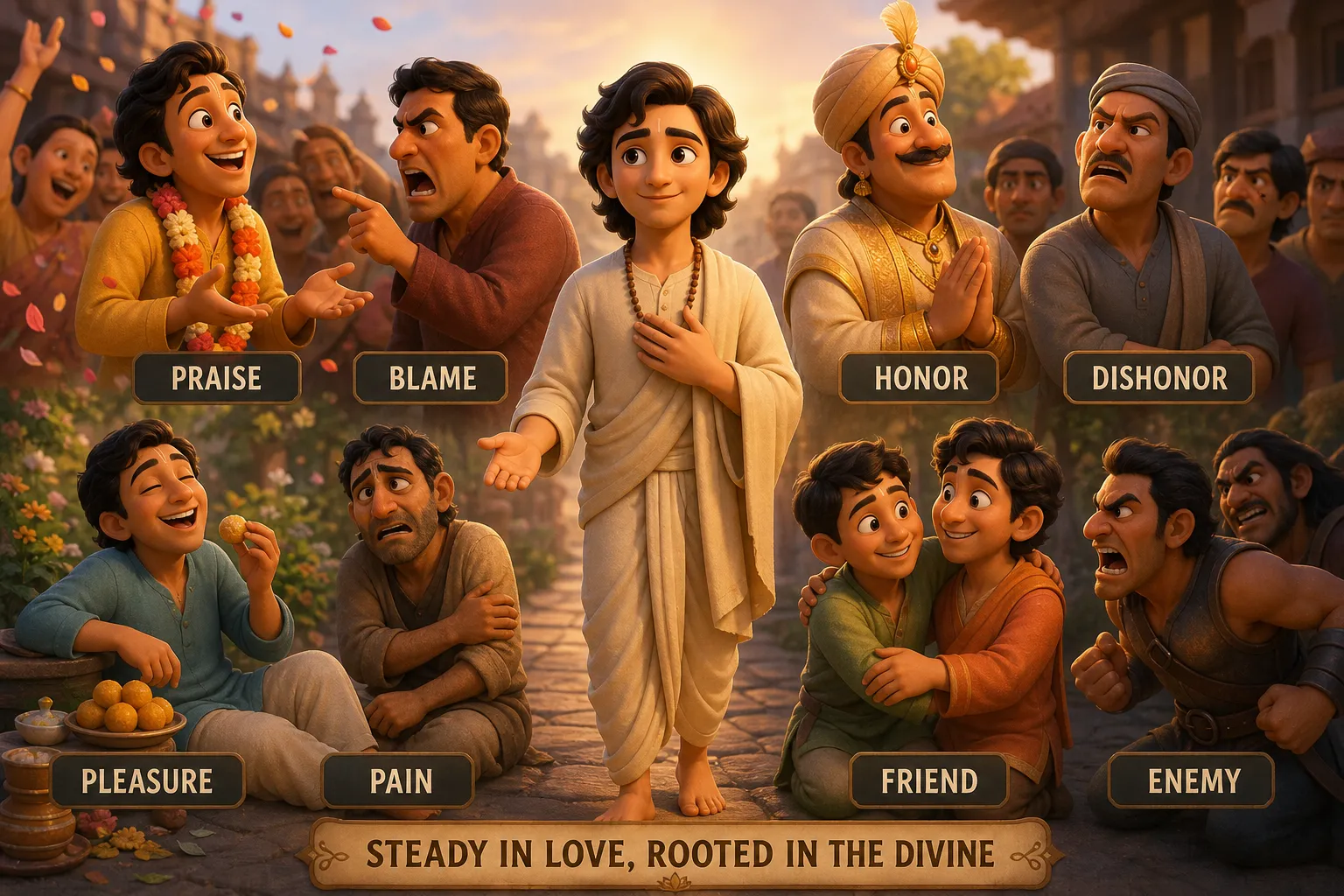
The parā-bhakta does not disturb the world and is not disturbed by the world. The heart is not rock-like and insensitive, nor is it weak and easily wounded. The ideal is a flower-like heart toward others and a diamond-like heart in receiving difficult experiences.

The parā-bhakta is free from elation, envy, fear, anxiety, dependence, expectation, impurity, partiality, sorrow, selfish undertakings, emotional extremes, craving, and hatred. Friend and enemy, honor and dishonor, praise and criticism, heat and cold, pleasure and pain — these pairs continue in life, but they do not shake the one established in knowledge.

Such a person is not trying to become complete through action. Actions may still be performed, but they do not arise from inner incompleteness. The jñānī acts from fullness. If a venture succeeds, the jñānī is pūrṇa. If it fails, the jñānī is pūrṇa. Pūrṇatvam is no longer a destination; it has become a way of life.

The Final Verse: Dharmyāmṛtam

The chapter ends by calling this teaching dharmyāmṛtam. It is dharmya because it is a righteous, valid, scriptural way of life. It is amṛtam because it leads to immortality, freedom from saṁsāra. Therefore Chapter 12 is not merely a chapter on good behavior. It is the full spiritual journey from ordinary desire to mokṣa.

Those who follow this teaching as taught, with śraddhā and with Bhagavān as the supreme goal, are exceedingly dear to Bhagavān. Śraddhā allows the seeker to stay with the teaching long enough for transformation. Matparamāḥ means Bhagavān is not one goal among many; Bhagavān is the final goal.

Complete Chapter 12 Synopsis

Chapter 12 completes the middle section of the Bhagavad Gītā by showing how the knowledge of īśvara-svarūpam must culminate in bhakti. It begins with Arjuna’s question about saguṇa and nirguṇa, and uses that question to unfold the entire meaning of bhakti-yoga.

Bhakti-yoga is the complete spiritual journey. It begins with sakāma karma performed dhārmically and received as īśvara-prasāda. It matures into niṣkāma karma performed as īśvara-arpaṇam. It then turns inward through eka-rūpa upāsanā and expands through Viśvarūpa upāsanā. Finally, it culminates in jñāna-yoga through śravaṇam, mananam, and nididhyāsanam.

The culmination is the discovery of aham brahmāsmi. This is nirguṇa bhakti, advaita bhakti, and parā-bhakti. The highest devotee is the jñānī who has discovered that Bhagavān is not separate from oneself.

The second half of the chapter describes the fragrance of that knowledge. The parā-bhakta is compassionate, steady, free from hatred, free from dependence, free from ego, free from emotional extremes, and established in fullness. This is bhakti-yoga-phalam, the result of the entire path.

Thus Chapter 12 is both a map and a mirror. As a map, it shows the five levels of bhakti-yoga leading to mokṣa. As a mirror, it shows the qualities of the one who has completed the journey. The seeker can locate where they stand, begin from there, and move steadily toward the final recognition: Bhagavān is the highest goal, and in truth, Bhagavān is not away from oneself.