

अर्जुन उवाच ।
ज्यायसी चेत्कर्मणस्ते मता बुद्धिर्जनार्दन ।
तत्किं(ङ्) कर्मणि घोरे मां(न्) नियोजयसि केशव ॥
arjuna uvāca ।
jyāyasī cetkarmaṇaste matā buddhirjanārdana ।
tatkiṁ(ṅ) karmaṇi ghore māṁ(n) niyojayasi keśava ॥
Arjuna asks: “If ātma-jñānam is considered superior to karma, why am I being asked to perform this terrible action of war?”
अर्जुनः arjunaḥ = Arjuna, उवाच uvāca = said, ज्यायसी jyāyasī = superior / better, चेत् cet = if, कर्मणः karmaṇaḥ = than action, ते te = by you / in your view, मता matā = considered / thought, बुद्धिः buddhiḥ = knowledge / understanding, जनार्दन janārdana = O Janārdana, तत् tat = then / therefore, किम् kim = why, कर्मणि karmaṇi = in action, घोरे ghore = terrible / dreadful, माम् mām = me, नियोजयसि niyojayasi = you engage / you impel, केशव keśava = O Keśava
Reflection
◈Where am I comparing two duties or paths only because I want to avoid the harder one?
◈Am I using spiritual ideas like peace, detachment, or knowledge to escape an unpleasant responsibility?

व्यामिश्रेणेव वाक्येन बुद्धिं मोहयसीव मे ।
तदेकं(वँ) वद निश्चित्य येन श्रेयोऽहमाप्नुयाम् ॥
vyāmiśreṇeva vākyena buddhiṁ mohayasīva me ।
tadekaṁ(v) vada niścitya yena śreyo’hamāpnuyām ॥
Arjuna says: “Your words appear to confuse my intellect; therefore please clearly tell me one definite discipline by which I may attain śreyas.”
व्यामिश्रेण vyāmiśreṇa = mixed / confusing, इव iva = as though, वाक्येन vākyena = by statement / by words, बुद्धिम् buddhim = intellect / understanding, मोहयसि mohayasi = you confuse / bewilder, इव iva = as though, मे me = my, तत् tat = therefore / that, एकम् ekam = one / single, वद vada = tell, निश्चित्य niścitya = having decided / ascertained, येन yena = by which, श्रेयः śreyaḥ = the highest good / spiritual good, अहम् aham = I, आप्नुयाम् āpnuyām = may attain
Reflection
◈When a teaching appears confusing, do I ask with humility, or do I quickly blame the teacher, scripture, or situation?
◈Do I want real understanding, or do I only want someone to give me a simple command?

श्रीभगवानुवाच ।
लोकेऽस्मिन्द्विविधा निष्ठा पुरा प्रोक्ता मयानघ ।
ज्ञानयोगेन साङ्ख्यानां(ङ्) कर्मयोगेन योगिनाम् ॥
śrībhagavānuvāca ।
loke’smin dvividhā niṣṭhā purā proktā mayānagha ।
jñānayogena sāṅkhyānāṁ(ṅ) karmayogena yoginām ॥
Bhagavān Kṛṣṇa says that two lifestyles were taught from the beginning: the jñāna-pradhāna life for renunciates and the karma-pradhāna life for active householders.
श्रीभगवान् śrībhagavān = Bhagavān, उवाच uvāca = said, लोके loke = in the world / in this teaching tradition, अस्मिन् asmin = in this, द्विविधा dvividhā = twofold, निष्ठा niṣṭhā = commitment / spiritual discipline, पुरा purā = formerly / in the beginning, प्रोक्ता proktā = taught / declared, मया mayā = by Me, अनघ anagha = O sinless one, ज्ञानयोगेन jñānayogena = by the path of knowledge, साङ्ख्यानाम् sāṅkhyānām = of the contemplatives / seekers of knowledge, कर्मयोगेन karmayogena = by the path of karma-yoga, योगिनाम् yoginām = of the yogins / karma-yogins
Reflection
◈Am I treating karma-yoga and jñāna-yoga as optional paths because I want to avoid one of them?
◈Is my current lifestyle being used for purification, service, and maturity?

न कर्मणामनारम्भात् नैष्कर्म्यं पुरुषोऽश्नुते ।
न च संन्यसनादेव सिद्धिं समधिगच्छति ॥३.४॥
na karmaṇāmanārambhāt naiṣkarmyaṁ puruṣo’śnute ।
na ca sannyasanādeva siddhiṁ samadhigacchati ॥
A person does not attain liberation by merely avoiding action, nor does one attain liberation by mere external renunciation.
न na = not, कर्मणाम् karmaṇām = of actions, अनारम्भात् anārambhāt = from non-commencement / from not beginning, नैष्कर्म्यम् naiṣkarmyam = actionlessness / freedom from action, पुरुषः puruṣaḥ = a person, अश्नुते aśnute = attains, न na = not, च ca = and, संन्यसनात् saṃnyasanāt = from renunciation, एव eva = merely / alone, सिद्धिम् siddhim = perfection / accomplishment, समधिगच्छति samadhigacchati = attains fully
Reflection
◈Am I trying to escape an outer situation without addressing the inner cause of my disturbance?
◈Do I secretly believe that a change of place, role, or appearance will automatically make me spiritual?

न हि कश्चित्क्षणमपि जातु तिष्ठत्यकर्मकृत् ।
कार्यते ह्यवशः(ख्) कर्म सर्वः(फ्) प्रकृतिजैर्गुणैः ॥
na hi kaścitkṣaṇamapi jātu tiṣṭhatyakarmakṛt ।
kāryate hyavaśaḥ(kh) karma sarvaḥ(f) prakṛtijairguṇaiḥ ॥
No one can remain without action even for a moment, because everyone is helplessly made to act by the guṇas born of prakṛti.
न na = not, हि hi = indeed, कश्चित् kaścit = anyone, क्षणम् kṣaṇam = even for a moment, अपि api = even, जातु jātu = at any time / ever, तिष्ठति tiṣṭhati = remains / stays, अकर्मकृत् akarmakṛt = not doing action, कार्यते kāryate = is made to act / is caused to act, हि hi = indeed, अवशः avaśaḥ = helpless / not independent, कर्म karma = action, सर्वः sarvaḥ = everyone, प्रकृतिजैः prakṛtijaiḥ = born of prakṛti, गुणैः guṇaiḥ = by the guṇas
Reflection
◈When I try to be inactive, what kind of activity does my mind immediately run toward?
◈Which guṇa seems to dominate me often — sattva, rajas, or tamas — and how does it shape my actions?

कर्मेन्द्रियाणि संयम्य य आस्ते मनसा स्मरन् ।
इन्द्रियार्थान्विमूढात्मा मिथ्याचारः(स्) स उच्यते ॥
karmendriyāṇi saṁyamya ya āste manasā smaran ।
indriyārthānvimūḍhātmā mithyācāraḥ(s) sa ucyate ॥
One who outwardly restrains the organs of action but mentally dwells on sense objects is deluded and is called a hypocrite.
कर्मेन्द्रियाणि karmendriyāṇi = organs of action, संयम्य saṃyamya = having restrained, यः yaḥ = whoever / he who, आस्ते āste = sits / remains, मनसा manasā = by the mind / mentally, स्मरन् smaran = remembering / dwelling upon, इन्द्रियार्थान् indriyārthān = sense objects, विमूढात्मा vimūḍhātmā = one whose mind is deluded, मिथ्याचारः mithyācāraḥ = hypocrite / one of false conduct, सः saḥ = he, उच्यते ucyate = is called
Reflection
◈Where does my outer behavior look spiritual or restrained, while my mind is still dwelling on the same old desires?
◈Am I trying to suppress a desire without understanding it, regulating it, or growing out of it?

यस्त्विन्द्रियाणि मनसा नियम्यारभतेऽर्जुन ।
कर्मेन्द्रियैः(ख्) कर्मयोगम् असक्तः(स्) स विशिष्यते ॥
yastvindriyāṇi manasā niyamyārabhate’rjuna ।
karmendriyaiḥ(kh) karmayogam asaktaḥ(s) sa viśiṣyate ॥
The one who regulates the sense organs through the mind and performs karma-yoga through the organs of action, without attachment, is superior.
यः yaḥ = he who, तु tu = but, इन्द्रियाणि indriyāṇi = the senses, मनसा manasā = by the mind, नियम्य niyamya = having controlled / restrained, आरभते ārabhate = undertakes / begins, अर्जुन arjuna = O Arjuna, कर्मेन्द्रियैः karmendriyaiḥ = by the organs of action, कर्मयोगम् karmayogam = karma-yoga / the discipline of action, असक्तः asaktaḥ = unattached, सः saḥ = he, विशिष्यते viśiṣyate = is distinguished / excels
Reflection
◈Am I using my present duties as karma-yoga, or am I seeing them only as burdens?
◈Where do I need more regulation in artha, kāma, entertainment, food, speech, or comfort?

नियतं(ङ्) कुरु कर्म त्वं(ङ्) कर्म ज्यायो ह्यकर्मणः ।
शरीरयात्रापि च ते न प्रसिद्ध्येदकर्मणः ॥
niyataṁ(ṅ) kuru karma tvaṁ(ṅ) karma jyāyo hyakarmaṇaḥ ।
śarīrayātrāpi ca te na prasiddhyedakarmaṇaḥ ॥
Perform your prescribed duty, because action is superior to inaction; even the maintenance of your body is not possible through inaction.
नियतम् niyatam = prescribed / obligatory, कुरु kuru = do, कर्म karma = action / duty, त्वम् tvam = you, कर्म karma = action, ज्यायः jyāyaḥ = superior / better, हि hi = indeed, अकर्मणः akarmaṇaḥ = than inaction, शरीरयात्रा śarīrayātrā = bodily maintenance / sustaining the body, अपि api = even, च ca = and, ते te = your / for you, न na = not, प्रसिद्ध्येत् prasiddhyet = would be accomplished / would succeed, अकर्मणः akarmaṇaḥ = from inaction / by inaction
Reflection
◈What is one niyata karma — required duty — that I am avoiding right now?
◈In my daily actions, am I giving more than I take from family, society, and dharma?

यज्ञार्थात्कर्मणोऽन्यत्र लोकोऽयं(ङ्) कर्मबन्धनः ।
तदर्थं(ङ्) कर्म कौन्तेय मुक्तसङ्गः(स्) समाचर ॥
yajñārthātkarmaṇo’nyatra loko’yaṁ(ṅ) karmabandhanaḥ ।
tadarthaṁ(ṅ) karma kaunteya muktasaṅgaḥ(s) samācara ॥
Actions done for yajña liberate; actions done without that offering attitude bind, so perform action for that yajña, free from attachment.
यज्ञार्थात् yajñārthāt = for the sake of yajña / for sacrifice, कर्मणः karmaṇaḥ = from action, अन्यत्र anyatra = other than / apart from, लोकः lokaḥ = the world / person, अयम् ayam = this, कर्मबन्धनः karmabandhanaḥ = bound by action, तदर्थम् tadartham = for that sake / for that purpose, कर्म karma = action / duty, कौन्तेय kaunteya = O son of Kuntī, मुक्तसङ्गः muktasaṅgaḥ = free from attachment, समाचर samācara = perform well / perform properly
Reflection
◈Is my daily work mainly for taking, or is it also a contribution?
◈Which ordinary action can I consciously convert into yajña today?

सहयज्ञाः(फ्) प्रजाः(स्) सृष्ट्वा पुरोवाच प्रजापतिः ।
अनेन प्रसविष्यध्वम् एष वोऽस्त्विष्टकामधुक् ॥
sahayajñāḥ(f) prajāḥ(s) sṛṣṭvā purovāca prajāpatiḥ ।
anena prasaviṣyadhvam eṣa vo’stviṣṭakāmadhuk ॥
Having created human beings along with yajña in the beginning, Prajāpati said: “May you prosper by this yajña; may this be the source of your desired blessings.”
सहयज्ञाः sahayajñāḥ = together with yajña, प्रजाः prajāḥ = beings / people, सृष्ट्वा sṛṣṭvā = having created, पुरा purā = formerly / in the beginning, उवाच uvāca = said, प्रजापतिः prajāpatiḥ = Prajāpati / the Lord of beings, अनेन anena = by this, प्रसविष्यध्वम् prasaviṣyadhvam = may you multiply / may you prosper, एषः eṣaḥ = this, वः vaḥ = for you, अस्तु astu = may it be, इष्टकामधुक् iṣṭakāmadhuk = fulfiller of desired objects
Reflection
◈Am I living mainly as a consumer, or am I consciously contributing back to the order that supports me?
◈Which part of my life can become more yajña-based: food, money, work, family, nature, or study?

देवान्भावयतानेन ते देवा भावयन्तु वः ।
परस्परं भावयन्तः(श्) श्रेयः(फ्) परमवाप्स्यथ ॥
devānbhāvayatānena te devā bhāvayantu vaḥ ।
parasparaṁ bhāvayantaḥ(sh) śreyaḥ(f) paramavāpsyatha ॥
Nourish the devatās through yajña, and may those devatās nourish you; thus, mutually nourishing one another, you shall attain the supreme good.
देवान् devān = the devas, भावयत bhāvayata = nourish / propitiate, अनेन anena = by this, ते te = those, देवाः devāḥ = devas, भावयन्तु bhāvayantu = may they nourish / bless, वः vaḥ = you, परस्परम् parasparam = mutually / one another, भावयन्तः bhāvayantaḥ = nourishing / supporting, श्रेयः śreyaḥ = the highest good / welfare, परम् param = supreme, अवाप्स्यथ avāpsyatha = you will attain
Reflection
◈Do I treat nature mainly as something to use, or as a sacred order to respect and nourish?
◈What nourishes me every day that I may be taking for granted?

इष्टान्भोगान्हि वो देवा(:) दास्यन्ते यज्ञभाविताः ।
तैर्दत्तानप्रदायैभ्यो(यः) यो भुङ्क्ते स्तेन एव सः ॥
iṣṭānbhogānhi vo devā(ḥ) dāsyante yajñabhāvitāḥ ।
tairdattānapradāyaibhyo(aḥ) yo bhuṅkte stena eva saḥ ॥
The devatās, nourished by yajña, give desired enjoyments; one who enjoys their gifts without offering back is indeed a thief.
इष्टान् iṣṭān = desired, भोगान् bhogān = enjoyments / objects of enjoyment, हि hi = indeed, वः vaḥ = to you / for you, देवाः devāḥ = the devas, दास्यन्ते dāsyante = will give, यज्ञभाविताः yajñabhāvitāḥ = nourished by yajña, तैः taiḥ = by them, दत्तान् dattān = given, अप्रदाय apradāya = without offering / without giving back, एभ्यः ebhyaḥ = to these, यः yaḥ = whoever / he who, भुङ्क्ते bhuṅkte = enjoys, स्तेनः stenaḥ = thief, एव eva = indeed / alone, सः saḥ = he
Reflection
◈What blessings do I enjoy every day without consciously thanking Bhagavān or the people and forces that support me?
◈Where am I consuming more than I am contributing?

यज्ञशिष्टाशिनः(स्) सन्तो(तः) मुच्यन्ते सर्वकिल्बिषैः ।
भुञ्जते ते त्वघं पापा(:) ये पचन्त्यात्मकारणात् ॥
yajñaśiṣṭāśinaḥ(s) santo(aḥ) mucyante sarvakilbiṣaiḥ ।
bhuñjate te tvaghaṁ pāpā(ḥ) ye pacantyātmakāraṇāt ॥
Those who partake of what remains after offering to Bhagavān are freed from spiritual obstacles, while those who cook only for themselves consume sin.
यज्ञशिष्टाशिनः yajñaśiṣṭāśinaḥ = those who eat what remains after yajña, सन्तः santaḥ = noble people / good people, मुच्यन्ते mucyante = are freed, सर्वकिल्बिषैः sarvakilbiṣaiḥ = from all sins, भुञ्जते bhuñjate = they enjoy / eat, ते te = they, तु tu = but, अघम् agham = sin, पापाः pāpāḥ = sinful people, ये ye = who, पचन्ति pacanti = cook, आत्मकारणात् ātmakāraṇāt = for their own sake
Reflection
◈Do I usually eat with gratitude, or do I eat as though food is simply mine by right?
◈What result or experience in my life can I receive as īśvara-prasāda instead of immediately judging it as a source of happiness or sorrow?

अन्नाद्भवन्ति भूतानि पर्जन्यादन्नसम्भवः ।
यज्ञाद्भवति पर्जन्यो(यः) यज्ञः(ख्) कर्मसमुद्भवः ॥
annādbhavanti bhūtāni parjanyādannasambhavaḥ ।
yajñādbhavati parjanyo(aḥ) yajñaḥ(kh) karmasamudbhavaḥ ॥
Beings are born from food; food comes from rain; rain comes from yajña; and yajña arises from karma.
अन्नात् annāt = from food, भवन्ति bhavanti = are born / come into being, भूतानि bhūtāni = beings, पर्जन्यात् parjanyāt = from rain, अन्नसम्भवः annasambhavaḥ = the arising of food / production of food, यज्ञात् yajñāt = from yajña, भवति bhavati = comes / arises, पर्जन्यः parjanyaḥ = rain, यज्ञः yajñaḥ = yajña / sacrifice, कर्मसमुद्भवः karmasamudbhavaḥ = born of action / having action as its source
Reflection
◈When I eat, do I remember the whole chain — rain, soil, farmers, animals, society, and Bhagavān’s order?
◈Which daily action of mine supports the yajña-cycle, and which action may be disturbing it?

कर्म ब्रह्मोद्भवं(वँ) विद्धि ब्रह्माक्षरसमुद्भवम् ।
तस्मात्सर्वगतं ब्रह्म नित्यं(यँ) यज्ञे प्रतिष्ठितम् ॥
karma brahmodbhavaṁ(v) viddhi brahmākṣarasamudbhavam ।
tasmātsarvagataṁ brahma nityaṁ(y) yajñe pratiṣṭhitam ॥
Know that karma is born of the Veda, the Veda is born of Bhagavān, and therefore the all-pervading Veda is ever established in yajña.
कर्म karma = action, ब्रह्मोद्भवम् brahmodbhavam = born of Brahma / born of the Veda, विद्धि viddhi = know, ब्रह्म brahma = Brahma / the Veda, अक्षरसमुद्भवम् akṣarasamudbhavam = born of the imperishable, तस्मात् tasmāt = therefore, सर्वगतम् sarvagatam = all-pervading, ब्रह्म brahma = Brahma / the Veda, नित्यम् nityam = always, यज्ञे yajñe = in yajña, प्रतिष्ठितम् pratiṣṭhitam = established
Reflection
◈Am I allowing śāstra to guide my idea of right action, or am I relying only on personal convenience?
◈Where in my life is the Vedic spirit of yajña alive — in giving, sharing, serving, studying, or offering?

एवं प्रवर्तितं(ञ्) चक्रं(न्) नानुवर्तयतीह यः ।
अघायुरिन्द्रियारामो(मः) मोघं पार्थ स जीवति ॥
evaṁ pravartitaṁ(ñ) cakraṁ(n) nānuvartayatīha yaḥ ।
aghāyurindriyārāmo(aḥ) moghaṁ pārtha sa jīvati ॥
O Pārtha, one who does not follow this divinely initiated cycle of giving and receiving, and lives only in sense enjoyment, lives a sinful and wasted life.
एवम् evam = thus / in this way, प्रवर्तितम् pravartitam = set in motion, चक्रम् cakram = wheel / cycle, न na = does not, अनुवर्तयति anuvartayati = follows / lives in accordance with, इह iha = here / in this world, यः yaḥ = who / whoever, अघायुः aghāyuḥ = one whose life is sinful, इन्द्रियारामः indriyārāmaḥ = one who delights in the senses, मोघम् mogham = vainly / uselessly, पार्थ pārtha = O Pārtha, सः saḥ = he, जीवति jīvati = lives
Reflection
◈Do I measure success more by what I possess or by what I contribute?
◈Where am I receiving from the cycle of life but not giving back proportionately?

यस्त्वात्मरतिरेव स्यात् आत्मतृप्तश्च मानवः ।
आत्मन्येव च सन्तुष्टः(स्) तस्य कार्यं(न्) न विद्यते ॥
yastvātmaratireva syāt ātmatṛptaśca mānavaḥ ।
ātmanyeva ca santuṣṭaḥ(s) tasya kāryaṁ(n) na vidyate ॥
But for the one who delights in the Self, is fulfilled by the Self, and is content in the Self alone, there is no duty to be accomplished for fulfillment.
यः yaḥ = who / whoever, तु tu = but, आत्मरतिः ātmaratiḥ = one who delights in the Self, एव eva = alone / indeed, स्यात् syāt = may be / would be, आत्मतृप्तः ātmatṛptaḥ = satisfied by the Self, च ca = and, मानवः mānavaḥ = person / human being, आत्मनि ātmani = in the Self, एव eva = alone, च ca = and, सन्तुष्टः santuṣṭaḥ = content, तस्य tasya = for him / of him, कार्यम् kāryam = duty / thing to be done, न na = not, विद्यते vidyate = exists / is found
Reflection
◈Am I acting mainly for inner completion, or can I slowly learn to act as an offering while seeking fullness through Self-knowledge?
◈What object, relationship, achievement, or role am I treating as the source of my security or happiness?

नैव तस्य कृतेनार्थो(:) नाकृतेनेह कश्चन ।
न चास्य सर्वभूतेषु कश्चिदर्थव्यपाश्रयः ॥३.१८॥
naiva tasya kṛtenārtho(aḥ) nākṛteneha kaścana ।
na cāsya sarvabhūteṣu kaścidarthavyapāśrayaḥ ॥
For the Self-fulfilled jñānī, there is nothing to gain through action, nothing to lose through inaction, and no dependence on any being for any purpose.
न na = not, एव eva = indeed / at all, तस्य tasya = for him / of him, कृतेन kṛtena = by what is done, अर्थः arthaḥ = purpose / gain, न na = not, अकृतेन akṛtena = by what is not done, इह iha = here / in this world, कश्चन kaścana = any, न na = not, च ca = and, अस्य asya = for him / of him, सर्वभूतेषु sarvabhūteṣu = among all beings, कश्चित् kaścit = any, अर्थव्यपाश्रयः arthavyapāśrayaḥ = dependence for any purpose / dependence for gain
Reflection
◈Am I more dependent on action, always needing to be busy, or on inaction, avoiding what needs to be done?
◈What person, role, object, or result have I turned from a luxury into a necessity?

तस्मादसक्तः(स्) सततं(ङ्) कार्यं(ङ्) कर्म समाचर ।
असक्तो ह्याचरन्कर्म परमाप्नोति पूरुषः ॥
tasmādasaktaḥ(s) satataṁ(ṅ) kāryaṁ(ṅ) karma samācara ।
asakto hyācarankarma paramāpnoti pūruṣaḥ ॥
Therefore, always perform the duty that must be done, without attachment; for by performing action without attachment, a person ultimately attains mokṣa.
तस्मात् tasmāt = therefore, असक्तः asaktaḥ = unattached, सततम् satatam = constantly / always, कार्यम् kāryam = obligatory / to be done, कर्म karma = action / duty, समाचर samācara = perform properly, असक्तः asaktaḥ = unattached, हि hi = indeed, आचरन् ācaran = performing / practising, कर्म karma = action / duty, परम् param = the supreme / highest, आप्नोति āpnoti = attains, पूरुषः pūruṣaḥ = person / human being
Reflection
◈What is one kāryam karma — duty that must be done — that I am avoiding because it feels unpleasant?
◈When I act, am I present with the duty, or am I lost in anxiety about the future and brooding over the past?

कर्मणैव हि संसिद्धिम् आस्थिता जनकादयः ।
लोकसङ्ग्रहमेवापि सम्पश्यन्कर्तुमर्हसि ॥
karmaṇaiva hi saṁsiddhim āsthitā janakādayaḥ ।
lokasaṅgrahamevāpi sampaśyankartumarhasi ॥
Janaka and others attained liberation while remaining in a life of duty; therefore, even considering the welfare of society, you ought to act.
कर्मणा karmaṇā = by action, एव eva = alone / indeed, हि hi = indeed, संसिद्धिम् saṃsiddhim = perfection / complete accomplishment, आस्थिताः āsthitāḥ = attained / reached, जनकादयः janakādayaḥ = Janaka and others, लोकसङ्ग्रहम् lokasaṅgraham = welfare / stability of the world, एव eva = even / indeed, अपि api = also, सम्पश्यन् sampaśyan = seeing / considering, कर्तुम् kartum = to do / to perform, अर्हसि arhasi = you ought / you should
Reflection
◈Am I treating my responsibilities as obstacles to spirituality, or as opportunities for karma-yoga?
◈Who learns from my actions — children, family, students, colleagues, community — and what am I teaching them through my conduct?
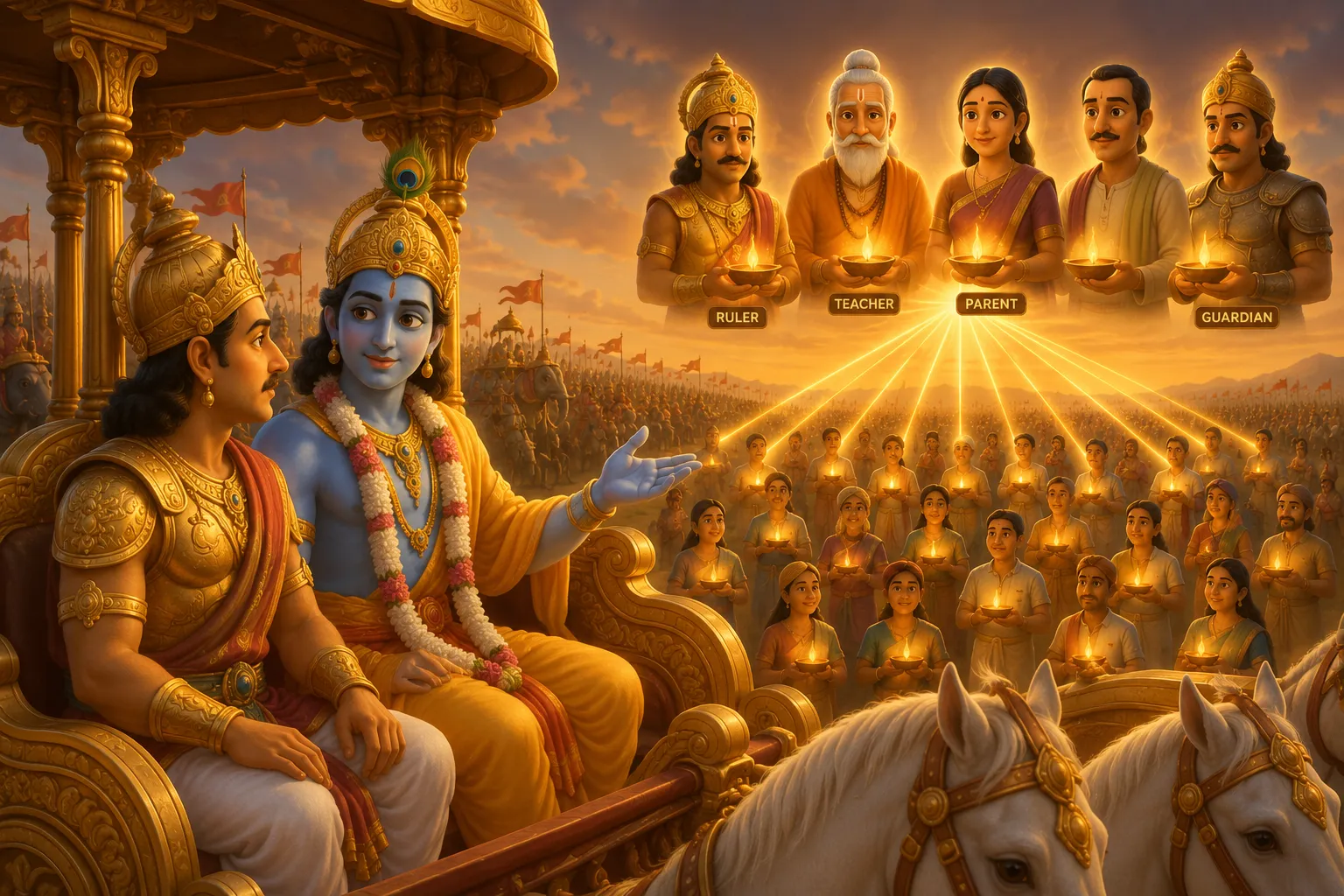
यद्यदाचरति श्रेष्ठः(स्) तत्तदेवेतरो जनः ।
स यत्प्रमाणं(ङ्) कुरुते लोकस्तदनुवर्तते ॥
yadyadācarati śreṣṭhaḥ(s) tattadevetaro janaḥ ।
sa yatpramāṇaṁ(ṅ) kurute lokastadanuvartate ॥
Whatever a respected person does, others imitate; whatever standard such a person sets, the world follows.
यत् yat = whatever, यत् yat = whatever, आचरति ācarati = does / practises, श्रेष्ठः śreṣṭhaḥ = the best person / noble person, तत् tat = that, तत् tat = that, एव eva = indeed / exactly, इतरः itaraḥ = other, जनः janaḥ = person / people, सः saḥ = he, यत् yat = whatever, प्रमाणम् pramāṇam = standard / authority, कुरुते kurute = makes / establishes, लोकः lokaḥ = the world / people, तत् tat = that, अनुवर्तते anuvartate = follows
Reflection
◈Who may be learning from my conduct — children, family, students, colleagues, friends, or community?
◈If someone copied my speech, habits, money-handling, anger, devotion, and discipline, would they become better?

न मे पार्थास्ति कर्तव्यं(न्) त्रिषु लोकेषु किञ्चन ।
नानवाप्तमवाप्तव्यं(वँ) वर्त एव च कर्मणि ॥
na me pārthāsti kartavyaṁ(n) triṣu lokeṣu kiñcana ।
nānavāptamavāptavyaṁ(v) varte eva ca karmaṇi ॥
O Pārtha, I have nothing to accomplish in all three worlds, and nothing unattained to attain; still, I remain engaged in action.
न na = not, मे me = for me / of me, पार्थ pārtha = O Pārtha, अस्ति asti = exists / is, कर्तव्यम् kartavyam = duty / something to be done, त्रिषु triṣu = in the three, लोकेषु lokeṣu = worlds, किञ्चन kiñcana = anything whatsoever, न na = not, अनवाप्तम् anavāptam = unattained, अवाप्तव्यम् avāptavyam = to be attained, वर्ते varte = I engage / I remain active, एव eva = indeed / still, च ca = and, कर्मणि karmaṇi = in action
Reflection
◈Do I act only when I personally gain something, or can I act because dharma requires it?
◈Where do I use “I don’t need this” as an excuse to avoid responsibility?

यदि ह्यहं(न्) न वर्तेयं(ञ्) जातु कर्मण्यतन्द्रितः ।
मम वर्त्मानुवर्तन्ते मनुष्याः(फ्) पार्थ सर्वशः ॥
yadi hyahaṁ(n) na varteyaṁ(ñ) jātu karmaṇyatandritaḥ ।
mama vartmānuvartante manuṣyāḥ(f) pārtha sarvaśaḥ ॥
O Pārtha, if I were ever not tirelessly engaged in action, people would follow my path in every way.
यदि yadi = if, हि hi = indeed, अहम् aham = I, न na = not, वर्तेयम् varteyam = would remain / would engage, जातु jātu = at any time / ever, कर्मणि karmaṇi = in action, अतन्द्रितः atandritaḥ = alert / unwearied, मम mama = my, वर्त्म vartma = path / way, अनुवर्तन्ते anuvartante = follow, मनुष्याः manuṣyāḥ = people / human beings, पार्थ pārtha = O Pārtha, सर्वशः sarvaśaḥ = in every way / entirely
Reflection
◈Where am I being watched by others, and what are they learning from my conduct?
◈Am I atandritaḥ — alert and careful — in the duties that others may imitate?

उत्सीदेयुरिमे लोका(:) न कुर्यां(ङ्) कर्म चेदहम् ।
सङ्करस्य च कर्ता स्याम् उपहन्यामिमाः(फ्) प्रजाः ॥
utsīdeyurime lokā(ḥ) na kuryāṁ(ṅ) karma cedaham ।
saṅkarasya ca kartā syām upahanyāmimāḥ(f) prajāḥ ॥
If I did not perform action, these worlds would decline; I would become the cause of confusion and would destroy these people.
उत्सीदेयुः utsīdeyuḥ = would perish / would decline, इमे ime = these, लोकाः lokāḥ = worlds / people, न na = not, कुर्याम् kuryām = I would do / I would perform, कर्म karma = action / duty, चेत् cet = if, अहम् aham = I, सङ्करस्य saṅkarasya = of confusion / disorder, च ca = and, कर्ता kartā = maker / cause, स्याम् syām = I would be, उपहन्याम् upahanyām = I would destroy / harm, इमाः imāḥ = these, प्रजाः prajāḥ = beings / people
Reflection
◈Where might my neglect of duty create confusion or difficulty for others?
◈Am I setting a clear dhārmic example in the roles I already have?

सक्ताः(ख्) कर्मण्यविद्वांसो(सः) यथा कुर्वन्ति भारत ।
कुर्याद्विद्वांस्तथासक्तः(श्) चिकीर्षुर्लोकसंग्रहम् ॥
saktāḥ(kh) karmaṇyavidvāṁso(aḥ) yathā kurvanti bhārata ।
kuryādvidvāṁstathāsaktaḥ(ś) cikīrṣurlokasaṅgraham ॥
O Bhārata, just as the ignorant act with attachment, the wise should also act outwardly, but without attachment, wishing to protect and guide society.
सक्ताः saktāḥ = attached, कर्मणि karmaṇi = to action / in action, अविद्वांसः avidvāṃsaḥ = ignorant people / those without knowledge, यथा yathā = as / just as, कुर्वन्ति kurvanti = do / perform, भारत bhārata = O Bhārata, कुर्यात् kuryāt = should do / should perform, विद्वान् vidvān = the wise person, तथा tathā = so / in that way, असक्तः asaktaḥ = unattached, चिकीर्षुः cikīrṣuḥ = wishing to do / wishing to accomplish, लोकसङ्ग्रहम् lokasaṅgraham = welfare / protection / cohesion of the world
Reflection
◈Where am I doing the right action outwardly, but with attachment, anxiety, or hunger for recognition inwardly?
◈In one role I already have, how can I act more for lokasaṅgraha — the welfare and guidance of others?

न बुद्धिभेदं(ञ्) जनयेत् अज्ञानां(ङ्) कर्मसङ्गिनाम् ।
जोषयेत्सर्वकर्माणि विद्वान्युक्तः(सः) समाचरन् ॥
na buddhibhedaṁ(ñ) janayet ajñānāṁ(ṅ) karmasaṅginām ।
joṣayetsarvakarmāṇi vidvānyuktaḥ(s) samācaran ॥
The wise should not unsettle the minds of ignorant people attached to action, but should encourage them to perform all appropriate actions while themselves acting with steadiness.
न na = not, बुद्धिभेदम् buddhibhedam = confusion / disturbance of understanding, जनयेत् janayet = should produce / should cause, अज्ञानाम् ajñānām = of the ignorant, कर्मसङ्गिनाम् karmasaṅginām = of those attached to action, जोषयेत् joṣayet = should encourage / should engage, सर्वकर्माणि sarvakarmāṇi = all actions, विद्वान् vidvān = the wise person, युक्तः yuktaḥ = disciplined / integrated, समाचरन् samācaran = performing properly / practising well
Reflection
◈Do I ever use spiritual ideas to dismiss or discourage practices that are actually helping someone grow?
◈When guiding others, do I speak according to their maturity, or according to what I want to display?

प्रकृतेः(ख्) क्रियमाणानि गुणैः(ख्) कर्माणि सर्वशः ।
अहङ्कारविमूढात्मा कर्ताहमिति मन्यते ॥
prakṛteḥ(kh) kriyamāṇāni guṇaiḥ(kh) karmāṇi sarvaśaḥ ।
ahaṅkāravimūḍhātmā kartāhamiti manyate ॥
All actions are performed by the guṇas of prakṛti, but the one deluded by ahaṅkāra thinks, “I am the doer.”
प्रकृतेः prakṛteḥ = of prakṛti / of nature, क्रियमाणानि kriyamāṇāni = being done / being performed, गुणैः guṇaiḥ = by the guṇas, कर्माणि karmāṇi = actions, सर्वशः sarvaśaḥ = in every way / entirely, अहङ्कारविमूढात्मा ahaṅkāravimūḍhātmā = one whose mind is deluded by ego, कर्ता kartā = doer, अहम् aham = I, इति iti = thus, मन्यते manyate = thinks / imagines
Reflection
◈Where do I strongly feel, “I alone am doing everything,” and therefore carry unnecessary pressure?
◈Can I notice one emotion today as a movement in the mind rather than saying, “This is me”?

तत्त्ववित्तु महाबाहो गुणकर्मविभागयोः ।
गुणा गुणेषु वर्तन्ते इति मत्वा न सज्जते ॥
tattvavittu mahābāho guṇakarmavibhāgayoḥ ।
guṇā guṇeṣu vartante iti matvā na sajjate ॥
O mighty-armed Arjuna, the knower of truth understands the distinction between the guṇas and their actions, and knowing that guṇas interact with guṇas, remains unattached.
तत्त्ववित् tattvavit = knower of the truth, तु tu = but, महाबाहो mahābāho = O mighty-armed one, गुणकर्मविभागयोः guṇakarmavibhāgayoḥ = with regard to the twofold division of guṇas and actions, गुणाः guṇāḥ = the guṇas, गुणेषु guṇeṣu = among the guṇas / in the field of guṇas, वर्तन्ते vartante = function / operate, इति iti = thus, मत्वा matvā = having understood / having known, न na = not, सज्जते sajjate = gets attached
Reflection
◈When my body or mind goes through a difficult state, do I immediately say, “This is me,” or can I observe it as a movement in prakṛti?
◈In which relationship do I most easily lose objectivity and get caught in “my ego versus your ego”?

प्रकृतेर्गुणसंमूढाः(स्) सज्जन्ते गुणकर्मसु ।
तानकृत्स्नविदो मन्दान् कृत्स्नविन्न विचालयेत् ॥
prakṛterguṇasammūḍhāḥ(s) sajjante guṇakarmasu ।
tānakṛtsnavido mandān kṛtsnavinna vicālayet ॥
Those deluded by the guṇas of prakṛti become attached to the actions of the guṇas; the wise person of complete knowledge should not unsettle such immature people of incomplete knowledge.
प्रकृतेः prakṛteḥ = of prakṛti / of nature, गुणसम्मूढाः guṇasammūḍhāḥ = completely deluded by the guṇas, सज्जन्ते sajjante = become attached, गुणकर्मसु guṇakarmasu = to the actions/functions of the guṇas, तान् tān = them, अकृत्स्नविदः akṛtsnavidaḥ = those who do not know the whole truth, मन्दान् mandān = dull-minded / immature, कृत्स्नवित् kṛtsnavit = the knower of the whole truth, न na = not, विचालयेत् vicālayet = should disturb / unsettle
Reflection
◈Do I ever disturb others by giving teachings that may be true but are not suitable for their current maturity?
◈Am I mistaking partial knowledge for complete knowledge — knowing only body, role, and duty, but forgetting the higher Self?

मयि सर्वाणि कर्माणि संन्यस्याध्यात्मचेतसा ।
निराशीर्निर्ममो भूत्वा युध्यस्व विगतज्वरः ॥
mayi sarvāṇi karmāṇi saṃnyasyādhyātmacetasā ।
nirāśīrnirmamo bhūtvā yudhyasva vigatajvaraḥ ॥
With spiritual clarity, offer all actions to Bhagavān, be prepared for results, remain free from possessiveness and mental fever, and perform your duty.
मयि mayi = in Me / unto Me, सर्वाणि sarvāṇi = all, कर्माणि karmāṇi = actions, संन्यस्य sannyasya = having renounced / having offered, अध्यात्मचेतसा adhyātmacetasā = with a mind centered on the Self, निराशीः nirāśīḥ = free from expectation, निर्ममः nirmamaḥ = free from possessiveness, भूत्वा bhūtvā = having become, युध्यस्व yudhyasva = fight, विगतज्वरः vigatajvaraḥ = free from agitation / fever
Reflection
◈What is one action I do daily that I can consciously offer to Bhagavān?
◈When success comes, do I remember the many factors that supported me, or do I claim everything as “mine”?

ये मे मतमिदं(न्) नित्यम् अनुतिष्ठन्ति मानवाः ।
श्रद्धावन्तोऽनसूयन्तो(तः) मुच्यन्ते तेऽपि कर्मभिः ॥
ye me matamidaṁ(n) nityam anutiṣṭhanti mānavāḥ ।
śraddhāvanto'nasūyanto(taḥ) mucyante te'pi karmabhiḥ ॥
Those who constantly follow this karma-yoga teaching with śraddhā and without a fault-finding attitude become free from the bondage of karma.
ये ye = those who, मे me = my, मतम् matam = teaching / view, इदम् idam = this, नित्यम् nityam = constantly / always, अनुतिष्ठन्ति anutiṣṭhanti = follow / practise, मानवाः mānavāḥ = human beings / people, श्रद्धावन्तः śraddhāvantaḥ = endowed with faith, अनसूयन्तः anasūyantaḥ = not finding fault / not cavilling, मुच्यन्ते mucyante = are freed, ते te = they, अपि api = also / even, कर्मभिः karmabhiḥ = from actions / by actions
Reflection
◈Do I practice karma-yoga steadily, or only when life is easy?
◈When I do not understand a teaching, do I inquire respectfully or reject it quickly?

ये त्वेतदभ्यसूयन्तो(तः) नानुतिष्ठन्ति मे मतम् ।
सर्वज्ञानविमूढांस्तान् विद्धि नष्टानचेतसः ॥
ye tvetadabhyasūyanto(taḥ) nānutiṣṭhanti me matam ।
sarvajñānavimūḍhāṁstān viddhi naṣṭānacetasaḥ ॥
But those who criticize and refuse to follow this karma-yoga teaching are deluded in all forms of knowledge and are spiritually lost.
ये ye = those who, तु tu = but, एतत् etat = this, अभ्यसूयन्तः abhyasūyantaḥ = finding fault / cavilling, न na = not, अनुतिष्ठन्ति anutiṣṭhanti = follow / practise, मे me = my, मतम् matam = teaching / view, सर्वज्ञानविमूढान् sarvajñānavimūḍhān = deluded regarding all knowledge, तान् tān = them, विद्धि viddhi = know, नष्टान् naṣṭān = lost / ruined, अचेतसः acetasaḥ = lacking discrimination / without clear understanding
Reflection
◈Where do I criticize a discipline mainly because I do not want to follow it?
◈Am I living more by śāstra-guided values or by instinct, mood, and convenience?

सदृशं(ञ्) चेष्टते स्वस्याः(फ्) प्रकृतेर्ज्ञानवानपि ।
प्रकृतिं(यँ) यान्ति भूतानि निग्रहः(ख्) किं(ङ्) करिष्यति ॥
sadṛśaṁ(ñ) ceṣṭate svasyāḥ(f) prakṛterjñānavānapi ।
prakṛtiṁ(y) yānti bhūtāni nigrahaḥ(kh) kiṁ kariṣyati ॥
Even a knowledgeable person acts according to his own nature; all beings follow their prakṛti, so what can mere suppression accomplish?
सदृशम् sadṛśam = in accordance with / according to, चेष्टते ceṣṭate = acts / behaves, स्वस्याः svasyāḥ = of one’s own, प्रकृतेः prakṛteḥ = nature, ज्ञानवान् jñānavān = a knowledgeable person / one endowed with knowledge, अपि api = even, प्रकृतिम् prakṛtim = nature, यान्ति yānti = follow / go toward, भूतानि bhūtāni = beings, निग्रहः nigrahaḥ = restraint / suppression, किम् kim = what, करिष्यति kariṣyati = will do
Reflection
◈What kind of work or duty feels most natural to my temperament, and does it align with dharma?
◈Where am I suppressing my nature instead of refining and channeling it properly?

इन्द्रियस्येन्द्रियस्यार्थे रागद्वेषौ व्यवस्थितौ ।
तयोर्न वशमागच्छेत् तौ ह्यस्य परिपन्थिनौ ॥
indriyasyendriyasyārthe rāgadveṣau vyavasthitau ।
tayorna vaśamāgacchet tau hyasya paripanthinau ॥
Likes and dislikes naturally arise toward the objects of every sense organ, but one should not come under their control because they are enemies to spiritual growth.
इन्द्रियस्य indriyasya = of each sense organ, इन्द्रियस्य indriyasya = of each sense organ, अर्थे arthe = in the object / with reference to the object, रागद्वेषौ rāgadveṣau = attachment and aversion, व्यवस्थितौ vyavasthitau = are firmly placed / are present, तयोः tayoḥ = of those two, न na = not, वशम् vaśam = control / sway, आगच्छेत् āgacchet = one should come / one should fall into, तौ tau = those two, हि hi = indeed, अस्य asya = for this person / for him, परिपन्थिनौ paripanthinau = enemies / obstacles
Reflection
◈Which like or dislike most often controls my decisions instead of dharma?
◈Where do I avoid a necessary duty simply because I dislike it?

श्रेयान्स्वधर्मो विगुणः(फ्) परधर्मात्स्वनुष्ठितात् ।
स्वधर्मे निधनं श्रेयः(फ्) परधर्मो भयावहः ॥
śreyānsvadharmo viguṇaḥ(f) paradharmātsvanuṣṭhitāt ।
svadharme nidhanaṁ śreyaḥ(f) paradharmo bhayāvahaḥ ॥
One’s own dharmic duty, even if imperfectly performed, is better than another’s duty done well; even death in svadharma is better, for paradharma is dangerous.
श्रेयान् śreyān = better / superior, स्वधर्मः svadharmaḥ = one’s own dharma, विगुणः viguṇaḥ = defective / lacking merit, परधर्मात् paradharmāt = than another’s dharma, स्वनुष्ठितात् svanuṣṭhitāt = well performed, स्वधर्मे svadharme = in one’s own dharma, निधनम् nidhanam = death, श्रेयः śreyaḥ = better / preferable, परधर्मः paradharmaḥ = another’s dharma, भयावहः bhayāvahaḥ = fear-producing / dangerous
Reflection
◈What duty in my life am I avoiding because someone else’s path looks easier or more attractive?
◈Does my current work or responsibility fit both coordinates: my svabhāva and dharma?

अर्जुन उवाच ।
अथ केन प्रयुक्तोऽयं पापं(ञ्) चरति पूरुषः ।
अनिच्छन्नपि वार्ष्णेय बलादिव नियोजितः ॥
arjuna uvāca ।
atha kena prayukto’yaṁ pāpaṁ(ñ) carati pūruṣaḥ ।
anicchannapi vārṣṇeya balādiva niyojitaḥ ॥
Arjuna asks: O Vārṣṇeya, by what is a person driven to commit wrong action, even unwillingly, as though forced by some power?
अर्जुनः arjunaḥ = Arjuna, उवाच uvāca = said, अथ atha = then / now, केन kena = by whom / by what, प्रयुक्तः prayuktaḥ = impelled / prompted, अयम् ayam = this, पापम् pāpam = sin / wrong action, चरति carati = does / commits, पूरुषः pūruṣaḥ = person, अनिच्छन् anicchan = not wishing / unwilling, अपि api = even, वार्ष्णेय vārṣṇeya = O descendant of Vṛṣṇi, बलात् balāt = by force / forcibly, इव iva = as though / as if, नियोजितः niyojitaḥ = compelled / made to act
Reflection
◈What wrong action do I repeat even though I know it is not good for me?
◈When I fail to follow dharma, what force is usually behind it — desire, anger, fear, jealousy, laziness, or insecurity?

श्रीभगवानुवाच ।
काम एष क्रोध एष(:) रजोगुणसमुद्भवः ।
महाशनो महापाप्मा विद्ध्येनमिह वैरिणम् ॥
śrībhagavānuvāca ।
kāma eṣa krodha eṣa(ḥ) rajoguṇasamudbhavaḥ ।
mahāśano mahāpāpmā viddhyenamiha vairiṇam ॥
Bhagavān answers: it is kāma and krodha, born of rajo-guṇa, insatiable and greatly sinful; know this to be the enemy here.
श्रीभगवान् śrībhagavān = Śrī Bhagavān, उवाच uvāca = said, कामः kāmaḥ = desire, एषः eṣaḥ = this, क्रोधः krodhaḥ = anger, एषः eṣaḥ = this, रजोगुणसमुद्भवः rajoguṇasamudbhavaḥ = born of the quality of rajas, महाशनः mahāśanaḥ = great devourer, महापाप्मा mahāpāpmā = greatly sinful one, विद्धि viddhi = know, एनम् enam = this one / him, इह iha = here, वैरिणम् vairiṇam = enemy
Reflection
◈Which desire most often makes me compromise dharma or self-control?
◈When I get angry, what desire was blocked just before the anger arose?

धूमेनाव्रियते वह्निः(र्) यथादर्शो मलेन च ।
यथोल्बेनावृतो गर्भः(स्) तथा तेनेदमावृतम् ॥
dhūmenāvriyate vahniḥ(r) yathādarśo malena ca ।
yatholbenāvṛto garbhaḥ(s) tathā tenedamāvṛtam ॥
Just as fire is covered by smoke, a mirror by dust, and a fetus by the womb, knowledge is covered by desire.
धूमेन dhūmena = by smoke, आव्रियते āvriyate = is covered, वह्निः vahniḥ = fire, यथा yathā = just as, आदर्शः ādarśaḥ = mirror, मलेन malena = by dust / impurity, च ca = and, यथा yathā = just as, उल्बेन ulbena = by the womb-covering / amnion, आवृतः āvṛtaḥ = covered, गर्भः garbhaḥ = embryo / fetus, तथा tathā = so / in the same way, तेन tena = by that, इदम् idam = this, आवृतम् āvṛtam = covered
Reflection
◈Which desire in my life is like smoke — removable by a little clear thinking?
◈Which desire is like dust — needing repeated effort and discipline?

आवृतं(ञ्) ज्ञानमेतेन ज्ञानिनो नित्यवैरिणा ।
कामरूपेण कौन्तेय दुष्पूरेणानलेन च ॥
āvṛtaṁ(ñ) jñānametena jñānino nityavairiṇā ।
kāmarūpeṇa kaunteya duṣpūreṇānalena ca ॥
O Kaunteya, knowledge is covered by this desire, the permanent enemy of the spiritual student, which is like an insatiable fire.
आवृतम् āvṛtam = covered, ज्ञानम् jñānam = knowledge, एतेन etena = by this, ज्ञानिनः jñāninaḥ = of the wise person, नित्यवैरिणा nityavairiṇā = by the eternal enemy, कामरूपेण kāmarūpeṇa = having the form of desire, कौन्तेय kaunteya = O son of Kuntī, दुष्पूरेण duṣpūreṇa = difficult to satisfy / insatiable, अनलेन analena = by fire, च ca = and
Reflection
◈Which desire most often covers my discrimination and makes me justify what I know is not right?
◈Where do I keep adding fuel to the fire, expecting desire to end through more fulfillment?

इन्द्रियाणि मनो बुद्धिः(र्) अस्याधिष्ठानमुच्यते ।
एतैर्विमोहयत्येष(:) ज्ञानमावृत्य देहिनम् ॥
indriyāṇi mano buddhiḥ(r) asyādhiṣṭhānamucyate ।
etairvimohayatyeṣa(ḥ) jñānamāvṛtya dehinam ॥
The sense organs, mind, and intellect are the seats of kāma; through them it covers knowledge and deludes the embodied person.
इन्द्रियाणि indriyāṇi = sense organs, मनः manaḥ = mind, बुद्धिः buddhiḥ = intellect, अस्य asya = of this, अधिष्ठानम् adhiṣṭhānam = seat / abode, उच्यते ucyate = is said, एतैः etaiḥ = by these, विमोहयति vimohayati = deludes / confuses, एषः eṣaḥ = this, ज्ञानम् jñānam = knowledge, आवृत्य āvṛtya = having covered, देहिनम् dehinam = the embodied one
Reflection
◈Which sense contact most often becomes repeated thinking in my mind?
◈What object, person, or situation has my intellect wrongly judged as necessary for happiness?

तस्मात्त्वमिन्द्रियाण्यादौ नियम्य भरतर्षभ ।
पाप्मानं प्रजहि ह्येनं(ञ्) ज्ञानविज्ञाननाशनम् ॥
tasmāttvamindriyāṇyādau niyamya bharatarṣabha ।
pāpmānaṁ prajahi hyenaṁ(ñ) jñānavijñānanāśanam ॥
Therefore, O best of the Bharatas, first control the sense organs and destroy this sinful kāma, which destroys jñānam and vijñānam.
तस्मात् tasmāt = therefore, त्वम् tvam = you, इन्द्रियाणि indriyāṇi = the sense organs, आदौ ādau = at the beginning / first, नियम्य niyamya = having controlled, भरतर्षभ bharatarṣabha = O best of the Bharatas, पाप्मानम् pāpmānam = the sinful one / sin, प्रजहि prajahi = destroy / give up completely, हि hi = indeed, एनम् enam = this one, ज्ञानविज्ञाननाशनम् jñānavijñānanāśanam = destroyer of knowledge and wisdom
Reflection
◈Which sense organ most often pulls me away from dharma — eyes, ears, tongue, touch, or mind through digital stimulation?
◈What one discipline can I begin with: food, speech, screen use, shopping, entertainment, or gossip?

इन्द्रियाणि पराण्याहुः(र्) इन्द्रियेभ्यः(फ्) परं मनः ।
मनसस्तु परा बुद्धिः(र्) यो बुद्धेः(फ्) परतस्तु सः ॥
indriyāṇi parāṇyāhuḥ(r) indriyebhyaḥ(f) paraṁ manaḥ ।
manasastu parā buddhiḥ(r) yo buddheḥ(f) paratastu saḥ ॥
The senses are superior to the body; the mind is superior to the senses; the intellect is superior to the mind; and the Self is superior even to the intellect.
इन्द्रियाणि indriyāṇi = the sense organs, पराणि parāṇi = superior / subtler, आहुः āhuḥ = they say, इन्द्रियेभ्यः indriyebhyaḥ = than the sense organs, परम् param = superior / subtler, मनः manaḥ = the mind, मनसः manasaḥ = than the mind, तु tu = but / indeed, परा parā = superior / subtler, बुद्धिः buddhiḥ = the intellect, यः yaḥ = that which / he who, बुद्धेः buddheḥ = than the intellect, परतः parataḥ = beyond / higher than, तु tu = but / indeed, सः saḥ = that / he
Reflection
◈Do I usually live from the senses, the mind, the intellect, or the awareness behind them?
◈When my mind is disturbed, can I let the intellect examine it instead of obeying it immediately?

एवं बुद्धेः(फ्) परं बुद्ध्वा संस्तभ्यात्मानमात्मना ।
जहि शत्रुं महाबाहो कामरूपं(न्) दुरासदम् ॥
evaṁ buddheḥ(f) paraṁ buddhvā saṁstabhyātmānamātmanā ।
jahi śatruṁ mahābāho kāmarūpaṁ(n) durāsadam ॥
Knowing the Self as superior to the intellect, steady the mind through the mind and destroy the difficult enemy called kāma.
एवम् evam = thus / in this way, बुद्धेः buddheḥ = than the intellect, परम् param = higher / that which is superior, बुद्ध्वा buddhvā = having known, संस्तभ्य saṃstabhya = having restrained / steadied, आत्मानम् ātmānam = oneself / the lower self, आत्मना ātmanā = by oneself / by the higher Self, जहि jahi = destroy / conquer, शत्रुम् śatrum = the enemy, महाबाहो mahābāho = O mighty-armed one, कामरूपम् kāmarūpam = having the form of desire, दुरासदम् durāsadam = difficult to overcome / hard to assail
Reflection
◈What desire in my life comes from the feeling, “I am incomplete without this”?
◈Do I only understand the teaching during study, or is it available when desire and anger arise?