

श्रीभगवानुवाच ।
अनाश्रितः(ख्) कर्मफलं(ङ्) कार्यं(ङ्) कर्म करोति यः ।
स संन्यासी च योगी च न निरग्निर्न चाक्रियः ॥६.१॥
śrībhagavānuvāca ।
anāśritaḥ(kh) karmaphalaṁ(ṅ) kāryaṁ(ṅ) karma karoti yaḥ ।
sa saṁnyāsī ca yogī ca na niragnirna cākriyaḥ ॥
The true saṁnyāsī and true yogī is the karma-yogī who performs the duty meant for inner growth without depending on material results.
श्रीभगवान् śrībhagavān = Bhagavān, उवाच uvāca = said, अनाश्रितः anāśritaḥ = not depending on, not resorting to, कर्मफलम् karmaphalam = the result of action, कार्यम् kāryam = that which ought to be done, कर्म karma = action, duty, करोति karoti = performs, does, यः yaḥ = who, सः saḥ = he, संन्यासी saṁnyāsī = saṁnyāsī, renunciate, च ca = and, योगी yogī = yogī, च ca = and, न na = not, निरग्निः niragniḥ = one who has given up sacred fires; one who has given up ritualistic activities, न na = not, च ca = and, अक्रियः akriyaḥ = inactive; one who has given up activity
Reflection
◈Which material results do I depend on most for my emotional security — praise, money, success, control, recognition, or comfort?
◈When I perform my daily duties, do I see them as burdens, as transactions, or as opportunities for inner growth?

यं संन्यासमिति प्राहुः(र्) योगं(न्) तं(वँ) विद्धि पाण्डव ।
न ह्यसंन्यस्तसङ्कल्पो(पः) योगी भवति कश्चन ॥६.२॥
yaṁ saṁnyāsamiti prāhuḥ(r) yogaṁ(n) taṁ(v) viddhi pāṇḍava ।
na hyasaṁnyastasaṅkalpo(paḥ) yogī bhavati kaścana ॥
Bhagavān tells Arjuna that true saṁnyāsa is karma-yoga itself, because no one becomes a yogī without giving up saṅkalpa — the binding mental obsession with future results.
यम् yam = which, संन्यासम् saṁnyāsam = renunciation, saṁnyāsa, इति iti = thus, as, प्राहुः prāhuḥ = they say, they call, योगम् yogam = yoga; here, karma-yoga, तम् tam = that, विद्धि viddhi = know, understand, पाण्डव pāṇḍava = O Arjuna, descendant of Pāṇḍu, न na = not, हि hi = indeed, for, असंन्यस्तसङ्कल्पः asaṁnyastasaṅkalpaḥ = one who has not renounced saṅkalpa, योगी yogī = yogī, भवति bhavati = becomes, कश्चन kaścana = anyone whatsoever
Reflection
◈What future worry repeatedly takes my mind away from the duty I am doing now?
◈Do I know the difference between planning and worrying in my own life?

आरुरुक्षोर्मुनेर्योगं(ङ्) कर्म कारणमुच्यते ।
योगारूढस्य तस्यैव शमः(ख्) कारणमुच्यते ॥६.३॥
ārurukṣormuneryogaṁ(ṅ) karma kāraṇamucyate ।
yogārūḍhasya tasyaiva śamaḥ(kh) kāraṇamucyate ॥
For a seeker who wants to rise to dhyāna-yoga or jñāna-yoga, karma-yoga is the means; for one who has become prepared, withdrawal from excessive activity becomes the means.
आरुरुक्षोः ārurukṣoḥ = of one who wishes to rise, मुनेः muneḥ = of the reflective seeker, योगम् yogam = yoga; here, dhyāna-yoga or jñāna-yoga, कर्म karma = action; here, karma-yoga, कारणम् kāraṇam = means, cause, उच्यते ucyate = is said, योगारूढस्य yogārūḍhasya = of one who has reached yoga; of one who is prepared, तस्य tasya = for him, of him, एव eva = alone, indeed, शमः śamaḥ = withdrawal, quietude, reduction of activity, कारणम् kāraṇam = means, cause, उच्यते ucyate = is said
Reflection
◈Am I trying to enter meditation or Vedānta without first preparing my mind through karma-yoga?
◈Have some activities that once helped my growth now become mere busyness or extroversion?

यदा हि नेन्द्रियार्थेषु न कर्मस्वनुषज्जते ।
सर्वसङ्कल्पसंन्यासी योगारूढस्तदोच्यते ॥६.४॥
yadā hi nendriyārtheṣu na karmasvanuṣajjate ।
sarvasaṅkalpasaṁnyāsī yogārūḍhastadocyate ॥
A person is called yogārūḍha, one who is ready for deeper meditation and self-inquiry, when he is no longer obsessed with sense pleasures or the actions meant to secure them, and has renounced all binding saṅkalpas.
यदा yadā = when, हि hi = indeed, न na = not, इन्द्रियार्थेषु indriyārtheṣu = in sense objects, न na = not, कर्मसु karmasu = in actions, अनुषज्जते anuṣajjate = is attached, clings, सर्वसङ्कल्पसंन्यासी sarvasaṅkalpasaṁnyāsī = one who has renounced all binding saṅkalpas, योगारूढः yogārūḍhaḥ = one who has reached yoga; one who is ready for yoga, तदा tadā = then, उच्यते ucyate = is said, is called
Reflection
◈Which sense object or comfort still has the power to disturb my mind when it is unavailable?
◈Are my actions mainly directed toward artha-kāma, or have dharma and mokṣa become my real priority?

उद्धरेदात्मनात्मानं(न्) नात्मानमवसादयेत् ।
आत्मैव ह्यात्मनो बन्धुः(र्) आत्मैव रिपुरात्मनः ॥६.५॥
uddharedātmanātmānaṁ(n) ātmānamavasādayet ।
ātmaiva hyātmano bandhuḥ(r) ātmaiva ripurātmanaḥ ॥
One must uplift oneself through one’s own body-mind-sense-intellect instruments and never weaken oneself, because one’s own inner equipment can become either one’s friend or one’s enemy.
उद्धरेत् uddharet = one should uplift, आत्मना ātmanā = by oneself; by one’s own inner equipment, आत्मानम् ātmānam = oneself, न na = not, आत्मानम् ātmānam = oneself, अवसादयेत् avasādayet = one should lower, weaken, or degrade, आत्मा ātmā = oneself; here, one’s inner equipment, एव eva = alone, indeed, हि hi = for, indeed, आत्मनः ātmanaḥ = of oneself, बन्धुः bandhuḥ = friend, आत्मा ātmā = oneself; here, one’s inner equipment, एव eva = alone, indeed, रिपुः ripuḥ = enemy, आत्मनः ātmanaḥ = of oneself
Reflection
◈Where do I weaken myself through thoughts like “I cannot,” “I am not fit,” or “It is too late for me”?
◈Are my body, senses, mind, and intellect functioning as my friends or as my obstacles?

बन्धुरात्मात्मनस्तस्य येनात्मैवात्मना जितः ।
अनात्मनस्तु शत्रुत्वे वर्तेतात्मैव शत्रुवत् ॥६.६॥
bandhurātmātmanastasya yenātmaivātmanā jitaḥ ।
anātmanastu śatrutve vartetātmaiva śatruvat ॥
For the person who has mastered the body-mind-sense complex, it becomes a friend; for the person who has not mastered it, the same body-mind-sense complex behaves like an enemy.
बन्धुः bandhuḥ = friend, आत्मा ātmā = self; here, the body-mind-sense complex, आत्मनः ātmanaḥ = of oneself, तस्य tasya = of him, for that person, येन yena = by whom, आत्मा ātmā = self; here, the body-mind-sense complex, एव eva = indeed, alone, आत्मना ātmanā = by oneself, जितः jitaḥ = mastered, conquered, अनात्मनः anātmanaḥ = of one whose self is not mastered; of the uncontrolled person, तु tu = but, शत्रुत्वे śatrutve = in the condition of enmity, वर्तेत varteta = would remain, would behave, आत्मा ātmā = self; here, the body-mind-sense complex, एव eva = indeed, alone, शत्रुवत् śatruvat = like an enemy
Reflection
◈In which area of my life has an instrument become a master — food, phone, speech, anger, sleep, comfort, entertainment, or comparison?
◈Do I mistake habit-driven behavior for freedom? For example, when I say “I am free to do what I want,” am I truly choosing with clarity, or am I being pushed by a craving, impulse, or old pattern?

जितात्मनः(फ्) प्रशान्तस्य परमात्मा समाहितः ।
शीतोष्णसुखदुःखेषु तथा मानापमानयोः ॥६.७॥
jitātmanaḥ(f) praśāntasya paramātmā samāhitaḥ ।
śītoṣṇasukhaduḥkheṣu tathā mānāpamānayoḥ ॥
For the person who has mastered the body-mind-sense complex and gained inner tranquility, the Paramātmā becomes clearly available, and such a person remains unaffected by heat and cold, pleasure and pain, honor and dishonor.
Reflection
◈Which pair of opposites disturbs me most: physical comfort and discomfort, pleasure and pain, or honor and dishonor?
◈When someone praises or criticizes me, do I use it for learning, or do I let it define my worth?

ज्ञानविज्ञानतृप्तात्मा कूटस्थो विजितेन्द्रियः ।
युक्त इत्युच्यते योगी समलोष्टाश्मकाञ्चनः ॥६.८॥
jñānavijñānatṛptātmā kūṭastho vijitendriyaḥ ।
yukta ityucyate yogī samaloṣṭāśmakāñcanaḥ ॥
A true yogī is one whose mind is fulfilled by knowledge and assimilation, who is steady like an anvil, who has mastered the senses, and for whom clay, stone, and gold are essentially the same.
Reflection
◈Do I understand myself mainly as the body-mind, or am I beginning to see the body-mind as an instrument known by consciousness?
◈Which object or achievement has “gold value” in my mind — something I secretly believe will make me complete?

सुहृन्मित्रार्युदासीन मध्यस्थद्वेष्यबन्धुषु ।
साधुष्वपि च पापेषु समबुद्धिर्विशिष्यते ॥६.९॥
suhṛnmitrāryudāsīna madhyasthadveṣyabandhuṣu ।
sādhuṣvapi ca pāpeṣu samabuddhirviśiṣyate ॥
The spiritually mature person excels because he has samabuddhi — an equal vision toward all kinds of people, while still responding appropriately at the practical level.
Reflection
◈Which category of person disturbs my mind most: friend, relative, critic, enemy, indifferent person, or openly difficult person?
◈Can I set boundaries or correct wrong behavior without carrying hatred inside?

योगी युञ्जीत सततम् आत्मानं रहसि स्थितः ।
एकाकी यतचित्तात्मा निराशीरपरिग्रहः ॥६.१०॥
yogī yuñjīta satatam ātmānaṁ rahasi sthitaḥ ।
ekākī yatacittātmā nirāśīraparigrahaḥ ॥
The meditator should regularly practice meditation in solitude, alone, with body and mind disciplined, free from binding desires and the burden of possessiveness.
Reflection
◈Do I have a quiet and sacred place for meditation, or am I expecting the mind to become quiet in a noisy and cluttered setting?
◈Which desire becomes binding in my meditation — family worry, career worry, health worry, financial worry, or desire for control?

शुचौ देशे प्रतिष्ठाप्य स्थिरमासनमात्मनः ।
नात्युच्छ्रितं(न्) नातिनीचं(ञ्) चैलाजिनकुशोत्तरम् ॥६.११॥
śucau deśe pratiṣṭhāpya sthiramāsanamātmanaḥ ।
nātyucchritaṁ(n) nātinīcaṁ(ñ) cailājinakuśottaram ॥
For meditation, one should prepare one’s own steady seat in a clean and spiritually pure place, neither too high nor too low, suitable for alert and undisturbed sitting.
Reflection
◈Is my meditation place physically clean and spiritually uplifting, or does it carry associations of distraction, clutter, and casual activity?
◈Is my seat steady and suitable for alert sitting, or does it make the body restless, sleepy, or uncomfortable?

तत्रैकाग्रं मनः(ख्) कृत्वा यतचित्तेन्द्रियक्रियः ।
उपविश्यासने युञ्ज्यात्(द्) योगमात्मविशुद्धये ॥६.१२॥
tatraikāgraṁ manaḥ(kh) kṛtvā yatacittendriyakriyaḥ ।
upaviśyāsane yuñjyāt(d) yogamātmaviśuddhaye ॥
Having seated oneself on the prepared seat, the meditator should make the mind one-pointed, restrain the activities of the mind and senses, and practice meditation for inner purification.
Reflection
◈When I sit for meditation, do I deliberately gather the mind, or do I simply close my eyes and let the mind wander?
◈Which sense activity most disturbs my one-pointedness: looking, listening, speaking, touching the phone, or mental replay of conversations?

समं(ङ्) कायशिरोग्रीवं(न्) धारयन्नचलं स्थिरः ।
सम्प्रेक्ष्य नासिकाग्रं स्वं(न्) दिशश्चानवलोकयन् ॥६.१३॥
samaṁ(ṅ) kāyaśirogrīvaṁ(n) dhārayannacalaṁ sthiraḥ ।
samprekṣya nāsikāgraṁ svaṁ(n) diśaścānavalokayan ॥
The meditator should sit steadily, keeping the trunk, head, and neck aligned, relaxed but unmoving, with the gaze withdrawn and not wandering in different directions.
Reflection
◈When I sit for meditation, does my body remain steady, or do I keep adjusting, leaning, scratching, and moving?
◈Do my eyes pull my mind outward through phones, screens, objects, and people even when I want to be quiet?

प्रशान्तात्मा विगतभीः(र्) ब्रह्मचारिव्रते स्थितः ।
मनः(स्) संयम्य मच्चित्तः(त्तो) युक्त आसीत मत्परः ॥६.१४॥
praśāntātmā vigatabhīḥ(r) brahmacārivrate sthitaḥ ।
manaḥ saṁyamya maccittaḥ(tto) yukta āsīta matparaḥ ॥
The meditator should sit with a calm mind, free from fear, committed to brahmacarya-discipline, restraining the mind, and keeping it centered on Bhagavān as the supreme goal.
Reflection
◈When I sit for meditation, which fear about the future most often occupies my mind?
◈Do I mistake constant worry for responsibility, or can I act responsibly and still surrender the result to Bhagavān?

युञ्जन्नेवं सदात्मानं(यँ) योगी नियतमानसः ।
शान्तिं(न्) निर्वाणपरमां मत्संस्थामधिगच्छति ॥६.१५॥
yuñjannevaṁ sadātmānaṁ(y) yogī niyatamānasaḥ ।
śāntiṁ(n) nirvāṇaparamāṁ matsaṁsthāmadhigacchati ॥
By regularly practicing meditation in this way with a restrained mind, the yogī gains peace rooted in Bhagavān, culminating in liberation.
Reflection
◈Is my meditation regular enough to reshape the mind, or do I practice only when I feel disturbed?
◈When my mind wanders during meditation, do I get frustrated, or do I understand that gently bringing it back is the practice?

नात्यश्नतस्तु योगोऽस्ति न चैकान्तमनश्नतः ।
न चाति स्वप्नशीलस्य जाग्रतो नैव चार्जुन ॥६.१६॥
nātyaśnatastu yogo'sti na caikāntamanaśnataḥ ।
na cāti svapnaśīlasya jāgrato naiva cārjuna ॥
Meditation does not succeed for one who overeats, totally fasts, oversleeps, or forces oneself to remain awake excessively; moderation is necessary for dhyāna.
Reflection
◈Which extreme affects my meditation more: overeating, under-eating, oversleeping, or insufficient sleep?
◈Do I use food, screens, or sleep as escape from emotional discomfort?

युक्ताहारविहारस्य युक्तचेष्टस्य कर्मसु ।
युक्तस्वप्नावबोधस्य योगो भवति दुःखहा ॥६.१७॥
yuktāhāravihārasya yuktaceṣṭasya karmasu ।
yuktasvapnāvabodhasya yogo bhavati duḥkhahā ॥
For one who is moderate in food, recreation, activity, sleep, and waking, meditation becomes a destroyer of sorrow and a source of peace.
Reflection
◈Which area most disturbs my meditation: food, entertainment, work, sleep, or lack of spiritual reminder?
◈Is recreation in my life like “pickle” that supports balance, or has it become the main meal?

यदा विनियतं(ञ्) चित्तमात्मन्येवावतिष्ठते ।
निःस्पृहः(स्) सर्वकामेभ्यः(भ्यो) युक्त इत्युच्यते तदा ॥६.१८॥
yadā viniyataṁ(ñ) cittamātmanyevāvatiṣṭhate ।
niḥspṛhaḥ(s) sarvakāmebhyaḥ(bhyo) yukta ityucyate tadā ॥
When the well-restrained mind abides in the Self alone, and the person is free from craving for all sense pleasures, then he is called a true yogī.
Reflection
◈What does my mind most often run toward when it feels incomplete: food, praise, achievement, comfort, relationship, control, entertainment, or security?
◈Can I notice a desire as an object known to me, rather than immediately becoming the desire?

यथा दीपो निवातस्थः(स्थो) नेङ्गते सोपमा स्मृता ।
योगिनो यतचित्तस्य युञ्जतो योगमात्मनः ॥६.१९॥
yathā dīpo nivātasthaḥ(stho) neṅgate sopamā smṛtā ।
yogino yatacittasya yuñjato yogamātmanaḥ ॥
The restrained mind of a yogī practicing ātma-dhyānam is compared to a lamp flame in a windless place — steady, protected, and free from flickering.
Reflection
◈What are the strongest “winds” that make my mind flicker during meditation: phone, noise, desire, fear, regret, planning, or emotional conversations?
◈Before meditation, do I protect the mind with a transition, or do I place it directly in the wind and expect steadiness?

यत्रोपरमते चित्तं(न्) निरुद्धं(यँ) योगसेवया ।
यत्र चैवात्मनात्मानं पश्यन्नात्मनि तुष्यति ॥६.२०॥
yatroparamate cittaṁ(n) niruddhaṁ(y) yogasevayā ।
yatra caivātmanātmānaṁ paśyannātmani tuṣyati ॥
When the mind becomes quiet through meditation, the seeker recognizes the Self through the purified mind and discovers contentment in the Self alone.
Reflection
◈Do I seek dramatic experiences in meditation, or am I willing to value quiet clarity?
◈Can I notice that every thought, emotion, and sensation is known — and then ask, “What is the awareness because of which it is known?”
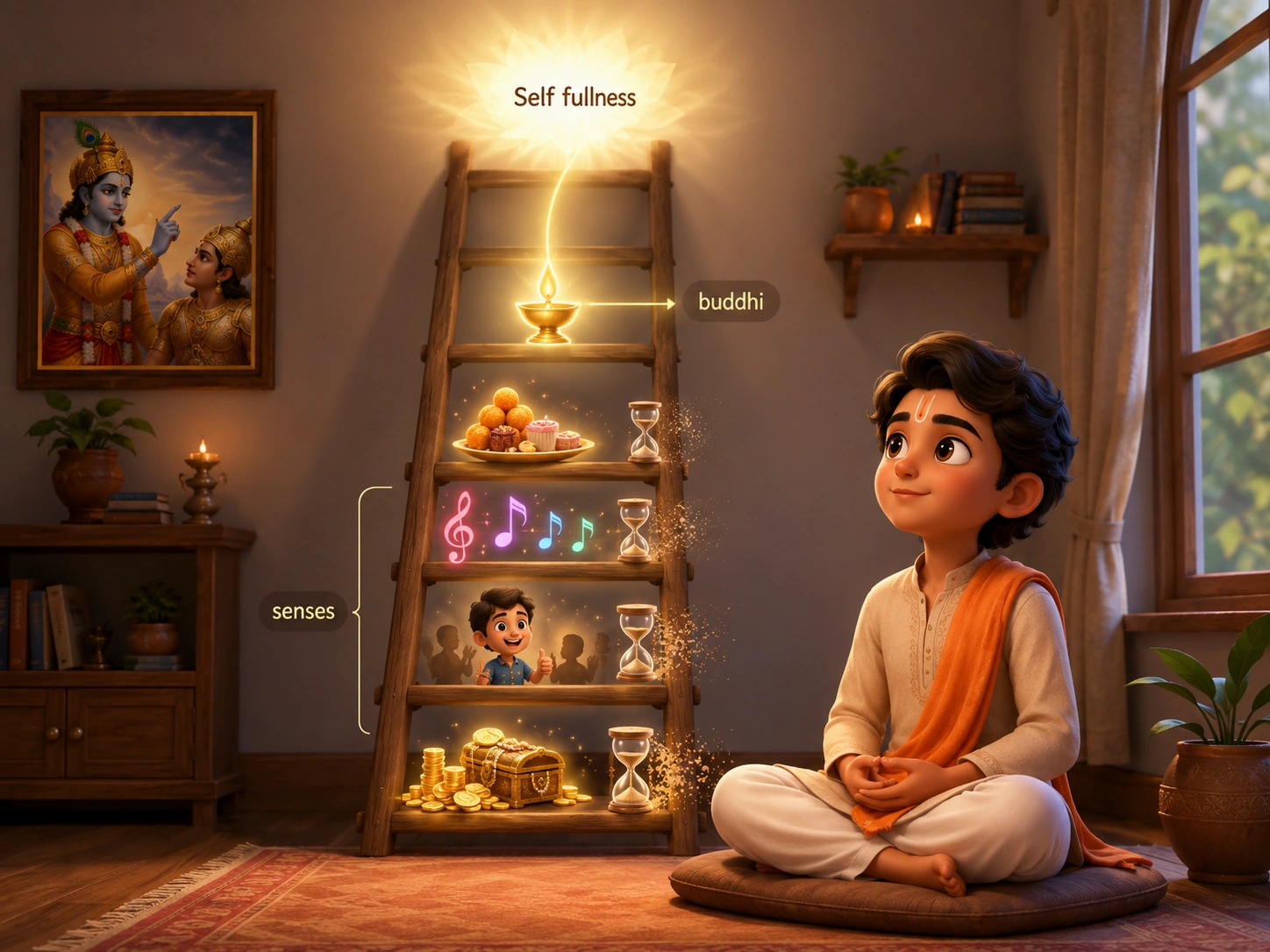
सुखमात्यन्तिकं(यँ) यत्तत्(द्) बुद्धिग्राह्यमतीन्द्रियम् ।
वेत्ति यत्र न चैवायं स्थितश्चलति तत्त्वतः ॥६.२१॥
sukhamātyantikaṁ(y) yattat(d) buddhigrāhyamatīndriyam ।
vetti yatra na caivāyaṁ sthitaścalati tattvataḥ ॥
In mature meditation, the seeker recognizes the absolute happiness that is beyond the senses, grasped by the subtle intellect, and once established in that truth, does not move away from it.
Reflection
◈Which sensory or emotional experience do I secretly treat as though it can give lasting happiness?
◈Do I mistake a pleasant meditation experience for Self-knowledge, or do I use the quiet mind to recognize the awareness behind all experiences?

यं(लँ) लब्ध्वा चापरं(लँ) लाभं मन्यते नाधिकं(न्) ततः ।
यस्मिन्स्थितो न दुःखेन गुरुणापि विचाल्यते ॥६.२२॥
yaṁ(l) labdhvā cāparaṁ(l) lābhaṁ manyate nādhikaṁ(n) tataḥ ।
yasminsthito na duḥkhena guruṇāpi vicālyate ॥
Having gained the fullness of the Self, the yogī does not consider any other gain greater, and being established in it, he is not shaken even by the heaviest sorrow.
Reflection
◈What gain do I still imagine will finally complete me — wealth, recognition, relationship, security, success, health, or control?
◈When sorrow comes, do I experience it as a painful event in the mind, or do I conclude, “I am destroyed”?

तं(वँ) विद्याद्दुःखसंयोगः(ग) वियोगं(यँ) योगसंज्ञितम् ।
स निश्चयेन योक्तवयः(व्यो) योगोऽनिर्विण्णचेतसा ॥६.२३॥
taṁ(v) vidyādduḥkhasaṁyogaḥ(ga) viyogaṁ(y) yogasaṁjñitam ।
sa niścayena yoktavyaḥ(yo) yogo'nirviṇṇacetasā ॥
One should know this yoga as disconnection from association with sorrow, and it must be practiced with firm conviction and a mind that does not become discouraged.
Reflection
◈What sorrow do I most strongly identify with as “me” rather than seeing it as an experience known in the mind?
◈When meditation feels ordinary or difficult, do I become discouraged and stop, or do I continue with patience?

सङ्कल्पप्रभवान्कामान्(स्) त्यक्त्वा सर्वानशेषतः ।
मनसैवेन्द्रियग्रामं(व्ँ) विनियम्य समन्ततः ॥६.२४॥
saṅkalpaprabhavānkāmān(s) tyaktvā sarvānaśeṣataḥ ।
manasaivendriyagrāmaṁ(v) viniyamya samantataḥ ॥
The seeker should completely give up desires born of mental brooding and fantasy, and restrain the entire group of sense-organs from all directions through the mind.
Reflection
◈What desire in my life is being strengthened mainly by repeated imagination and mental storytelling?
◈Which sense-door most often feeds my restlessness: eyes, ears, tongue, touch, or constant phone use?

शनैः(श्) शनैरुपरमेद् बुद्ध्या धृतिगृहीतया ।
आत्मसंस्थं मनः(ख्) कृत्वा न किञ्चिदपि चिन्तयेत् ॥६.२५॥
śanaiḥ(sh) śanairuparamed buddhyā dhṛtigṛhītayā ।
ātmasaṁsthaṁ manaḥ(kh) kṛtvā na kiñcidapi cintayet ॥
The seeker should gradually withdraw the mind with a firm intellect, place it in the Self, and not entertain any thought other than the Self-thought.
Reflection
◈Do I expect my mind to become quiet instantly, or do I allow gradual withdrawal?
◈When the mind wanders, does my intellect firmly bring it back, or does it join the wandering?

यतो यतो निश्चरति मनश्चञ्चलमस्थिरम् ।
ततस्ततो नियम्यैत्(द्) आत्मन्येव वशं(न्) नयेत् ॥६.२६॥
yato yato niścarati manaścañcalamasthiram ।
tatastato niyamyaitat(d) ātmanyeva vaśaṁ(n) nayet ॥
Whenever the restless and unsteady mind wanders away, the seeker should restrain it from that object and bring it back again under the control of the Self.
Reflection
◈When my mind wanders during meditation, do I feel guilty and give up, or do I see the return as part of meditation?
◈What are the most common objects my mind runs toward: family, work, phone, food, fear, memory, or planning?

प्रशान्तमनसं ह्येनं(य्ँ) योगिनं सुखमुत्तमम् ।
उपैति शान्तरजसं ब्रह्मभूतमकल्मषम् ॥६.२७॥
praśāntamanasaṁ hyenaṁ(y) yoginaṁ sukhamuttamam ।
upaiti śāntarajasaṁ brahmabhūtamakalmaṣam ॥
Supreme happiness comes to the yogī whose mind is tranquil, whose rajas has become quiet, who is free from impurity, and who has owned up the truth of Brahman.
Reflection
◈Is my mind becoming more praśānta through practice, or am I still feeding restlessness in daily life?
◈What form of rajas most disturbs me: planning, proving, comparing, controlling, worrying, or reacting?

युञ्जन्नेवं सदात्मानं(य्ँ) योगी विगतकल्मषः ।
सुखेन ब्रह्मसंस्पर्शम अत्यन्तं सुखमश्नुते ॥६.२८॥
yuñjannevaṁ sadātmānaṁ(y) yogī vigatakalmaṣaḥ ।
sukhena brahmasaṁsparśam atyantaṁ sukhamaśnute ॥
Thus, by constantly engaging the mind in meditation, the purified yogī effortlessly gains the limitless happiness that belongs to Brahman.
Reflection
◈Do I give my mind regular time to dwell on the teaching, or do I expect peace without repeated practice?
◈What are the main kalmaṣas that block peace in my mind: fear, anger, guilt, jealousy, craving, pride, or wrong self-identity?

सर्वभूतस्थमात्मानं सर्वभूतानि चात्मनि ।
ईक्षते योगयुक्तात्मा सर्वत्र समदर्शनः ॥६.२९॥
sarvabhūtasthamātmānaṁ sarvabhūtāni cātmani ।
īkṣate yogayuktātmā sarvatra samadarśanaḥ
The yogī whose mind is disciplined and saturated with Self-knowledge sees the same Self in all beings and all beings in the Self.
Reflection
◈Which labels most strongly block my vision of the same Self in others: status, behavior, caste, wealth, education, personality, religion, or usefulness?
◈Can I disagree with someone or set a boundary without denying the sacred presence in that person?

यो मां पश्यति सर्वत्र सर्वं(ञ्) च मयि पश्यति ।
तस्याहं न प्रणश्यामि स च मे न प्रणश्यति ॥६.३०॥
yo māṁ paśyati sarvatra sarvaṁ(ñ) ca mayi paśyati ।
tasyāhaṁ na praṇaśyāmi sa ca me na praṇaśyati ॥
One who sees Bhagavān everywhere and sees everything in Bhagavān is never separated from Bhagavān, nor is Bhagavān ever lost to that person.
Reflection
◈Do I remember Bhagavān only in temple and prayer, or can I see Bhagavān’s presence in daily duties also?
◈Which situation makes me feel Bhagavān is absent: stress, illness, conflict, failure, or loneliness?