

धृतराष्ट्र उवाच ।
धर्मक्षेत्रे कुरुक्षेत्रे समवेता युयुत्सवः ।
मामकाः(फ्) पाण्डवाश्चैव किमकुर्वत सञ्जय ॥१.१॥
dhṛtarāṣṭra uvāca ।
dharmakṣetre kurukṣetre samavetā yuyutsavaḥ ।
māmakāḥ(f) pāṇḍavāścaiva kimakurvata sañjaya ॥
Dhṛtarāṣṭra asks Sañjaya what his sons and the Pāṇḍavas, assembled in holy Kurukṣetra and eager to fight, did.
धृतराष्ट्रः dhṛtarāṣṭraḥ = Dhṛtarāṣṭra, उवाच uvāca = said, धर्मक्षेत्रे dharmakṣetre = in the field of dharma, कुरुक्षेत्रे kurukṣetre = in Kurukṣetra / in the field of the Kurus, समवेताः samavetāḥ = assembled, युयुत्सवः yuyutsavaḥ = desirous of fighting, मामकाः māmakāḥ = my people / my sons, पाण्डवाः pāṇḍavāḥ = the Pāṇḍavas, च ca = and, एव eva = indeed / also, किम् kim = what, अकुर्वत akurvata = did, सञ्जय sañjaya = O Sañjaya
Reflection
◈Where do I use the language of “my people” in a way that weakens my commitment to dharma?
◈Have I ever justified a wrong action because it was done by someone close to me?

सञ्जय उवाच ।
दृष्ट्वा तु पाण्डवानीकं(वँ) व्यूढं(न्) दुर्योधनस्तदा ।
आचार्यमुपसङ्गम्य राजा वचनमब्रवीत् ॥१.२॥
sañjaya uvāca ।
dṛṣṭvā tu pāṇḍavānīkaṁ(v) vyūḍhaṁ(n) duryodhanastadā ।
ācāryamupasaṅgamya rājā vacanamabravīt ॥
Sañjaya said that King Duryodhana, seeing the Pāṇḍava army tactically arranged, approached Droṇācārya and spoke.
सञ्जयः sañjayaḥ = Sañjaya, उवाच uvāca = said, दृष्ट्वा dṛṣṭvā = having seen, तु tu = but / however, पाण्डवानीकम् pāṇḍavānīkam = the army of the Pāṇḍavas, व्यूढम् vyūḍham = arranged / arrayed, दुर्योधनः duryodhanaḥ = Duryodhana, तदा tadā = then, आचार्यम् ācāryam = the teacher, उपसङ्गम्य upasaṅgamya = having approached, राजा rājā = the king, वचनम् vacanam = words / statement, अब्रवीत् abravīt = spoke / said
Reflection
◈When I see someone else better prepared or better organized, do I become objective or insecure?
◈Is my confidence based only on outer resources, or is it supported by dharma and inner clarity?

पश्यैतां पाण्डुपुत्राणाम् आचार्य महतीं(ञ्) चमूम् ।
व्यूढां(न्) द्रुपदपुत्रेण तव शिष्येण धीमता ॥१.३॥
paśyaitāṁ pāṇḍuputrāṇām ācārya mahatīṁ(ñ) camūm ।
vyūḍhāṁ(n) drupadaputreṇa tava śiṣyeṇa dhīmatā ॥
Duryodhana asks Droṇācārya to look at the vast Pāṇḍava army arranged by Dhṛṣṭadyumna, Drupada’s son and Droṇa’s own clever disciple.
पश्य paśya = see / behold, एताम् etām = this, पाण्डुपुत्राणाम् pāṇḍuputrāṇām = of the sons of Pāṇḍu, आचार्य ācārya = O teacher, महतीम् mahatīm = great / mighty, चमूम् camūm = army, व्यूढाम् vyūḍhām = arrayed / arranged, द्रुपदपुत्रेण drupadaputreṇa = by the son of Drupada, तव tava = your, शिष्येण śiṣyeṇa = by the student / disciple, धीमता dhīmatā = intelligent / wise
Reflection
◈Do I ever use someone’s old hurt or sensitive relationship to push them into action?
◈When I am under pressure, does my speech become clear and honest, or pointed and provocative?

अत्र शूरा महेष्वासाः(सा) भीमार्जुनसमा युधि ।
युयुधानो विराटश्च द्रुपदश्च महारथः ॥१.४॥
atra śūrā maheṣvāsāḥ(sā) bhīmārjunasamā yudhi ।
yuyudhāno virāṭaśca drupadaśca mahārathaḥ ॥
Duryodhana says that in the Pāṇḍava army there are many brave, powerful archers equal to Bhīma and Arjuna in battle, including Yuyudhāna, Virāṭa, and Drupada.
अत्र atra = here, शूराः śūrāḥ = heroes / brave warriors, महेष्वासाः maheṣvāsāḥ = great archers, भीमार्जुनसमाः bhīmārjunasamāḥ = equal to Bhīma and Arjuna, युधि yudhi = in battle, युयुधानः yuyudhānaḥ = Yuyudhāna, विराटः virāṭaḥ = Virāṭa, च ca = and, द्रुपदः drupadaḥ = Drupada, च ca = and, महारथः mahārathaḥ = great chariot-warrior / mighty warrior
Reflection
◈When I see another person’s strength, do I assess it calmly or become inwardly disturbed?
◈Do I repeatedly list other people’s advantages in a way that weakens my confidence?

धृष्टकेतुश्चेकितानः(ख्) काशिराजश्च वीर्यवान् ।
पुरुजित्कुन्तिभोजश्च शैब्यश्च नरपुङ्गवः ॥१.५॥
dhṛṣṭaketuścekitānaḥ(kh) kāśirājaśca vīryavān ।
purujitkuntibhojaśca śaibyaśca narapuṅgavaḥ ॥
Duryodhana continues naming powerful Pāṇḍava-side warriors: Dhṛṣṭaketu, Cekitāna, the mighty king of Kāśī, Purujit, Kuntibhoja, and Śaibya, the best among men.
धृष्टकेतुः dhṛṣṭaketuḥ = Dhṛṣṭaketu, चेकितानः cekitānaḥ = Cekitāna, काशिराजः kāśirājaḥ = king of Kāśī, च ca = and, वीर्यवान् vīryavān = powerful / valiant, पुरुजित् purujit = Purujit, कुन्तिभोजः kuntibhojaḥ = Kuntibhoja, च ca = and, शैब्यः śaibyaḥ = Śaibya, च ca = and, नरपुङ्गवः narapuṅgavaḥ = best among men
Reflection
◈When I list the strengths of others, am I preparing wisely or increasing my anxiety?
◈Do I become smaller inside when I see another person’s support system, skill, or influence?

युधामन्युश्च विक्रान्तः(त) उत्तमौजाश्च वीर्यवान् ।
सौभद्रो द्रौपदेयाश्च सर्व एव महारथाः ॥१.६॥
yudhāmanyuśca vikrāntaḥ(ta) uttamaujāśca vīryavān ।
saubhadro draupadeyāśca sarva eva mahārathāḥ ॥
Duryodhana continues naming powerful Pāṇḍava-side warriors: the mighty Yudhāmanyu, the valiant Uttamaujā, Abhimanyu the son of Subhadrā, and the sons of Draupadī — all of them great warriors.
युधामन्युः yudhāmanyuḥ = Yudhāmanyu, च ca = and, विक्रान्तः vikrāntaḥ = valiant / courageous, उत्तमौजाः uttamaujāḥ = Uttamaujā, च ca = and, वीर्यवान् vīryavān = powerful / valiant, सौभद्रः saubhadraḥ = son of Subhadrā, द्रौपदेयाः draupadeyāḥ = sons of Draupadī, च ca = and, सर्वे sarve = all, एव eva = indeed, महारथाः mahārathāḥ = great chariot-warriors / mighty warriors
Reflection
◈Do I calmly recognize challenges, or do I keep repeating them until they feel bigger than they are?
◈When I see capable people on the other side, does my mind become alert or afraid?

अस्माकं(न्) तु विशिष्टा ये तान्निबोध द्विजोत्तम ।
नायका मम सैन्यस्य संज्ञार्थं(न्) तान्ब्रवीमि ते ॥१.७॥
asmākaṁ(n) tu viśiṣṭā ye tānnibodha dvijottama ।
nāyakā mama sainyasya saṁjñārthaṁ(n) tānbravīmi te ॥
Duryodhana tells Droṇācārya, “O best among brāhmaṇas, now know the prominent leaders of my army; I shall mention them to you for your information.”
अस्माकम् asmākam = of us / our, तु tu = but / however, विशिष्टाः viśiṣṭāḥ = distinguished / special, ये ye = who, तान् tān = them, निबोध nibodha = know / understand, द्विजोत्तम dvijottama = O best of the twice-born, नायकाः nāyakāḥ = leaders, मम mama = my, सैन्यस्य sainyasya = of the army, संज्ञार्थम् saṃjñārtham = for recognition / for information, तान् tān = them, ब्रवीमि bravīmi = I shall tell / I tell, ते te = to you
Reflection
◈When I feel afraid, do I become humble and clear, or controlling and forceful?
◈Do I use phrases like “my team,” “my plan,” or “my people” in a way that makes me defensive?

भवान्भीष्मश्च कर्णश्च कृपश्च समितिञ्जयः ।
अश्वत्थामा विकर्णश्च सौमदत्तिस्तथैव च ॥१.८॥
bhavānbhīṣmaśca karṇaśca kṛpaśca samitiñjayaḥ ।
aśvatthāmā vikarṇaśca saumadattistathaiva ca ॥
Duryodhana names the powerful leaders on his side: Droṇa himself, Bhīṣma, Karṇa, Kṛpa the undefeated warrior, Aśvatthāmā, Vikarṇa, and Saumadatti.
भवान् bhavān = you, भीष्मः bhīṣmaḥ = Bhīṣma, च ca = and, कर्णः karṇaḥ = Karṇa, च ca = and, कृपः kṛpaḥ = Kṛpa, च ca = and, समितिञ्जयः samitiñjayaḥ = conqueror in battle, अश्वत्थामा aśvatthāmā = Aśvatthāmā, विकर्णः vikarṇaḥ = Vikarṇa, च ca = and, सौमदत्तिः saumadattiḥ = son of Somadatta, तथा tathā = also / likewise, एव eva = indeed, च ca = and
Reflection
◈When I feel insecure, do I keep checking whether people are still on my side?
◈Do I honor people sincerely, or do I sometimes use respect to secure their support?

अन्ये च बहवः(श्) शूराः(रा) मदर्थे त्यक्तजीविताः ।
नानाशस्त्रप्रहरणाः(स्) सर्वे युद्धविशारदाः ॥१.९॥
anye ca bahavaḥ(sh) śūrāḥ(rā) madarthe tyaktajīvitāḥ ।
nānāśastrapraharaṇāḥ(s) sarve yuddhaviśāradāḥ ॥
Duryodhana says that many other brave warriors are also ready to give up their lives for his sake, equipped with many kinds of weapons and missiles, and skilled in warfare.
अन्ये anye = others, च ca = and, बहवः bahavaḥ = many, शूराः śūrāḥ = heroes / brave warriors, मदर्थे madarthe = for my sake, त्यक्तजीविताः tyaktajīvitāḥ = those who have given up their lives, नानाशस्त्रप्रहरणाः nānāśastrapraharaṇāḥ = armed with various weapons and missiles, सर्वे sarve = all, युद्धविशारदाः yuddhaviśāradāḥ = skilled in battle
Reflection
◈Do I appreciate people’s support, or do I start thinking they exist for my sake?
◈When I feel insecure, do I count how many people are ready to stand with me?

अपर्याप्तं(न्) तदस्माकं बलं भीष्माभिरक्षितम् ।
पर्याप्तं(न्) त्विदमेतेषां बलं भीमाभिरक्षितम् ॥१.१०॥
aparyāptaṁ(n) tadasmākaṁ balaṁ bhīṣmābhirakṣitam ।
paryāptaṁ(n) tvidameteṣāṁ balaṁ bhīmābhirakṣitam ॥
Duryodhana says that his army, though protected by Bhīṣma, is insufficient, while the Pāṇḍava army, protected by Bhīma, is more than sufficient to defeat them.
अपर्याप्तम् aparyāptam = insufficient / not adequate, तत् tat = that, अस्माकम् asmākam = our / of us, बलम् balam = army / strength, भीष्माभिरक्षितम् bhīṣmābhirakṣitam = protected by Bhīṣma, पर्याप्तम् paryāptam = sufficient / adequate, तु tu = but / however, इदम् idam = this, एतेषाम् eteṣām = of these / of them, बलम् balam = army / strength, भीमाभिरक्षितम् bhīmābhirakṣitam = protected by Bhīma
Reflection
◈Do I depend only on outer resources, or do I also build inner strength through dharma?
◈Have I experienced situations where I had support outside but still felt insecure inside?

अयनेषु च सर्वेषु यथाभागमवस्थिताः ।
भीष्ममेवाभिरक्षन्तु भवन्तः(स्) सर्व एव हि ॥१.११॥
ayaneṣu ca sarveṣu yathābhāgamavasthitāḥ ।
bhīṣmamevābhirakṣantu bhavantaḥ(s) sarva eva hi ॥
Duryodhana instructs all the warriors stationed at their assigned positions to protect Bhīṣma alone from every side.
अयनेषु ayaneṣu = in the positions / places of movement, च ca = and, सर्वेषु sarveṣu = in all, यथाभागम् yathābhāgam = according to division / according to assigned share, अवस्थिताः avasthitāḥ = stationed / situated, भीष्मम् bhīṣmam = Bhīṣma, एव eva = alone / indeed, अभिरक्षन्तु abhirakṣantu = let them protect / may they protect, भवन्तः bhavantaḥ = you all, सर्वे sarve = all, एव eva = indeed, हि hi = certainly / indeed
Reflection
◈When I feel insecure, do I only add more outer protection, or do I also look at my inner foundation?
◈Are my plans and safeguards supported by dharma, or are they driven mainly by fear?

तस्य सञ्जनयन्हर्षं(ङ्) कुरुवृद्धः(फ्) पितामहः ।
सिंहनादं(वँ) विनद्योच्चैः(श्) शङ्खं(न्) दध्मौ प्रतापवान् ॥१.१२॥
tasya sañjanayanharṣaṁ(ṅ) kuruvṛddhaḥ(f) pitāmahaḥ ।
siṁhanādaṁ(v) vinadyoccaiḥ(sh) śaṅkhaṁ(n) dadhmau pratāpavān ॥
The powerful Bhīṣma, the grandsire and eldest of the Kurus, generated enthusiasm in Duryodhana by roaring loudly like a lion and blowing his conch.
तस्य tasya = his / of him, सञ्जनयन् sañjanayan = producing / generating, हर्षम् harṣam = joy / delight, कुरुवृद्धः kuruvṛddhaḥ = elder of the Kurus, पितामहः pitāmahaḥ = grandsire, सिंहनादम् siṃhanādam = lion-roar / roar like a lion, विनद्य vinadya = having roared / having sounded, उच्चैः uccaiḥ = loudly, शङ्खम् śaṅkham = conch, दध्मौ dadhmau = blew, प्रतापवान् pratāpavān = powerful / glorious
Reflection
◈When someone near me is anxious, do I know how to encourage them at the right time?
◈When I am in a leadership role, do I step in with steadiness when the group is losing confidence?

ततः(श्) शङ्खाश्च भेर्यश्च पणवानकगोमुखाः ।
सहसैवाभ्यहन्यन्त स शब्दस्तुमुलोऽभवत् ॥१.१३॥
tataḥ(sh) śaṅkhāśca bheryaśca paṇavānakagomukhāḥ ।
sahasaivābhyahanyanta sa śabdastumulo'bhavat ॥
Thereafter, conches, kettledrums, drums, and horns were immediately sounded together, and that sound became tumultuous.
ततः tataḥ = then, शङ्खाः śaṅkhāḥ = conches, च ca = and, भेर्यः bheryaḥ = drums / kettledrums, च ca = and, पणवानकगोमुखाः paṇavānakagomukhāḥ = paṇavas, ānakas, and gomukhas; musical instruments, सहसा sahasā = suddenly / all at once, एव eva = indeed, अभ्यहन्यन्त abhyahanyanta = were sounded / were struck, सः saḥ = that, शब्दः śabdaḥ = sound, तुमुलः tumulaḥ = tumultuous / loud, अभवत् abhavat = became
Reflection
◈When I work with a group, do I help create order or add to confusion?
◈Do I respond with discipline, or do I simply join the excitement?

ततः(श्) श्वेतैर्हयैर्युक्ते महति स्यन्दने स्थितौ ।
माधवः(फ्) पाण्डवश्चैव दिव्यौ शङ्खौ प्रदध्मतुः ॥१.१४॥
tataḥ(sh) śvetairhayairyukte mahati syandane sthitau ।
mādhavaḥ(f) pāṇḍavaścaiva divyau śaṅkhau pradadhmatuḥ ॥
Thereafter, Kṛṣṇa and Arjuna, seated in the great chariot yoked with white horses, blew their divine conches.
ततः tataḥ = then, श्वेतैः śvetaiḥ = with white, हयैः hayaiḥ = horses, युक्ते yukte = yoked / joined, महति mahati = in the great, स्यन्दने syandane = chariot, स्थितौ sthitau = standing / seated, माधवः mādhavaḥ = Mādhava, पाण्डवः pāṇḍavaḥ = Pāṇḍava, च ca = and, एव eva = indeed, दिव्यौ divyau = divine, शङ्खौ śaṅkhau = two conches, प्रदध्मतुः pradadhmatuḥ = blew
Reflection
◈When I begin an important action, is my mind clear or merely excited?
◈Are my senses and mind like disciplined white horses, or are they pulling in different directions?

पाञ्चजन्यं हृषीकेशः(शो) देवदत्तं(न्) धनञ्जयः ।
पौण्ड्रं(न्) दध्मौ महाशङ्खं भीमकर्मा वृकोदरः ॥१.१५॥
pāñcajanyaṁ hṛṣīkeśaḥ(śo) devadattaṁ(n) dhanañjayaḥ ।
pauṇḍraṁ(n) dadhmau mahāśaṅkhaṁ bhīmakarmā vṛkodaraḥ ॥
Hṛṣīkeśa Kṛṣṇa blew Pāñcajanya, Dhanañjaya Arjuna blew Devadatta, and Bhīma, the terrible-doer and wolf-bellied one, blew the great conch Pauṇḍra.
पाञ्चजन्यम् pāñcajanyam = Pāñcajanya, हृषीकेशः hṛṣīkeśaḥ = Hṛṣīkeśa, देवदत्तम् devadattam = Devadatta, धनञ्जयः dhanañjayaḥ = Dhanañjaya, पौण्ड्रम् pauṇḍram = Pauṇḍra, दध्मौ dadhmau = blew, महाशङ्खम् mahāśaṅkham = great conch, भीमकर्मा bhīmakarmā = one of terrible deeds, वृकोदरः vṛkodaraḥ = Vṛkodara
Reflection
◈Do I assume that outer success will automatically remove inner sorrow?
◈When I face emotional difficulty, do I only look for external solutions, or do I also examine the mind?

अनन्तविजयं राजा कुन्तीपुत्रो युधिष्ठिरः ।
नकुलः(स्) सहदेवश्च सुघोषमणिपुष्पकौ ॥१.१६॥
anantavijayaṁ rājā kuntīputro yudhiṣṭhiraḥ ।
nakulaḥ(s) sahadevaśca sughoṣamaṇipuṣpakau ॥
King Yudhiṣṭhira, the son of Kuntī, blew Anantavijaya; Nakula and Sahadeva blew their conches Sughoṣa and Maṇipuṣpaka.
अनन्तविजयम् anantavijayam = Anantavijaya, राजा rājā = king, कुन्तीपुत्रः kuntīputraḥ = son of Kuntī, युधिष्ठिरः yudhiṣṭhiraḥ = Yudhiṣṭhira, नकुलः nakulaḥ = Nakula, सहदेवः sahadevaḥ = Sahadeva, च ca = and, सुघोषमणिपुष्पकौ sughoṣamaṇipuṣpakau = Sughoṣa and Maṇipuṣpaka
Reflection
◈When duty becomes difficult, do I remain steady or try to escape?
◈Is my idea of victory only outer success, or does it include staying with dharma?

काश्यश्च परमेष्वासः(श्) शिखण्डी च महारथः ।
धृष्टद्युम्नो विराटश्च सात्यकिश्चापराजितः ॥१.१७॥
kāśyaśca parameṣvāsaḥ(sh) śikhaṇḍī ca mahārathaḥ ।
dhṛṣṭadyumno virāṭaśca sātyakiścāparājitaḥ ॥
The great archer Kāśya, the mahāratha Śikhaṇḍī, Dhṛṣṭadyumna, Virāṭa, and the undefeated Sātyaki also blew their conches.
काश्यः kāśyaḥ = Kāśya / king of Kāśī, च ca = and, परमेष्वासः parameṣvāsaḥ = supreme archer / excellent bowman, शिखण्डी śikhaṇḍī = Śikhaṇḍī, च ca = and, महारथः mahārathaḥ = great chariot-warrior / mighty warrior, धृष्टद्युम्नः dhṛṣṭadyumnaḥ = Dhṛṣṭadyumna, विराटः virāṭaḥ = Virāṭa, च ca = and, सात्यकिः sātyakiḥ = Sātyaki, च ca = and, अपराजितः aparājitaḥ = unconquered / undefeated
Reflection
◈What is my parameṣvāsa — the skill I must develop properly for dharmic work?
◈Do I recognize the distinct strengths of different people in a group?

द्रुपदो द्रौपदेयाश्च सर्वशः(फ्) पृथिवीपते ।
सौभद्रश्च महाबाहुः(श्) शङ्खान्दध्मुः(फ्) पृथक्पृथक् ॥१.१८॥
drupado draupadeyāśca sarvaśaḥ(f) pṛthivīpate ।
saubhadraśca mahābāhuḥ(sh) śaṅkhāndadhmuḥ(f) pṛthakpṛthak ॥
O Ruler of the earth, Drupada, the sons of Draupadī, and mighty-armed Abhimanyu, the son of Subhadrā, blew their conches separately from all sides.
द्रुपदः drupadaḥ = Drupada, द्रौपदेयाः draupadeyāḥ = sons of Draupadī, च ca = and, सर्वशः sarvaśaḥ = all / in every way / altogether, पृथिवीपते pṛthivīpate = O ruler of the earth, सौभद्रः saubhadraḥ = son of Subhadrā, च ca = and, महाबाहुः mahābāhuḥ = mighty-armed one, शङ्खान् śaṅkhān = conches, दध्मुः dadhmuḥ = blew, पृथक् pṛthak = separately, पृथक् pṛthak = separately
Reflection
◈Do I know my distinct role in the groups and families I belong to?
◈Am I contributing clearly, or am I getting lost in the crowd?

स घोषो धार्तराष्ट्राणां हृदयानि व्यदारयत् ।
नभश्च पृथिवीं(ञ्) चैव तुमुलो व्यनुनादयन् ॥१.१९॥
sa ghoṣo dhārtarāṣṭrāṇāṁ hṛdayāni vyadārayat ।
nabhaśca pṛthivīṁ(ñ) caiva tumulo vyanunādayan ॥
That tumultuous Pāṇḍava conch-sound, resounding through the sky and the earth, pierced the hearts of the Kauravas.
सः saḥ = that, घोषः ghoṣaḥ = sound / noise, धार्तराष्ट्राणाम् dhārtarāṣṭrāṇām = of the sons of Dhṛtarāṣṭra, हृदयानि hṛdayāni = hearts, व्यदारयत् vyadārayat = tore / rent, नभः nabhaḥ = sky, च ca = and, पृथिवीम् pṛthivīm = earth, च ca = and, एव eva = indeed, तुमुलः tumulaḥ = tumultuous / loud, व्यनुनादयन् vyanunādayan = reverberating / making resound
Reflection
◈When I see someone act with clarity and dharma, do I feel inspired or threatened?
◈Is my own heart steady, or is it easily shaken because I know something is not right inside?

अथ व्यवस्थितान्दृष्ट्वा धार्तराष्ट्रान् कपिध्वजः ।
प्रवृत्ते शस्त्रसम्पाते धनुरुद्यम्य पाण्डवः ॥१.२०॥
atha vyavasthitāndṛṣṭvā dhārtarāṣṭrān kapidhvajaḥ ।
pravṛtte śastrasampāte dhanurudyamya pāṇḍavaḥ ॥
Then, when the discharge of weapons was about to begin, monkey-bannered Arjuna saw the sons of Dhṛtarāṣṭra arrayed and raised his bow.
अथ atha = then, व्यवस्थितान् vyavasthitān = arrayed / positioned, दृष्ट्वा dṛṣṭvā = having seen, धार्तराष्ट्रान् dhārtarāṣṭrān = the sons of Dhṛtarāṣṭra, कपिध्वजः kapidhvajaḥ = one whose flag has Hanumān / monkey-emblem, प्रवृत्ते pravṛtte = when begun / when commenced, शस्त्रसम्पाते śastrasampāte = in the discharge/falling of weapons, धनुः dhanuḥ = bow, उद्यम्य udyamya = having lifted / having raised, पाण्डवः pāṇḍavaḥ = Pāṇḍava / son of Pāṇḍu
Reflection
◈When the time for action comes, am I prepared, or am I still careless and scattered?
◈What is the “bow” I must lift in my own duty — study, practice, discipline, courage, or attention?
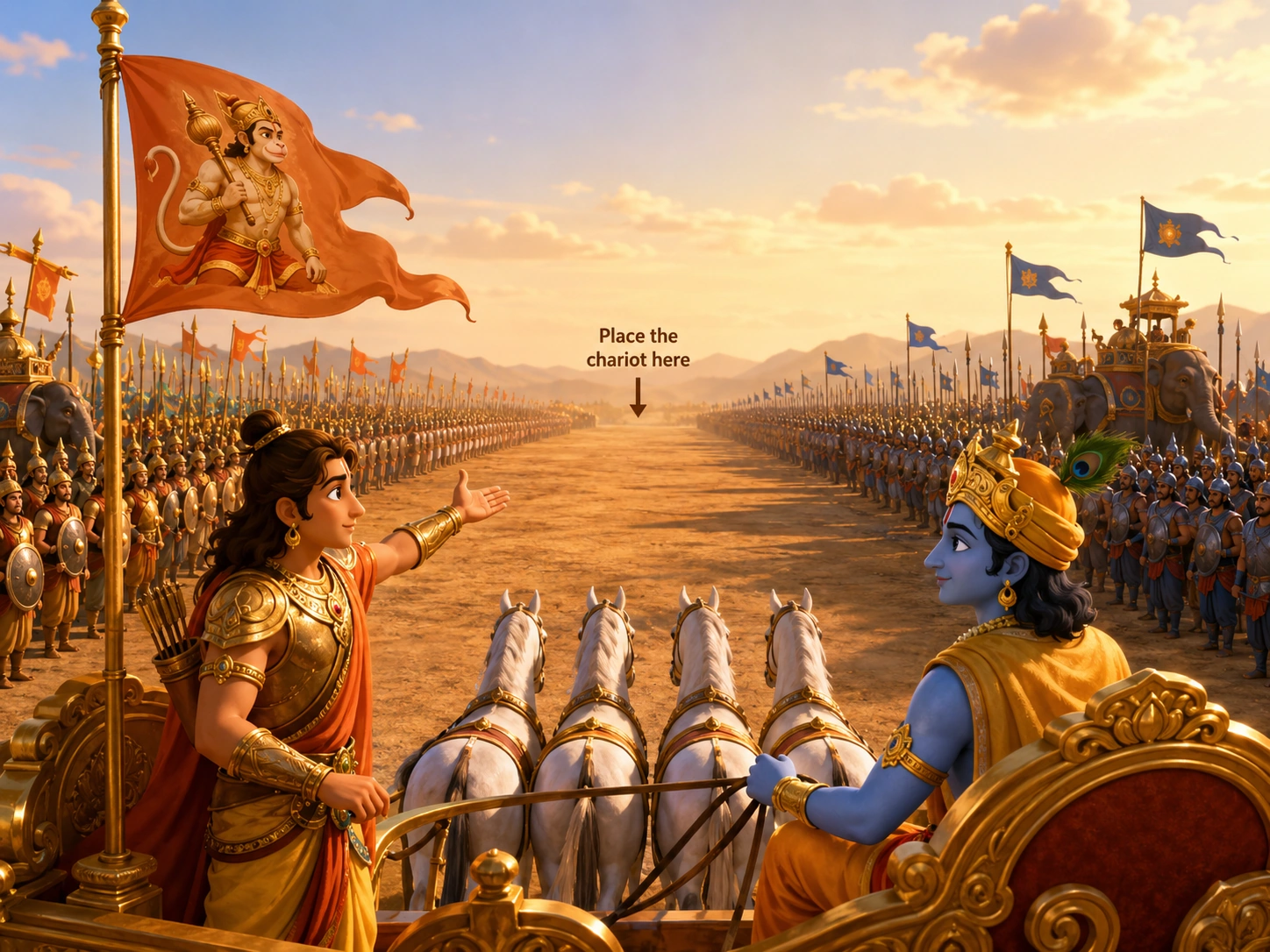
हृषीकेशं(न्) तदा वाक्यम् इदमाह महीपते ।
अर्जुन उवाच ।
सेनयोरुभयोर्मध्ये रथं स्थापय मेऽच्युत ॥१.२१॥
hṛṣīkeśaṁ(n) tadā vākyam idamāha mahīpate ।
arjuna uvāca ।
senayorubhayormadhye rathaṁ sthāpaya me'cyuta ॥
O king, then Arjuna spoke these words to Hṛṣīkeśa: “O Acyuta, place my chariot between the two armies.”
हृषीकेशम् hṛṣīkeśam = Hṛṣīkeśa, तदा tadā = then, वाक्यम् vākyam = statement / words, इदम् idam = this, आह āha = said, महीपते mahīpate = O ruler of the earth, अर्जुनः arjunaḥ = Arjuna, उवाच uvāca = said, सेनयोः senayoḥ = of the two armies, उभयोः ubhayoḥ = of both, मध्ये madhye = in the middle, रथम् ratham = chariot, स्थापय sthāpaya = place / station, मे me = for me, अच्युत acyuta = O Acyuta
Reflection
◈Before taking action, do I place myself where I can see the situation clearly — not only physically, but also mentally, emotionally, and dharmically?
◈Do I seek guidance from someone steady and dharmic, or do I rely only on my own confusion?

यावदेतान्निरीक्षेऽहं(यँ) योद्धुकामानवस्थितान् ।
कैर्मया सह योद्धव्यम् अस्मिन् रणसमुद्यमे ॥१.२२॥
yāvadetānnirīkṣe'haṁ(y) yoddhukāmānavasthitān ।
kairmayā saha yoddhavyam asmin raṇasamudyame ॥
Let me clearly see these people standing here, eager to fight, and know with whom I must fight in this great war-effort.
यावत् yāvat = as long as / until, एतान् etān = these, निरीक्षे nirīkṣe = I observe / I see, अहम् aham = I, योद्धुकामान् yoddhukāmān = desirous of fighting, अवस्थितान् avasthitān = standing / arrayed, कैः kaiḥ = with whom, मया mayā = by me, सह saha = with / together with, योद्धव्यम् yoddhavyam = to be fought / ought to be fought, अस्मिन् asmin = in this, रणसमुद्यमे raṇasamudyame = in the undertaking of battle
Reflection
◈Before I enter a serious action, do I take time to see the situation clearly?
◈Do I know who is involved and what role each person is playing?

योत्स्यमानानवेक्षेऽहं(यँ) य एतेऽत्र समागताः ।
धार्तराष्ट्रस्य दुर्बुद्धेः(र्) युद्धे प्रियचिकीर्षवः ॥१.२३॥
yotsyamānānavekṣe'haṁ(y) ya ete'tra samāgatāḥ ।
dhārtarāṣṭrasya durbuddheḥ(r) yuddhe priyacikīrṣavaḥ ॥
I wish to clearly see those who have assembled here, eager to fight, wanting to please the evil-minded son of Dhṛtarāṣṭra in this war.
योत्स्यमानान् yotsyamānān = those who are about to fight, अवेक्षे avekṣe = I observe / I behold, अहम् aham = I, ये ye = who, एते ete = these, अत्र atra = here, समागताः samāgatāḥ = assembled, धार्तराष्ट्रस्य dhārtarāṣṭrasya = of Dhṛtarāṣṭra’s son / of Duryodhana, दुर्बुद्धेः durbuddheḥ = of evil-minded / wicked-minded, युद्धे yuddhe = in battle, प्रियचिकीर्षवः priyacikīrṣavaḥ = wishing to do what is pleasing
Reflection
◈Do I clearly see when a person’s desire is adhārmic, or do I excuse it because the person is powerful or close to me?
◈Am I ever tempted to please someone even when I know their intention is wrong?

सञ्जय उवाच ।
एवमुक्तो हृषीकेशः(शो) गुडाकेशेन भारत ।
सेनयोरुभयोर्मध्ये स्थापयित्वा रथोत्तमम् ॥१.२४॥
sañjaya uvāca ।
evamukto hṛṣīkeśaḥ(śo) guḍākeśena bhārata ।
senayorubhayormadhye sthāpayitvā rathottamam ॥
Sanjaya said: O Bhārata, thus addressed by Guḍākeśa, Hṛṣīkeśa placed the excellent chariot between the two armies.
सञ्जयः sañjayaḥ = Sañjaya, उवाच uvāca = said, एवम् evam = thus, उक्तः uktaḥ = addressed / spoken to, हृषीकेशः hṛṣīkeśaḥ = Hṛṣīkeśa, गुडाकेशेन guḍākeśena = by Guḍākeśa / by Arjuna, भारत bhārata = O descendant of Bharata, सेनयोः senayoḥ = of the two armies, उभयोः ubhayoḥ = of both, मध्ये madhye = in the middle, स्थापयित्वा sthāpayitvā = having placed / having stationed, रथोत्तमम् rathottamam = the excellent chariot / best chariot
Reflection
◈Am I alert enough to receive teaching, or am I allowing tamas, carelessness, and mental dullness to dominate?
◈When I guide or help someone, can I serve quietly and steadily without needing recognition?

भीष्मद्रोणप्रमुखतः(स्) सर्वेषां(ञ्) च महीक्षिताम् ।
उवाच पार्थ पश्यैतान् समवेतान्कुरूनिति ॥१.२५॥
bhīṣmadroṇapramukhataḥ(s) sarveṣāṁ(ñ) ca mahīkṣitām ।
uvāca pārtha paśyaitān samavetānkurūniti ॥
In front of Bhīṣma, Droṇa, and all the kings, Kṛṣṇa said, “O Pārtha, see these assembled Kurus.”
भीष्मद्रोणप्रमुखतः bhīṣmadroṇapramukhataḥ = in front of Bhīṣma and Droṇa / before Bhīṣma and Droṇa, सर्वेषाम् sarveṣām = of all, च ca = and, महीक्षिताम् mahīkṣitām = kings / rulers of the earth, उवाच uvāca = said, पार्थ pārtha = O Pārtha, पश्य paśya = see / behold, एतान् etān = these, समवेतान् samavetān = assembled, कुरून् kurūn = Kurus, इति iti = thus
Reflection
◈How does my perspective change when I see a situation through anger, attachment, or dharma?
◈Have I ever been clear about a duty from a distance, but emotionally shaken when I saw the people involved?

तत्रापश्यत्स्थितान्पार्थः(फ्) पितॄनथ पितामहान् ।
आचार्यान्मातुलान्भ्रातॄन् पुत्रान्पौत्रान्सखींस्तथा ॥१.२६॥
tatrāpaśyatsthitānpārthaḥ(f) pitṝnatha pitāmahān ।
ācāryānmātulānbhrātṝnputrān pautrānsakhīṁstathā ॥
There, Arjuna saw standing before him fathers, grandfathers, teachers, uncles, brothers, sons, grandsons, and friends.
तत्र tatra = there, अपश्यत् apaśyat = saw, स्थितान् sthitān = standing / assembled, पार्थः pārthaḥ = Pārtha / Arjuna, पितॄन् pitṝn = fathers / elders, अथ atha = and also / then, पितामहान् pitāmahān = grandfathers / grandsires, आचार्यान् ācāryān = teachers, मातुलान् mātulān = maternal uncles, भ्रातॄन् bhrātṝn = brothers, पुत्रान् putrān = sons, पौत्रान् pautrān = grandsons, सखीन् sakhīn = friends, तथा tathā = also / likewise
Reflection
◈Do I think differently when a difficult decision involves “my people”?
◈Can I respect and love someone without allowing attachment to cloud dharma?

श्वशुरान्सुहृदश्चैव सेनयोरुभयोरपि ।
तान्समीक्ष्य स कौन्तेयः(स्) सर्वान्बन्धूनवस्थितान् ॥१.२७॥
śvaśurānsuhṛdaścaiva senayorubhayorapi ।
tānsamīkṣya sa kaunteyaḥ(s) sarvānbandhūnavasthitān ॥
Seeing all those relatives standing there in both armies — fathers-in-law and well-wishers also — Kaunteya looked upon them as his own kith and kin.
श्वशुरान् śvaśurān = fathers-in-law, सुहृदः suhṛdaḥ = friends / well-wishers, च ca = and, एव eva = indeed / also, सेनयोः senayoḥ = in the two armies, उभयोः ubhayoḥ = in both, अपि api = also, तान् tān = those, समीक्ष्य samīkṣya = having seen / having observed, सः saḥ = he, कौन्तेयः kaunteyaḥ = son of Kuntī / Arjuna, सर्वान् sarvān = all, बन्धून् bandhūn = relatives, अवस्थितान् avasthitān = standing / positioned
Reflection
◈When I see “my people” involved in a difficult situation, does my judgment change?
◈Can I recognize affection without letting attachment cloud dharma?

कृपया परयाविष्टः(टो) विषीदन्निदमब्रवीत् ।
अर्जुन उवाच ।
दृष्ट्वेमं स्वजनं(ङ्) कृष्ण युयुत्सुं समुपस्थितम् ॥१.२८॥
kṛpayā parayāviṣṭaḥ(ṭo) viṣīdannidamabravīt ।
arjuna uvāca ।
dṛṣṭvemaṁ svajanaṁ(ṅ) kṛṣṇa yuyutsuṁ samupasthitam ॥
Overpowered by intense attachment and sorrow, Arjuna said, “O Kṛṣṇa, seeing these my own people gathered here, eager to fight…”
कृपया kṛpayā = by compassion / pity, परया parayā = intense / supreme / overwhelming, आविष्टः āviṣṭaḥ = overcome / possessed / filled, विषीदन् viṣīdan = grieving / becoming despondent, इदम् idam = this, अब्रवीत् abravīt = spoke, अर्जुनः arjunaḥ = Arjuna, उवाच uvāca = said, दृष्ट्वा dṛṣṭvā = having seen, इमम् imam = this, स्वजनम् svajanam = one’s own people / kinsmen, कृष्ण kṛṣṇa = O Krishna, युयुत्सुम् yuyutsum = desirous of fighting, समुपस्थितम् samupasthitam = assembled / standing ready
Reflection
◈When I say “I care,” is it always love, or is it sometimes attachment and dependence?
◈Can I notice when an emotion has overpowered me instead of remaining a tool in my hands?

सीदन्ति मम गात्राणि मुखं(ञ्) च परिशुष्यति ।
वेपथुश्च शरीरे मे रोमहर्षश्च जायते ॥१.२९॥
sīdanti mama gātrāṇi mukhaṁ(ñ) ca pariśuṣyati ।
vepathuśca śarīre me romaharṣaśca jāyate ॥
My limbs are weakening, my mouth is drying up, my body is trembling, and my hairs are standing on end.
सीदन्ति sīdanti = are sinking / becoming weak, मम mama = my, गात्राणि gātrāṇi = limbs, मुखम् mukham = mouth, च ca = and, परिशुष्यति pariśuṣyati = dries up, वेपथुः vepathuḥ = trembling, च ca = and, शरीरे śarīre = in the body, मे me = my / in my, रोमहर्षः romaharṣaḥ = horripilation / hair standing on end, च ca = and, जायते jāyate = arises / is born
Reflection
◈When I am emotionally disturbed, what physical symptoms appear in my body?
◈Do I notice when I am repeating the same sorrowful or fearful thought again and again?

गाण्डीवं स्रंसते हस्तात् त्वक्चैव परिदह्यते ।
न च शक्नोम्यवस्थातुं भ्रमतीव च मे मनः ॥१.३०॥
gāṇḍīvaṁ sraṁsate hastāt tvakcaiva paridahyate ।
na ca śaknomyavasthātuṁ bhramatīva ca me manaḥ
Gāṇḍīva slips from my hand, my skin burns, I am unable to stand, and my mind seems to reel.
गाण्डीवम् gāṇḍīvam = the Gāṇḍīva bow, स्रंसते sraṃsate = slips / falls, हस्तात् hastāt = from the hand, त्वक् tvak = skin, च ca = and, एव eva = indeed / also, परिदह्यते paridahyate = burns / is burning, न na = not, च ca = and, शक्नोमि śaknomi = I am able, अवस्थातुम् avasthātum = to stand / to remain steady, भ्रमति bhramati = reels / wanders, इव iva = as though / as if, च ca = and, मे me = my, मनः manaḥ = mind
Reflection
◈What is my “Gāṇḍīva” — the duty, skill, or responsibility that slips when I am emotionally overwhelmed?
◈When my mind reels, do I still try to make major decisions immediately?

निमित्तानि च पश्यामि विपरीतानि केशव ।
न च श्रेयोऽनुपश्यामि हत्वा स्वजनमाहवे ॥१.३१॥
nimittāni ca paśyāmi viparītāni keśava ।
na ca śreyo’nupaśyāmi hatvā svajanamāhave
O Keśava, I see adverse omens, and I do not see any good in killing my own people in this battle.
निमित्तानि nimittāni = omens / signs, च ca = and, पश्यामि paśyāmi = I see, विपरीतानि viparītāni = adverse / unfavorable, केशव keśava = O Keśava, न na = not, च ca = and, श्रेयः śreyaḥ = good / welfare, अनुपश्यामि anupaśyāmi = I see / I perceive, हत्वा hatvā = having killed, स्वजनम् svajanam = one’s own people / kinsmen, आहवे āhave = in battle
Reflection
◈When I am emotionally weak, do I start seeing “bad signs” everywhere?
◈Have I made my life’s meaning depend too much on a person, role, result, or situation?

न काङ्क्षे विजयं(ङ्) कृष्ण न च राज्यं सुखानि च ।
किं(न्) नो राज्येन गोविन्द किं भोगैर्जीवितेन वा ॥१.३२॥
na kāṅkṣe vijayaṁ(ṅ) kṛṣṇa na ca rājyaṁ sukhāni ca ।
kiṁ(n) no rājyena govinda kiṁ bhogairjīvitena vā
O Kṛṣṇa, I do not desire victory, kingdom, or pleasures; O Govinda, what use is kingdom, enjoyment, or even life itself to us?
न na = not, काङ्क्षे kāṅkṣe = I desire, विजयम् vijayam = victory, कृष्ण kṛṣṇa = O Krishna, न na = not, च ca = and, राज्यम् rājyam = kingdom, सुखानि sukhāni = pleasures / comforts, च ca = and, किम् kim = what use / what, नः naḥ = to us / for us, राज्येन rājyena = by kingdom / with kingdom, गोविन्द govinda = O Govinda, किम् kim = what use / what, भोगैः bhogaiḥ = by enjoyments / with enjoyments, जीवितेन jīvitena = by life / with life, वा vā = or
Reflection
◈Have I ever felt that without one person, result, or role, life has no meaning?
◈Do I value people and goals without making them the only reason to live?

येषामर्थे काङ्क्षितं(न्) नः(नो) राज्यं भोगाः(स्) सुखानि च ।
त इमेऽवस्थिता युद्धे प्राणांस्त्यक्त्वा धनानि च ॥१.३३॥
yeṣāmarthe kāṅkṣitaṁ(n) no rājyaṁ bhogāḥ(s) sukhāni ca ।
ta ime'vasthitā yuddhe prāṇāṁstyaktvā dhanāni ca
Those for whose sake we desired kingdom, enjoyments, and pleasures are now standing here in battle, ready to give up their lives and wealth.
येषाम् yeṣām = for whose / of whom, अर्थे arthe = for the sake, काङ्क्षितम् kāṅkṣitam = desired, नः naḥ = by us / for us, राज्यम् rājyam = kingdom, भोगाः bhogāḥ = enjoyments, सुखानि sukhāni = pleasures, च ca = and, ते te = they, इमे ime = these, अवस्थिताः avasthitāḥ = standing / assembled, युद्धे yuddhe = in battle, प्राणान् prāṇān = lives, त्यक्त्वा tyaktvā = having given up / having abandoned, धनानि dhanāni = wealths / possessions, च ca = and
Reflection
◈Have I ever forgotten the original purpose of a duty because one person’s response affected me?
◈When I feel like giving up, can I ask, “What was the dharmic reason I began this?”

आचार्याः(फ्) पितरः(फ्) पुत्राः(स्) तथैव च पितामहाः ।
मातुलाः(श्) श्वशुराः(फ्) पौत्राः श्यालाः(स्) सम्बन्धिनस्तथा ॥१.३४॥
ācāryāḥ(f) pitaraḥ(f) putrāḥ(s) tathaiva ca pitāmahāḥ ।
mātulāḥ(sh) śvaśurāḥ(f) pautrāḥ śyālāḥ(s) sambandhinastathā
Teachers, fathers, sons, grandfathers, uncles, fathers-in-law, grandsons, brothers-in-law, and other relatives are standing here.
आचार्याः ācāryāḥ = teachers, पितरः pitaraḥ = fathers / elders, पुत्राः putrāḥ = sons, तथा tathā = likewise / also, एव eva = indeed / also, च ca = and, पितामहाः pitāmahāḥ = grandfathers / grandsires, मातुलाः mātulāḥ = maternal uncles, श्वशुराः śvaśurāḥ = fathers-in-law, पौत्राः pautrāḥ = grandsons, श्यालाः śyālāḥ = brothers-in-law, सम्बन्धिनः sambandhinaḥ = relatives / kinsmen, तथा tathā = also / likewise
Reflection
◈What sentence do I keep repeating when I am upset?
◈Does my repetition help me understand the situation, or does it keep me stuck?

एतान्न हन्तुमिच्छामि घ्नतोऽपि मधुसूदन ।
अपि त्रैलोक्यराज्यस्य हेतोः(ख्) किं(न्) नु महीकृते ॥१.३५॥
etānna hantumicchāmi ghnato'pi madhusūdana ।
api trailokyarājyasya hetoḥ(kh) kiṁ(n) nu mahīkṛte
O Madhusūdana, I do not wish to kill them even if they attack me; not even for the rulership of the three worlds, much less for this earth.
एतान् etān = these, न na = not, हन्तुम् hantum = to kill, इच्छामि icchāmi = I wish / desire, घ्नतः ghnataḥ = killing / striking, अपि api = even, मधुसूदन madhusūdana = O Madhusūdana, अपि api = even, त्रैलोक्यराज्यस्य trailokyarājyasya = of the kingdom of the three worlds, हेतोः hetoḥ = for the sake / because of, किम् kim = what, नु nu = indeed / then, महीकृते mahīkṛte = for the sake of the earth
Reflection
◈Do I make different rules when “my people” are involved?
◈Can I respect someone deeply and still see clearly when dharma is at stake?

निहत्य धार्तराष्ट्रान्नः(ख्) का प्रीतिः(स्) स्याज्जनार्दन ।
पापमेवाश्रयेदस्मान् हत्वैतानाततायिनः ॥१.३६॥
nihatya dhārtarāṣṭrānnaḥ(kh) kā prītiḥ(s) syājjanārdana ।
pāpamevāśrayedasmān hatvaitānātatāyinaḥ
O Janārdana, what joy can come to us by killing the sons of Dhṛtarāṣṭra? By killing these ātatāyinaḥ, sin alone will come to us.
निहत्य nihatya = having killed, धार्तराष्ट्रान् dhārtarāṣṭrān = the sons of Dhṛtarāṣṭra, नः naḥ = for us / to us, का kā = what, प्रीतिः prītiḥ = joy / satisfaction, स्यात् syāt = would be, जनार्दन janārdana = O Janārdana, पापम् pāpam = sin, एव eva = alone / indeed, आश्रयेत् āśrayet = would come upon / would attach to, अस्मान् asmān = us, हत्वा hatvā = having killed, एतान् etān = these, आततायिनः ātatāyinaḥ = aggressors / attackers
Reflection
◈Have I ever avoided a necessary duty and called that avoidance kindness?
◈When I say, “This feels wrong,” am I checking dharma, or only checking emotional discomfort?

तस्मान्नार्हा वयं हन्तुं(न्) धार्तराष्ट्रान्स्वबान्धवान् ।
स्वजनं हि कथं हत्वा सुखिनः(स्) स्याम माधव ॥१.३७॥
tasmānnārhā vayaṁ hantuṁ(n) dhārtarāṣṭrānsvabāndhavān ।
svajanaṁ hi kathaṁ hatvā sukhinaḥ(s) syāma mādhava
Therefore, O Mādhava, we should not kill the sons of Dhṛtarāṣṭra, who are our own relatives; how can we be happy by killing our own people?
तस्मात् tasmāt = therefore, न na = not, अर्हाः arhāḥ = fit / proper / worthy, वयम् vayam = we, हन्तुम् hantum = to kill, धार्तराष्ट्रान् dhārtarāṣṭrān = the sons of Dhṛtarāṣṭra, स्वबान्धवान् svabāndhavān = our own relatives, स्वजनम् svajanam = one’s own people / kinsmen, हि hi = indeed / surely, कथम् katham = how, हत्वा hatvā = having killed, सुखिनः sukhinaḥ = happy, स्याम syāma = may we be / would we be, माधव mādhava = O Mādhava
Reflection
◈Do I apply one standard for my people and another standard for others?
◈When I say, “But this person is close to me,” am I protecting dharma or protecting attachment?

यद्यप्येते न पश्यन्ति लोभोपहतचेतसः ।
कुलक्षयकृतं(न्) दोषं मित्रद्रोहे च पातकम् ॥१.३८॥
yadyapyete na paśyanti lobhopahatacetasaḥ ।
kulakṣayakṛtaṁ(n) doṣaṁ mitradrohe ca pātakam
Even though these greed-clouded people do not see the evil caused by family destruction and the sin in betraying friends, we can see it.
यदि yadi = although / if, अपि api = even, एते ete = these, न na = not, पश्यन्ति paśyanti = see, लोभोपहतचेतसः lobhopahatacetasaḥ = whose minds are overcome by greed, कुलक्षयकृतम् kulakṣayakṛtam = caused by the destruction of the family, दोषम् doṣam = fault / evil, मित्रद्रोहे mitradrohe = in betrayal of friends, च ca = and, पातकम् pātakam = sin
Reflection
◈Where does greed make me focus only on what I can gain?
◈Have I ever ignored damage to relationships because I wanted to win?

कथं(न्) न ज्ञेयमस्माभिः(फ्) पापादस्मान्निवर्तितुम् ।
कुलक्षयकृतं(न्) दोषं प्रपश्यद्भिर्जनार्दन ॥१.३९॥
kathaṁ(n) na jñeyamasmābhiḥ(f) pāpādasmānnivartitum ।
kulakṣayakṛtaṁ(n) doṣaṁ prapaśyadbhirjanārdana
O Janārdana, since we clearly see the evil caused by family destruction, why should we not decide to withdraw from this sinful action?
कथम् katham = how, न na = not, ज्ञेयम् jñeyam = to be known / should be known, अस्माभिः asmābhiḥ = by us, पापात् pāpāt = from sin, अस्मात् asmāt = from this, निवर्तितुम् nivartitum = to turn away / to withdraw, कुलक्षयकृतम् kulakṣayakṛtam = caused by the destruction of the family, दोषम् doṣam = fault / evil, प्रपश्यद्भिः prapaśyadbhiḥ = by those who clearly see, जनार्दन janārdana = O Janārdana
Reflection
◈Have I ever used a real concern to avoid a difficult duty?
◈When I call something wrong, am I checking dharma, or only checking whether it feels painful?

कुलक्षये प्रणश्यन्ति कुलधर्माः(स्) सनातनाः ।
धर्मे नष्टे कुलं(ङ्) कृत्स्नम् अधर्मोऽभिभवत्युत ॥१.४०॥
kulakṣaye praṇaśyanti kuladharmāḥ(s) sanātanāḥ ।
dharme naṣṭe kulaṁ(ṅ) kṛtsnam adharmo'bhibhavatyuta
When a family is destroyed, its long-standing family dharmas perish; when dharma is lost, adharma overtakes the entire family.
कुलक्षये kulakṣaye = when the family is destroyed / in the destruction of the family, प्रणश्यन्ति praṇaśyanti = perish / are destroyed, कुलधर्माः kuladharmāḥ = family duties / family traditions, सनातनाः sanātanāḥ = ancient / eternal, धर्मे dharme = when dharma, नष्टे naṣṭe = is destroyed / lost, कुलम् kulam = family, कृत्स्नम् kṛtsnam = entire / whole, अधर्मः adharmaḥ = adharma / unrighteousness, अभिभवति abhibhavati = overpowers / overwhelms, उत uta = indeed / also
Reflection
◈What kula-dharmāḥ [family dharmas] did I receive, and which of them am I actually passing on?
◈Is my home training people in dharma, or mainly in arthaḥ [material gain] and kāmaḥ [pleasure]?

अधर्माभिभवात्कृष्ण प्रदुष्यन्ति कुलस्त्रियः ।
स्त्रीषु दुष्टासु वार्ष्णेय जायते वर्णसङ्करः ॥१.४१॥
adharmābhibhavātkṛṣṇa praduṣyanti kulastriyaḥ ।
strīṣu duṣṭāsu vārṣṇeya jāyate varṇasaṅkaraḥ
O Krishna, when adharma overtakes the family, the women of the family become corrupted; when women are corrupted, confusion of varṇa and dharma arises.
अधर्माभिभवात् adharmābhibhavāt = because of the dominance of adharma, कृष्ण kṛṣṇa = O Kṛṣṇa, प्रदुष्यन्ति praduṣyanti = become corrupted / become spoiled, कुलस्त्रियः kulastriyaḥ = the women of the family, स्त्रीषु strīṣu = among women / when women, दुष्टासु duṣṭāsu = are corrupted, वार्ष्णेय vārṣṇeya = O descendant of Vṛṣṇi, जायते jāyate = is born / arises, वर्णसङ्करः varṇasaṅkaraḥ = mixture of varṇas / social confusion
Reflection
◈What values are the children or younger people around me absorbing from my daily conduct?
◈Is my home transmitting dharma, or mainly arthaḥ [material gain] and kāmaḥ [pleasure]?

सङ्करो नरकायैव कुलघ्नानां(ङ्) कुलस्य च ।
पतन्ति पितरो ह्येषां(ल्ँ) लुप्तपिण्डोदकक्रियाः ॥१.४२॥
saṅkaro narakāyaiva kulaghnānāṁ(ṅ) kulasya ca ।
patanti pitaro hyeṣāṁ(l) luptapiṇḍodakakriyāḥ
This confusion in family and dharma leads to downfall for the family-destroyers and the family; their ancestors also fall, being deprived of food-and-water offerings.
सङ्करः saṅkaraḥ = mixture / confusion, नरकाय narakāya = for hell / leading to hell, एव eva = indeed / certainly, कुलघ्नानाम् kulaghnānām = of the destroyers of the family, कुलस्य kulasya = of the family, च ca = and, पतन्ति patanti = fall, पितरः pitaraḥ = the ancestors, हि hi = indeed, एषाम् eṣām = of these people / their, लुप्तपिण्डोदकक्रियाः luptapiṇḍodakakriyāḥ = those whose piṇḍa-and-water rites are lost
Reflection
◈How do I express gratitude to my ancestors — only as a feeling, or also through action and practice?
◈Do I understand the difference between manuṣya-yajña [duty toward people] and pitṛ-yajña [duty toward ancestors]?

दोषैरेतैः(ख्) कुलघ्नानां(व्ँ) वर्णसङ्करकारकैः ।
उत्साद्यन्ते जातिधर्माः(ख्) कुलधर्माश्च शाश्वताः ॥१.४३॥
doṣairetaiḥ(kh) kulaghnānāṁ(v) varṇasaṅkarakārakaiḥ ।
utsādyante jātidharmāḥ(kh) kuladharmāśca śāśvatāḥ
Because of these defects caused by the destroyers of families, which produce varṇa-saṅkara, the long-standing jāti-dharmas and kula-dharmas are destroyed.
दोषैः doṣaiḥ = by these evils / faults, एतैः etaiḥ = by these, कुलघ्नानाम् kulaghnānām = of the destroyers of the family, वर्णसङ्करकारकैः varṇasaṅkarakārakaiḥ = causing varṇa-mixture, उत्साद्यन्ते utsādyante = are destroyed / ruined, जातिधर्माः jātidharmāḥ = duties/traditions of the jāti, कुलधर्माः kuladharmāḥ = family duties/traditions, च ca = and, शाश्वताः śāśvatāḥ = eternal / long-standing
Reflection
◈What family or community practice have I received but not yet understood properly?
◈Am I preserving dharma as living practice, or only as identity and nostalgia?

उत्सन्नकुलधर्माणां मनुष्याणां(ञ्) जनार्दन ।
नरके नियतं(व्ँ) वासः(सो) भवतीत्यनुशुश्रुम ॥१.४४॥
utsannakuladharmāṇāṁ manuṣyāṇāṁ(ñ) janārdana ।
narake niyataṁ(v) vāsaḥ(so) bhavatītyanuśuśruma
O Janārdana, we have heard that for people whose family traditions are destroyed, living in hell becomes inevitable.
उत्सन्नकुलधर्माणाम् utsannakuladharmāṇām = of those whose family dharmas are destroyed, मनुष्याणाम् manuṣyāṇām = of people / humans, जनार्दन janārdana = O Janārdana, नरके narake = in hell, नियतम् niyatam = certainly / surely, वासः vāsaḥ = dwelling / residence, भवति bhavati = becomes / is, इति iti = thus, अनुशुश्रुम anuśuśruma = we have heard
Reflection
◈Is my home becoming a place of trust where people can speak openly and safely?
◈Which family dharma helps create emotional security in my family?

अहो बत महत्पापं(ङ्) कर्तुं(व्ँ) व्यवसिता वयम् ।
यद्राज्यसुखलोभेन हन्तुं स्वजनमुद्यताः ॥१.४५॥
aho bata mahatpāpaṁ(ṅ) kartuṁ(v) vyavasitā vayam ।
yadrājyasukhalobhena hantuṁ svajanamudyatāḥ
Alas! We are about to commit a great sin, for out of greed for kingdom and pleasure, we are ready to kill our own people.
अहो aho = alas / oh, बत bata = indeed / alas, महत् mahat = great, पापम् pāpam = sin, कर्तुम् kartum = to do / to commit, व्यवसिताः vyavasitāḥ = resolved / determined, वयम् vayam = we, यत् yat = that / because, राज्यसुखलोभेन rājyasukhalobhena = because of greed for kingdom and pleasure, हन्तुम् hantum = to kill, स्वजनम् svajanam = one’s own people / kinsmen, उद्यताः udyatāḥ = ready / prepared
Reflection
◈Have I ever called a difficult duty “wrong” only because it caused emotional pain?
◈When I feel guilty, do I check the full dharma-adharma situation before deciding?

यदि मामप्रतीकारम् अशस्त्रं शस्त्रपाणयः ।
धार्तराष्ट्रा रणे हन्युः(स्) तन्मे क्षेमतरं भवेत् ॥१.४६॥
yadi māmapratīkāram aśastraṁ śastrapāṇayaḥ ।
dhārtarāṣṭrā raṇe hanyuḥ(s) tanme kṣemataraṁ bhavet
Even if the armed sons of Dhṛtarāṣṭra kill me in battle while I am unarmed and unresisting, that would be better for me.
यदि yadi = if, माम् mām = me, अप्रतीकारम् apratīkāram = not resisting / without retaliation, अशस्त्रम् aśastram = unarmed, शस्त्रपाणयः śastrapāṇayaḥ = those with weapons in hand, धार्तराष्ट्राः dhārtarāṣṭrāḥ = the sons of Dhṛtarāṣṭra, रणे raṇe = in battle, हन्युः hanyuḥ = they may kill, तत् tat = that, मे me = for me, क्षेमतरम् kṣemataram = better / more beneficial, भवेत् bhavet = would be
Reflection
◈Am I calling my withdrawal “peace” when it is actually avoidance of a difficult duty?
◈Will my silence or non-resistance reduce adharma, or allow it to continue?

सञ्जय उवाच ।
एवमुक्त्वार्जुनः(स्) सङ्ख्ये रथोपस्थ उपाविशत् ।
विसृज्य सशरं(ञ्) चापं शोकसंविग्नमानसः ॥१.४७॥
sañjaya uvāca ।
evamuktvārjunaḥ(s) saṅkhye rathopastha upāviśat ।
visṛjya saśaraṁ(ñ) cāpaṁ śokasaṁvignamānasaḥ
Sanjaya said: Having spoken thus, Arjuna cast aside his bow and arrows and sat down in the chariot, his mind overwhelmed by sorrow.
सञ्जयः sañjayaḥ = Sañjaya, उवाच uvāca = said, एवम् evam = thus, उक्त्वा uktvā = having spoken, अर्जुनः arjunaḥ = Arjuna, सङ्ख्ये saṅkhye = in battle, रथोपस्थे rathopasthe = on the seat of the chariot, उपाविशत् upāviśat = sat down, विसृज्य visṛjya = having cast aside / having put down, सशरम् saśaram = along with arrows, चापम् cāpam = bow, शोकसंविग्नमानसः śokasaṃvignamānasaḥ = whose mind was shaken by sorrow
Reflection
◈What is the “bow” in my life — the duty I am tempted to drop when emotions become strong?
◈Have I ever made a major decision while my mind was śoka-saṁvigna [shaken by sorrow]?