Chapter 3 Summary

कर्मयोगः

karmayogaḥ

Chapter Placement in the Bhagavad Gītā

Chapter 3 is titled Karma-Yogaḥ and belongs to the opening movement of the Bhagavad Gītā, where Bhagavān Kṛṣṇa is unfolding the spiritual life of the individual seeker. Chapter 2 introduced both jñāna-yoga and karma-yoga: jñānam was presented as the remedy for sorrow and delusion, while karma was taught as the necessary discipline for preparing the mind. Chapter 3 is born from Arjuna’s confusion about these two teachings. He thinks that if jñānam is superior, then karma can be avoided. Bhagavān corrects this misunderstanding by elaborating the necessity, nature, practice, and protection of karma-yoga.

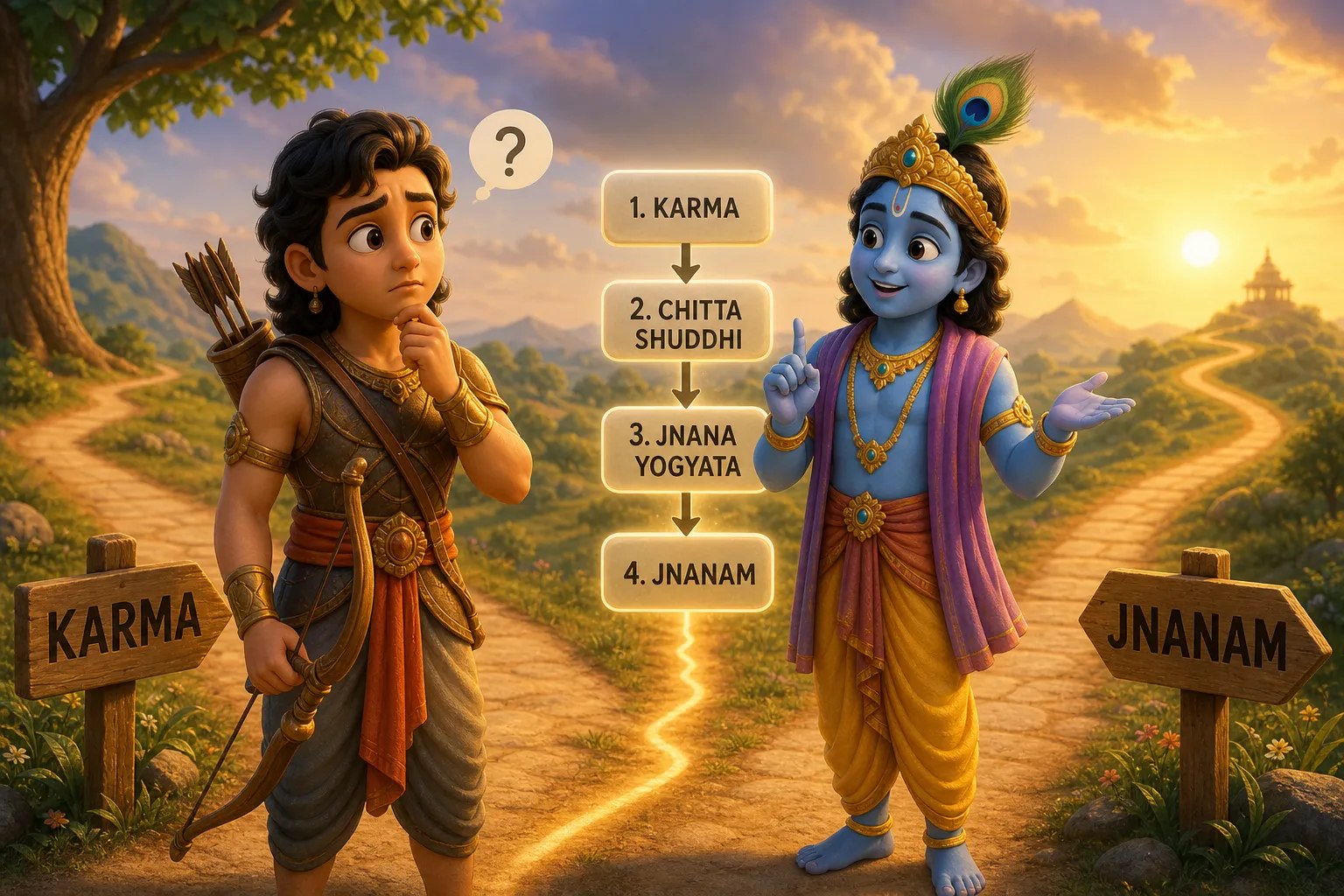
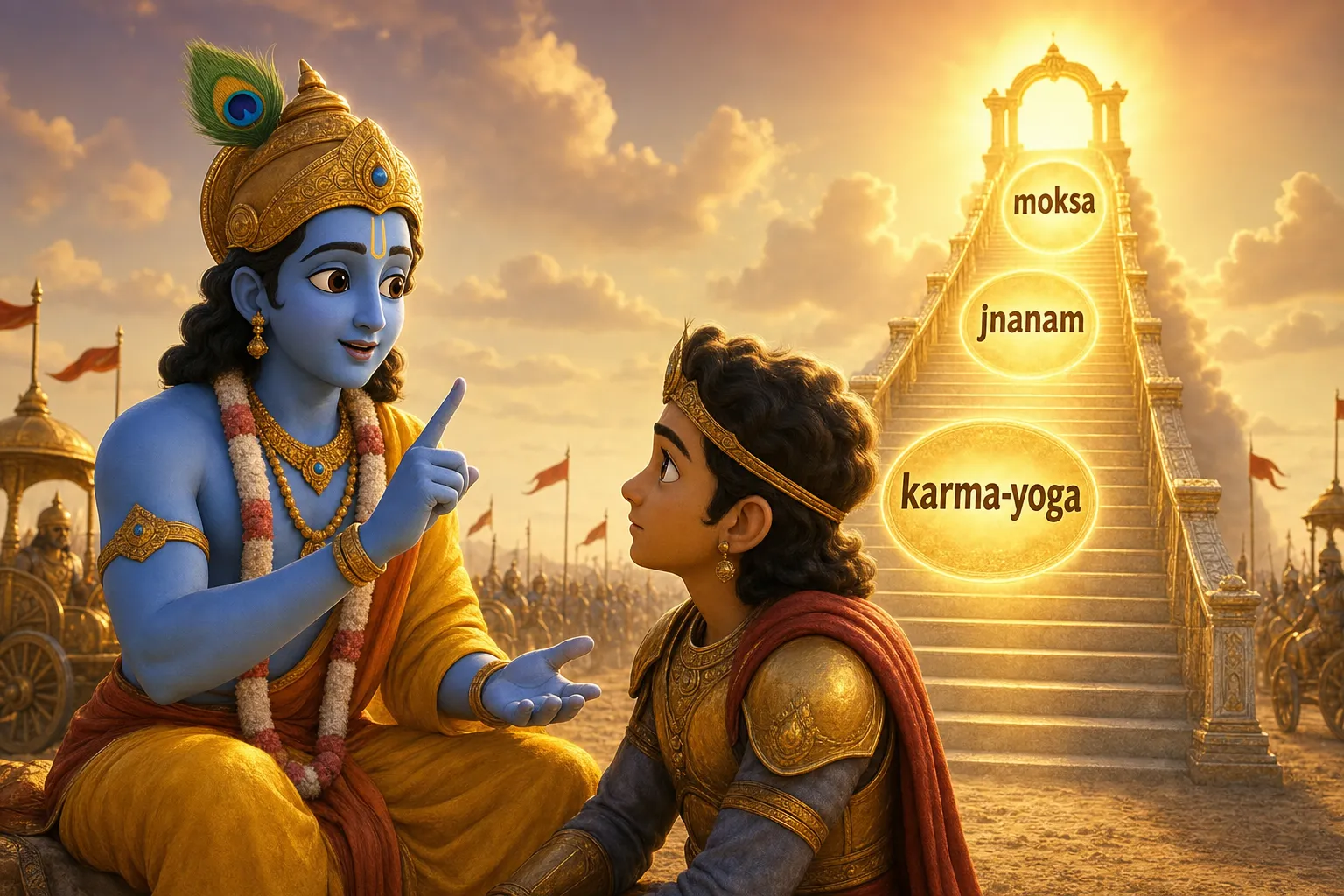
The chapter therefore serves as the detailed teaching on karma-yoga as the first indispensable stage of spiritual life. It does not deny the supremacy of jñānam; rather, it explains that jñānam becomes possible only when the mind is prepared. Karma-yoga is not the direct cause of mokṣa, but it gives jñāna-yogyatā, fitness for knowledge. The route is: karma-yoga → citta-śuddhi → jñāna-yoga → mokṣa.

Central Theme of the Chapter

The central theme of Chapter 3 is that one must perform one’s duty as karma-yoga rather than escape from action in the name of spirituality. Action itself is not the problem; the attitude behind action is the problem. When action is done with rāga, dveṣa, ego, anxiety, and possessiveness, it binds. When the same action is performed as worship, with proper attitude and dedication to Bhagavān, it purifies the mind and becomes karma-yoga.

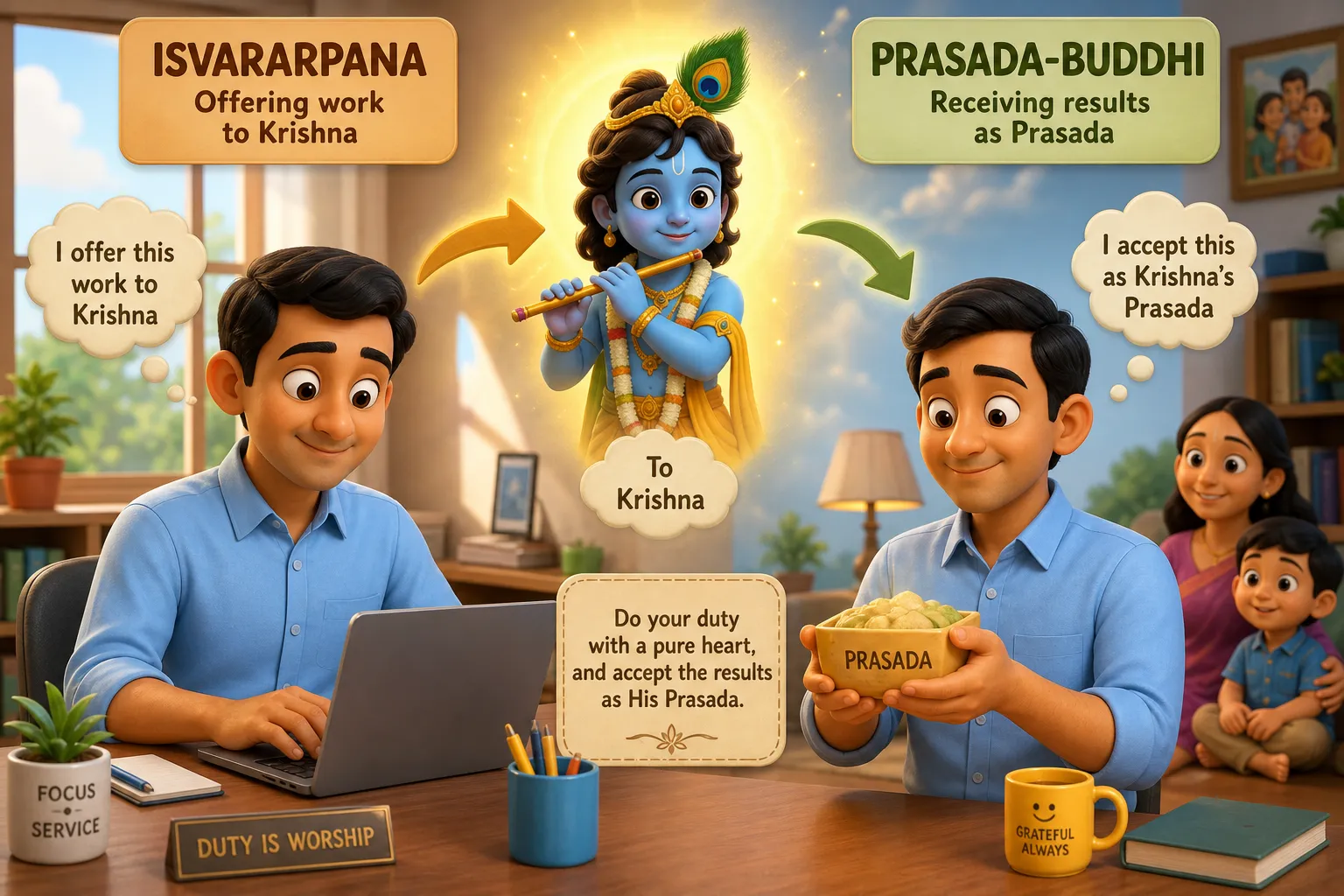
Karma-yoga has two parts: proper action and proper attitude. Proper action means sāttvika karma, action in which one gives more than one takes, contributes to the welfare of others, and lives a life of responsibility. Proper attitude means converting work into worship through īśvara-arpaṇa-bhāvanā and receiving results with prasāda-buddhi.

Thus, Chapter 3 teaches that spiritual growth does not require running away from life. It requires transforming life. Arjuna’s battlefield is not an obstacle to mokṣa when understood correctly; it is his field of karma-yoga. For Arjuna, the immediate duty is not to go to a forest or āśrama, but to stand in his role as a kṣatriya and perform dharma-yuddha with the right attitude.

Major Confusion Removed by the Chapter

The major confusion removed in this chapter is the idea that karma-yoga and jñāna-yoga are optional alternatives. Arjuna thinks he must choose one: either action or knowledge. This is a mistake. They are not two competing routes to mokṣa. Karma-yoga is the preparatory discipline, and jñāna-yoga is the direct means of liberation. To compare them as alternatives is like asking whether one should wash the hand or eat food. Washing does not remove hunger, but eating without washing is improper. Similarly, karma-yoga does not directly remove saṁsāra, but it prepares the mind for the knowledge that does.

The chapter also removes a second confusion: the idea that spiritual life means external renunciation before inner readiness. A premature jump into sannyāsa may create hypocrisy if the mind still dwells on worldly desires. Therefore, the teaching does not glorify escape. It asks the seeker to use the appropriate āśrama and role as a field of purification.

A third confusion removed is the belief that karma-yoga depends on the type of action. Karma-yoga depends on the attitude with which an action is performed. A brāhmaṇa’s ritual, a kṣatriya’s battle, a vaiśya’s business, or any legitimate duty can become worship when performed as īśvarārpaṇam for inner purification. Conversely, even a noble-looking action can fail to be karma-yoga if it is performed with selfishness, commercialism, pride, or attachment.

Main Teaching Framework

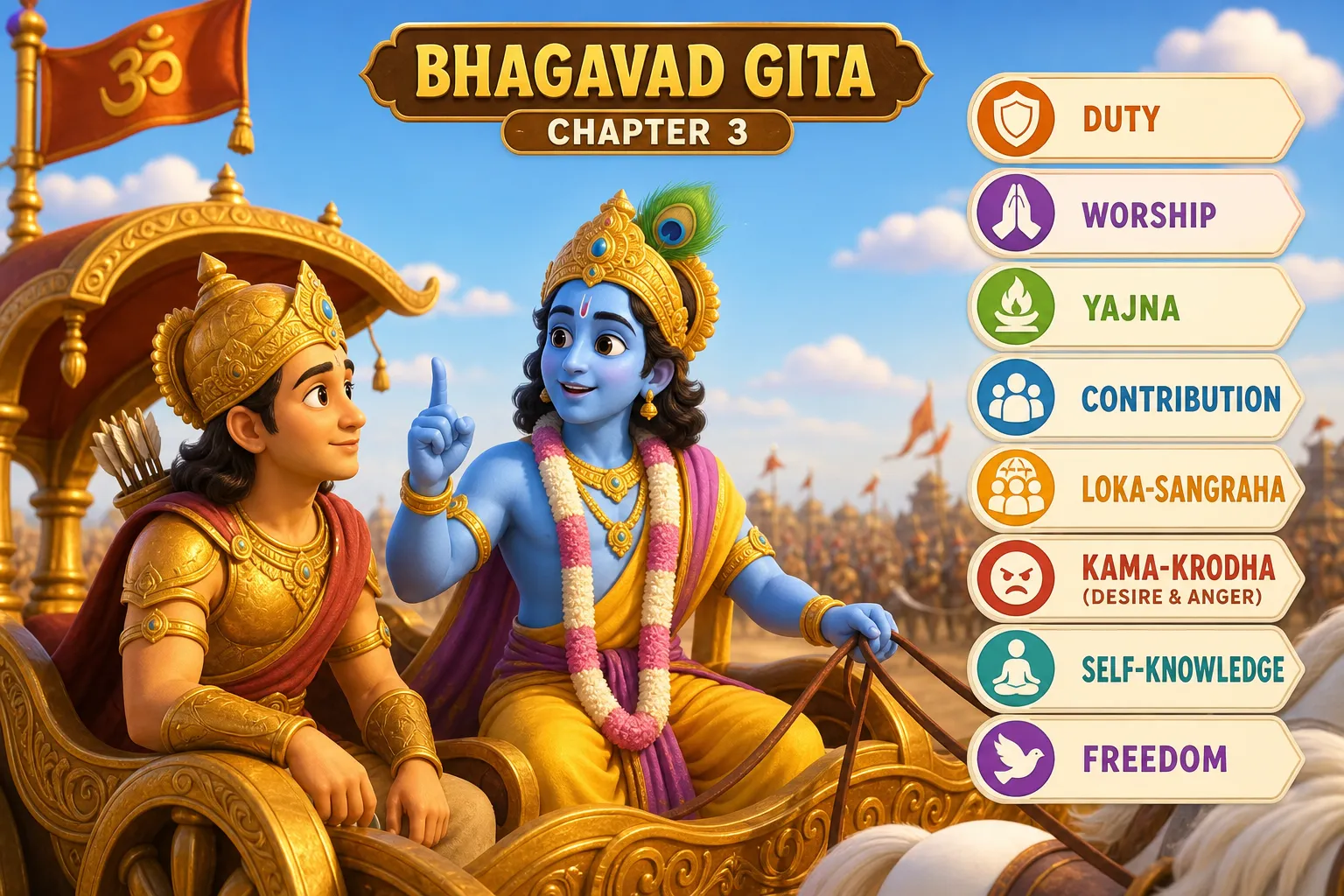
Chapter 3 develops through five major movements: first, Arjuna’s question and Bhagavān’s clarification that karma-yoga and jñāna-yoga are not optional alternatives; second, the necessity of action and the danger of mere external renunciation; third, the detailed teaching of karma-yoga as yajña and contribution; fourth, the role of the wise person in society through loka-saṅgraha; and fifth, the diagnosis and conquest of kāma-krodha, the inner enemy that obstructs dharma and knowledge.

The chapter begins with Arjuna’s complaint. He says, in effect: “If knowledge is superior to action, why do You push me into this terrible action?” Behind this question is not only philosophical confusion but also emotional avoidance. Arjuna wants to use the glory of jñānam as a reason to avoid an unpleasant duty. Bhagavān does not merely command him to fight; He teaches the logic of karma-yoga so that Arjuna can understand and choose rightly.

Bhagavān then distinguishes between sādhana and niṣṭhā. Sādhana refers to the spiritual disciplines: karma-yoga and jñāna-yoga. In sādhana there is no choice: both are required, in sequence. Niṣṭhā refers to lifestyle or āśrama: pravṛtti-mārga or gṛhastha life, and nivṛtti-mārga or sannyāsa life. In lifestyle there can be different arrangements, but the essential disciplines cannot be avoided.

Three life-routes are possible. One may follow gṛhastha-āśrama, practice karma-yoga, then enter sannyāsa and pursue jñāna-yoga. Or one may remain in gṛhastha-āśrama, practice karma-yoga, then continue there while pursuing jñāna-yoga. Or one may take to sannyāsa early, but then one must still find appropriate means for purification through japa, guru-sevā, and other disciplines. The third route is risky if the mind is not prepared. Therefore, for Arjuna, remaining in his role and performing his duty is the appropriate path.

Detailed Development of the Teaching

1. Action Cannot Be Avoided

Bhagavān first shows that nobody can remain without action. The body-mind complex is born of prakṛti and is driven by the guṇas. Even sitting quietly is not freedom from action if the mind is dwelling on objects. External withdrawal without inner maturity becomes mithyācāraḥ, hypocrisy. Therefore the question is not whether to act, but how to act.

Action is unavoidable, but bondage is avoidable. Karma becomes binding when performed with ego, attachment, and craving for results. Karma becomes purifying when performed as duty, with contribution, worship, and prasāda-buddhi.

2. Karma-Yoga as Proper Action and Proper Attitude

From verses 8 onward, the chapter enters its central teaching: karma-yoga. The word karma here means proper action, and yoga means proper attitude. Proper action is sāttvika karma — action that benefits others and expresses contribution. A life of taking more than giving weakens the mind spiritually; a life of giving more than taking purifies the mind.

Proper attitude has two major components. First, action is offered to Bhagavān as worship: īśvara-arpaṇa-bhāvanā. Second, results are received as prasāda: prasāda-buddhi. This attitude removes stress because one does what must be done without anxiety over uncontrollable variables and accepts the outcome as coming through the just order of Bhagavān.

3. Yajña as a Life of Contribution

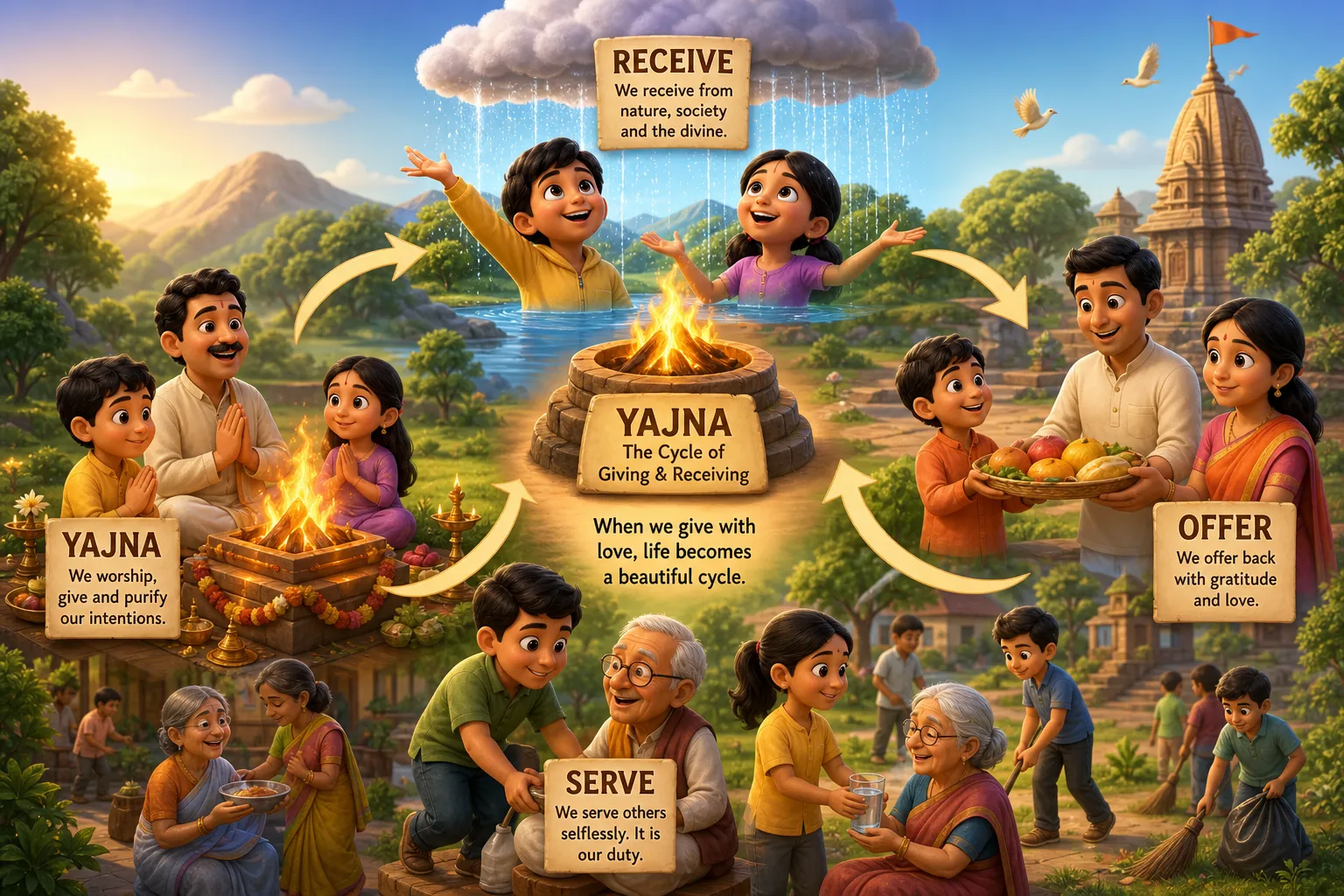
Karma-yoga is also presented as yajña, a life of mutual nourishment and contribution. Human life depends on a vast cosmic and social order: food, rain, ecological harmony, social cooperation, and the Vedic order of duty. We are constantly receiving. Therefore, life must not become mere consumption; it must complete the cycle through contribution.

The yajña teaching removes self-centered living. If one consumes without offering, acknowledging, and contributing, life becomes spiritually impure. Even ordinary consumption — food, medicine, wealth, education, comfort — should be received with gratitude and offered back through duty, service, and worship.

This gives the chapter a powerful social dimension. Karma-yoga is not merely personal stress management. It is a sacred way of participating in the cosmic order. The individual is not isolated. One’s actions affect the world, and the world sustains one’s life. Therefore contribution is not optional; it is the dhārmic repayment of what has already been received.

4. Karma-Yoga and Mokṣa

Karma-yoga does not directly give mokṣa. Mokṣa comes only through jñānam. But karma-yoga is indispensable because it purifies the mind, removes rāga-dveṣa, and prepares the seeker for śravaṇam, mananam, and nididhyāsanam. A karma-yogī ultimately attains mokṣa because karma-yoga leads to jñāna-yoga, and jñāna-yoga leads to liberation.

The inner impurity removed by karma-yoga is the delusion that the world is the source of happiness or sorrow. As long as one thinks, “The world must change for me to be happy,” one keeps adjusting the world and remains dependent. Karma-yoga purifies the mind so that one can later discover through jñānam that the misunderstood “I” is the source of sorrow and the understood “I” is the source of happiness.

5. The Wise Person and Loka-Saṅgraha

After explaining karma-yoga for the seeker, Bhagavān discusses the role of the wise person. A jñānī does not need karma for personal purification or liberation. Yet a gṛhastha-jñānī should continue duties, at least in a reduced form, for loka-saṅgraha, the welfare and guidance of society.

The reason is powerful: people learn more from the conduct of elders than from words. Parents, teachers, rulers, and respected people shape society by example. If the wise person abandons duties carelessly, others may imitate externally without inner maturity. Therefore the wise person must not create buddhi-bheda, confusion in the minds of those attached to action.

This teaching expands karma-yoga beyond personal growth. One’s life becomes a model. Even if one has no personal need for action, action may continue as a contribution to social order and dharmic stability.

6. The Five-Point Karma-Yoga Programme

In verse 30, Bhagavān summarizes karma-yoga as a five-point programme. The first point is adhyātma-cetasā, clarity about spiritual priority. Mokṣa must be the primary goal; dharma, artha, and kāma are legitimate but subordinate. A life that never turns toward ātma-jñānam is spiritually wasted.

The second point is mayi sarvāṇi karmāṇi sannyasya: offer all actions to Bhagavān. This is īśvarārpaṇa-buddhi. Since Bhagavān alone is the ultimate purifier, action becomes purifying when connected to Him.

The third point is nirāśīḥ, preparedness for any result. Every action produces a result, but the exact result is not fully under human control. A karma-yogī accepts results as prasāda, trusting the justice of Bhagavān’s order and recognizing the limitation of human calculation.

The fourth point is nirmamaḥ, freedom from possessiveness and arrogance. In success, the karma-yogī does not claim total credit. One’s effort matters, but success depends on countless visible and invisible factors. Gratitude to Bhagavān protects the mind from pride.

The fifth point is vigata-jvaraḥ, freedom from mental fever. When spiritual priority, offering, prasāda-buddhi, and humility are practiced, mental balance follows. Karma-yoga is therefore marked by samatvam, equanimity amid success and failure.

7. The Benefit and Loss

Those who follow this teaching with śraddhā and without fault-finding become free from karma, not because karma-yoga directly gives mokṣa, but because it leads them toward purification, guru, śāstra, śravaṇam, mananam, nididhyāsanam, knowledge, and liberation. Those who reject karma-yoga become spiritually lost, even if they gain material benefits.

8. Svabhāva, Rāga-Dveṣa, and Svadharma

Bhagavān then explains that every person has a svabhāva, a prakṛti shaped by the proportion of sattva, rajas, and tamas. Even jñānīs continue to express different temperaments at the level of the body-mind. Therefore one should not violently suppress one’s nature. Arjuna’s nature is kṣatriya and rajasic; if he runs away from battle in the name of renunciation, his dynamism will reappear elsewhere.

At the same time, prakṛti cannot become an excuse for adharma. Rāga and dveṣa naturally arise toward sense objects, but one should not come under their control. They are enemies because they pull the person away from dharma and karma-yoga.

This leads to the teaching of svadharma. One’s own dharma, even imperfectly performed, is better than another’s dharma well performed. Svadharma is not mere personal preference; it is duty aligned with both one’s nature and dharma. Arjuna’s svadharma is to fight the dharma-yuddha, not to imitate the external quietness of a renunciate.

9. Arjuna’s Question: Why Do People Do Wrong?

After the karma-yoga topic concludes at verse 35, Arjuna raises a new question. If dharma is necessary and people generally know what is right and wrong, why do they still commit wrong actions? Even a thief knows stealing is wrong, which is why he does it secretly. The problem is not merely ignorance of ethical rules; the problem is an inner force that overpowers discrimination.

10. Kāma-Krodha as the Inner Enemy

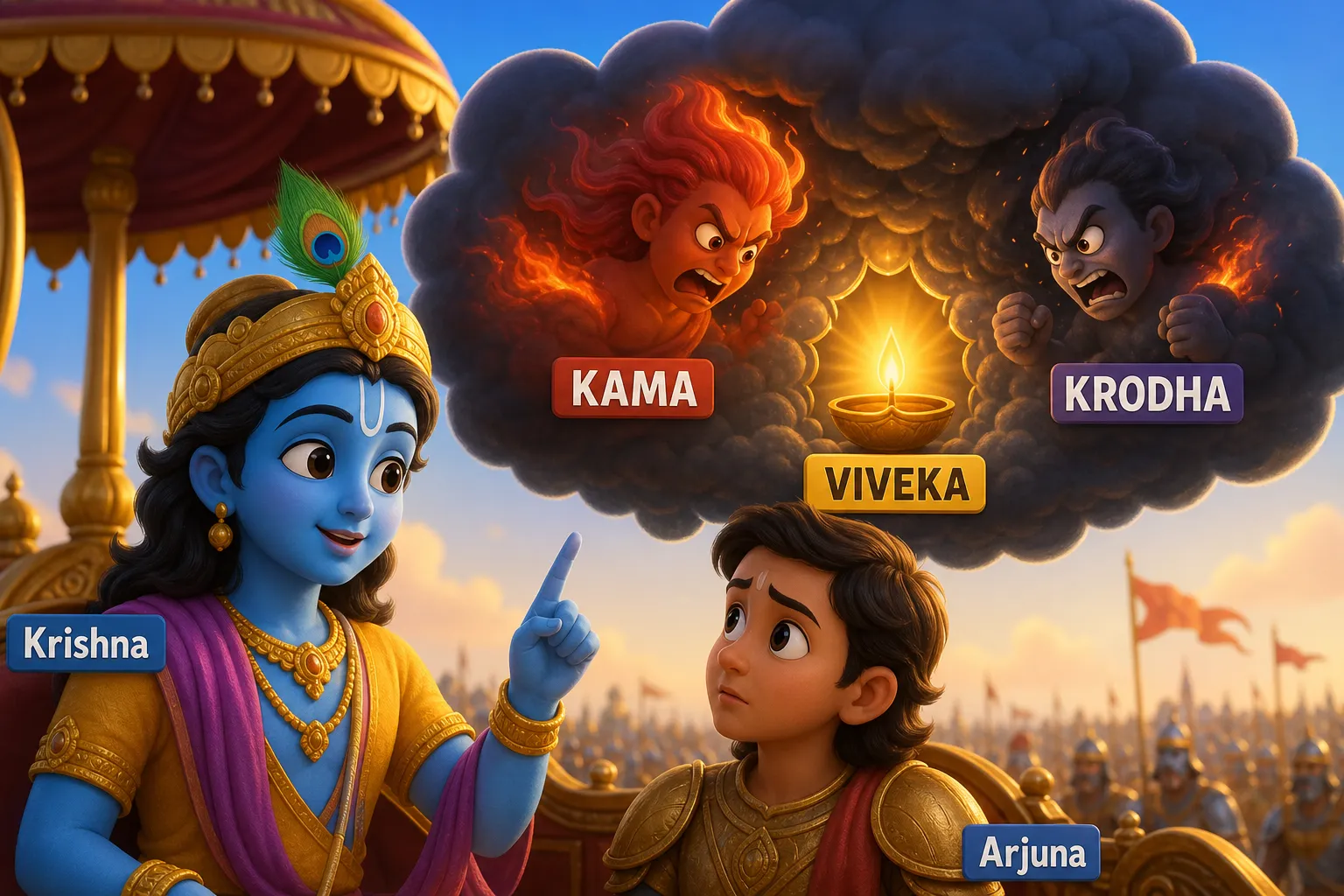
Bhagavān identifies that force as kāma and krodha, born of rajo-guṇa. Kāma is binding desire, the endless “I want.” When kāma is obstructed, it becomes krodha. These two cloud discriminative power and lead to the violation of dharma. Intelligence is not absent; it becomes temporarily covered.

Kāma is like an insatiable fire. Desire does not end by fulfillment. One desire is replaced by another. The objects change, but the background sense of lack continues as long as self-ignorance remains. Therefore kāma becomes especially painful for the Gītā student: one knows better, yet struggles against the force of desire.

11. How Kāma Covers Knowledge

Bhagavān gives three images for the covering of knowledge: smoke covering fire, dust covering a mirror, and the womb covering a fetus. These show degrees of covering. Sometimes desire is light and can be removed by a little viveka. Sometimes it needs repeated effort. Sometimes it is deep and requires time, discipline, maturity, and sustained karma-yoga.

Kāma covers jñānam, the discriminative power required throughout spiritual life. In karma-yoga, discrimination is needed to distinguish dharma from adharma. In jñāna-yoga, discrimination is needed to distinguish satya from mithyā. Thus viveka is required from beginning to end, and kāma is the permanent enemy of the spiritual student.

12. The Seats of Kāma and the Method of Handling It

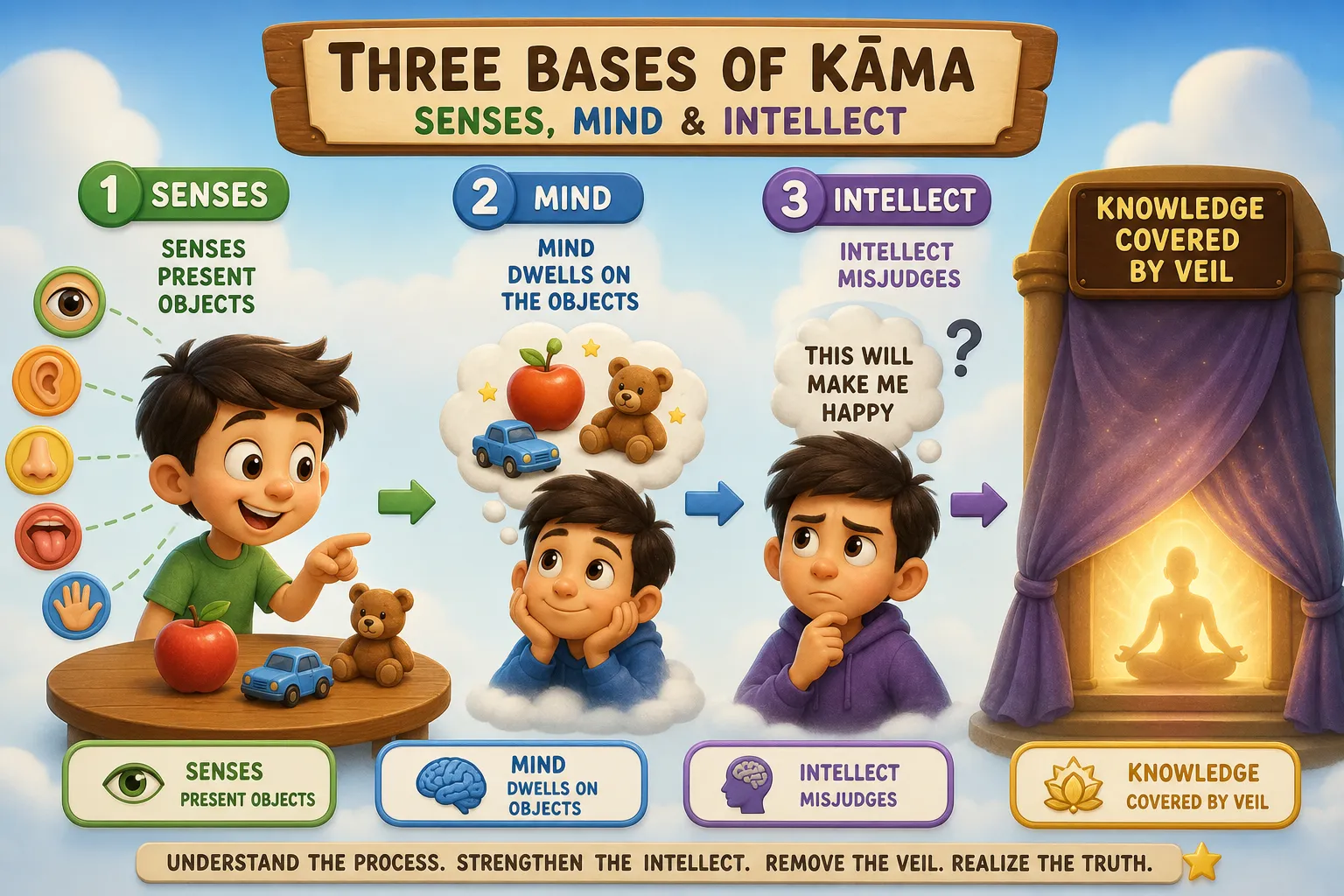
Kāma operates through three bases: the indriyāṇi, manas, and buddhi. The sense organs present the object. The mind dwells on it and develops attraction, saṁskāra, and vāsanā. The intellect makes the wrong judgment that the object is a source of happiness or security. Through these three, kāma covers knowledge and deludes the embodied person.

The first practical discipline is sense-control: indriyāṇi ādau niyamya. Since the senses are the entry gates of kāma, they must be regulated first. Kāma is called jñāna-vijñāna-nāśanam, the destroyer of both the first-stage understanding of ātma as distinct from anātma and the deeper assimilation that “I am the ātma.”

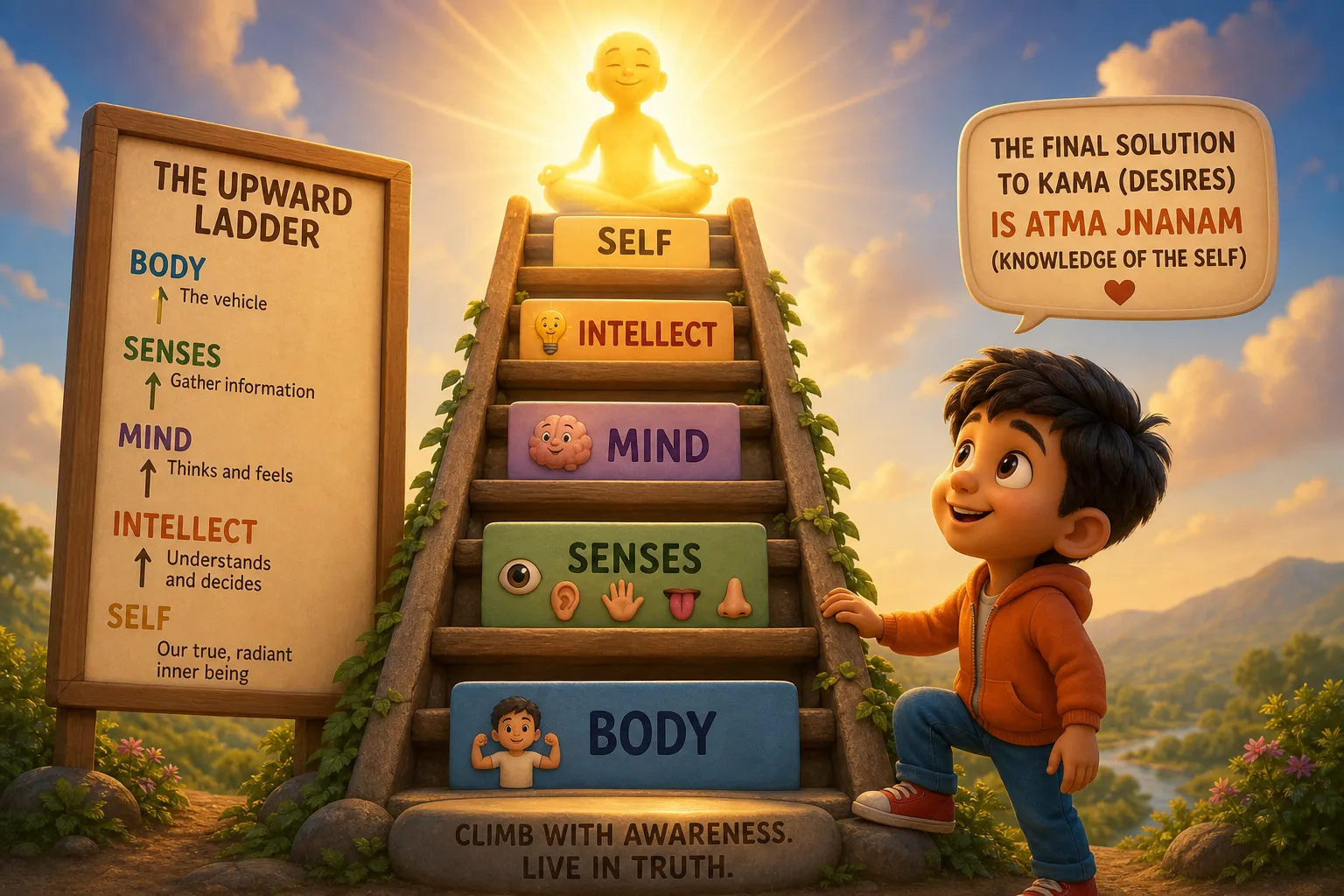
But sense-control is only the beginning. The deeper hierarchy is then revealed: senses are superior to the gross body, mind is superior to the senses, intellect is superior to the mind, and the Self is superior even to the intellect. The final solution to kāma is not suppression alone; it is ātma-jñānam.

Chapter Conclusion

Chapter 3 concludes by showing that the enemy called kāma must be destroyed by knowing the Self as superior to the intellect and steadying the mind in that knowledge. The permanent solution is not fulfilling every desire, nor merely repressing desire. Desire lives on the feeling of incompleteness. When the Self is known as full, kāma loses its foundation.

Thus, the chapter begins with Arjuna’s confusion between action and knowledge and ends with the highest inner solution to the very force that makes action adhārmic. It teaches that one must act, but act as karma-yoga; one must purify the mind, but not stop there; one must gain jñānam, and through that knowledge discover inner fullness.

Complete Chapter Synopsis

Chapter 3 is the great teaching of karma-yoga as spiritual preparation. It begins with Arjuna’s misunderstanding. Because jñānam was praised in Chapter 2, Arjuna assumes that karma can be avoided. Bhagavān corrects him: jñānam alone directly gives mokṣa, but karma-yoga alone prepares the mind for jñānam. Therefore there is no choice between karma-yoga and jñāna-yoga. Both are necessary, in sequence.

The chapter carefully distinguishes sādhana and niṣṭhā. As sādhana, karma-yoga and jñāna-yoga are compulsory. As lifestyle, one may follow pravṛtti or nivṛtti according to maturity and situation. But no lifestyle can bypass inner preparation. Premature renunciation without purity leads to pressure, conflict, or hypocrisy. Therefore Arjuna must not use spirituality as an escape from his duty.

The core of karma-yoga is the conversion of life into worship. One performs appropriate duties, contributes more than one takes, lives in the yajña spirit, offers actions to Bhagavān, accepts results as prasāda, remains humble in success, and maintains mental balance. Such a life purifies the mind by reducing rāga, dveṣa, anxiety, possessiveness, and ego.

The chapter also teaches that karma-yoga has a social dimension. The wise and responsible must continue to act for loka-saṅgraha. Society learns through example. Elders, rulers, parents, teachers, and respected people influence others more by conduct than by advice. Therefore action becomes a responsibility not only to oneself but to the world.

The final section turns inward. Even when dharma is known, people fall because of kāma-krodha. Desire covers discrimination, operates through senses, mind, and intellect, and pushes a person into adharma. Therefore the seeker must regulate the senses, steady the mind, educate the intellect, and finally know the Self as the fullness beyond the intellect. The ultimate conquest of kāma is not through possession but through Self-knowledge.

The whole chapter can be summarized as: Do your duty. Convert action into worship. Receive results as prasāda. Contribute to the world. Follow svadharma. Guard against rāga-dveṣa. Recognize kāma-krodha as the inner enemy. Prepare the mind through karma-yoga. Pursue jñāna-yoga. Discover inner fullness and be free.