
jñānavijñānayogaḥ · 7.21
Bhagavān Makes That Faith Firm
यो यो यां(य्ँ) यां(न्) तनुं भक्तः(श्) श्रद्धयार्चितुमिच्छति ।
तस्य तस्याचलां श्रद्धां(न्) तामेव विदधाम्यहम् ॥७.२१॥
yo yo yāṃ(y) yāṃ(n) tanuṃ bhaktaḥ(ś) śraddhayārcitumicchati ।
tasya tasyācalāṃ śraddhāṃ(n) tāmeva vidadhāmyaham
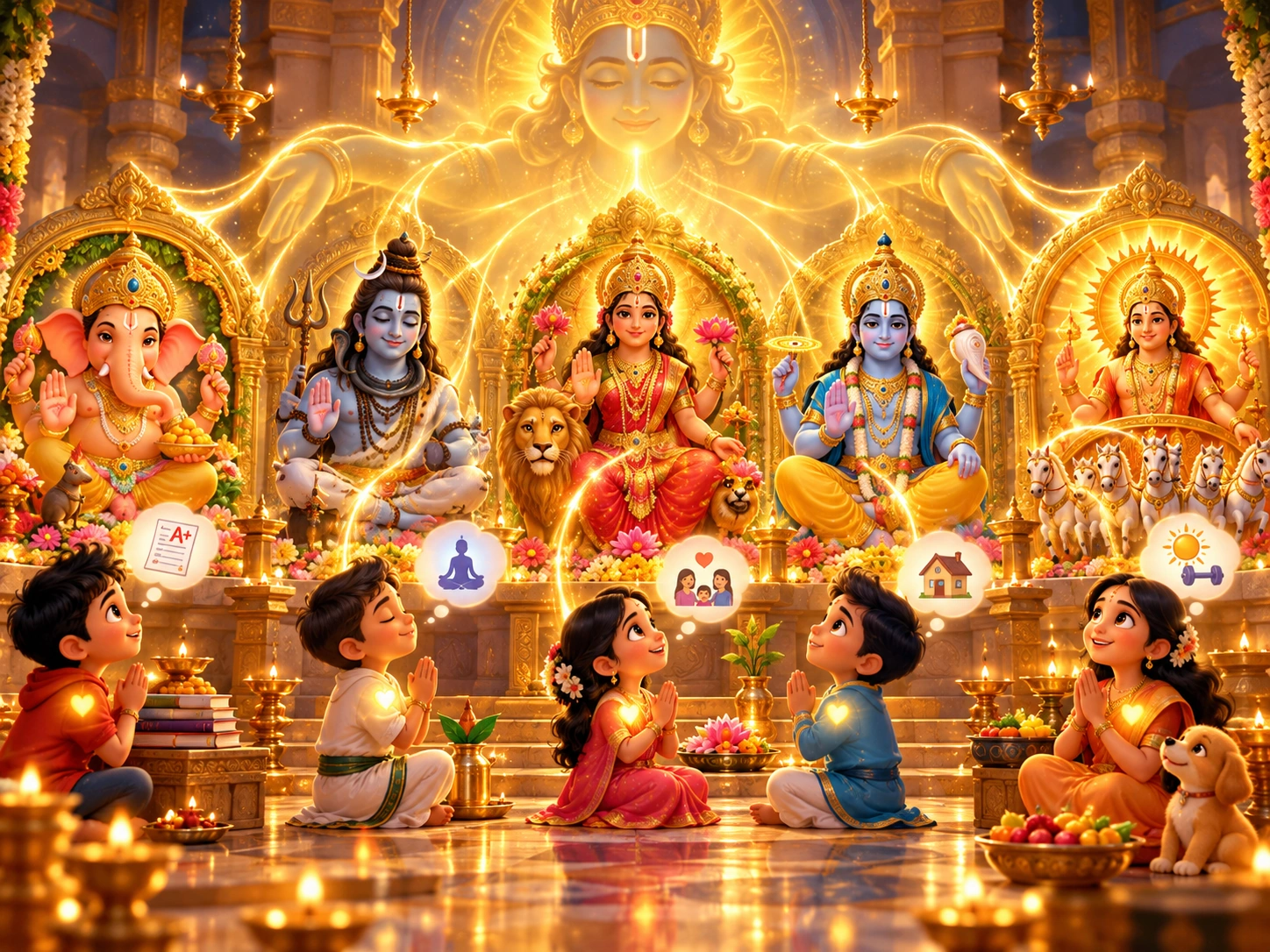
"Whichever sacred form a devotee chooses to worship with faith, Bhagavān strengthens that very faith and allows the devotee’s devotion to become firm."
Tap or click the image to view the full illustration.
Verse 7.20 introduced sakāma-bhakti: a devotee driven by a particular desire may approach a particular deity and follow the corresponding disciplines of worship. Verse 7.21 continues that discussion and adds an important positive feature: Bhagavān does not reject such a devotee. He supports and strengthens the devotee’s faith.
Kṛṣṇa says, yo yo yāṃ yāṃ tanuṃ bhaktaḥ — whichever devotee chooses whichever particular form. The word tanu here refers to a particular deity-form. The Vedic and later religious traditions provide many sacred forms through which devotees may worship: Sūrya, Śiva, Devī, Gaṇeśa, Viṣṇu, Dhanvantari, and many others. Different forms may traditionally be associated with different prayers and desired results. A person seeking health may turn toward a deity associated with health; someone seeking removal of an obstacle may approach another form; someone praying for prosperity, children, success, protection, or some other legitimate finite end may follow another form of worship.
But the teaching must not be misunderstood as, “There are many competing gods, and one of them is the real God.” Every named and pictured deity-form is finite as a form because a form has boundaries. Yet the infinite Bhagavān can be invoked through any sacred form, just as a national flag is physically small but can represent an entire nation.
Therefore the crucial question is not, “Which deity-form is inherently superior?” The crucial question is, “What am I invoking through that form?” A devotee may invoke a particular finite function and seek a finite result, or the same sacred form may be worshipped as the symbol of the infinite Bhagavān.
The verse next says, śraddhayā arcitum icchati — the devotee desires to worship with śraddhā, faith. Śraddhā matters greatly in worship. If someone performs a religious practice mechanically while inwardly dismissing it as meaningless, the mind is not fully participating. But when the devotee has genuine trust in the practice, the deity, and the scriptural method, the worship engages the person much more deeply.
This does not mean mere wishful thinking manufactures any result whatsoever. The point is that faith makes devotion effective as devotion. The devotee becomes committed, attentive, regular, and emotionally invested in the worship.
Then comes the central statement: tasya tasyācalāṃ śraddhāṃ tāmeva vidadhāmyaham — “I make that very faith of that devotee firm.”
Bhagavān does not say, “Since this devotee has not yet asked for mokṣa, I will reject the devotion.” Instead, Bhagavān works with the devotee at the devotee’s present level. A person begins with a particular need. That need brings the person to prayer. Prayer generates discipline. When the worship brings the expected benefit, the person’s faith becomes stronger. The next time a difficulty arises, the devotee remembers, “I prayed before. I received help. I will pray again.” Thus faith is reinforced.
This explains why particular temples, vratas, prayers, or deity-forms often become deeply important to families and communities. Someone receives a result, tells another person, that person also approaches the same form with faith, and the devotional tradition grows.
But Kṛṣṇa adds a deeper theological point through aham — “I.” Although the devotee appears to be worshipping a particular form, it is the one infinite Bhagavān who ultimately receives every act of worship and supports the devotee through that form. All finite forms belong within the infinite. If anything existed outside the infinite, the infinite would no longer be infinite.
Therefore worship offered through a sacred form does not go to an independent power outside Bhagavān. The form becomes the channel through which the infinite Bhagavān is approached. This is why sectarian rivalry misses the point. Śiva, Viṣṇu, Devī, Gaṇeśa, Sūrya, or another form need not become competing ultimate realities. When the infinite is invoked, different sacred names and forms point toward the same limitless Bhagavān.
At the same time, 7.21 remains within the discussion of sakāma-bhakti. The devotee described here is still primarily seeking a particular finite end. Bhagavān strengthens that devotee’s faith rather than rejecting the stage.
That strengthened faith can later become spiritually significant. A person who first discovered Bhagavān because of a practical need may gradually begin to love prayer itself. The mind may move from “Give me this result” to “Help me grow,” and eventually to “I want to know You.”
Thus 7.21 shows Īśvara-anugraha operating even within an early stage of bhakti. Bhagavān supports the devotee where the devotee currently stands, strengthens sincere faith, and leaves open the possibility that result-centered devotion will eventually mature into devotion for the infinite.